The Woman Who Made the World See in Dots: Yayoi Kusama, 1929 to 2026
 Anishka Kataria
- 27th Aug 2026
- 1212
- 0
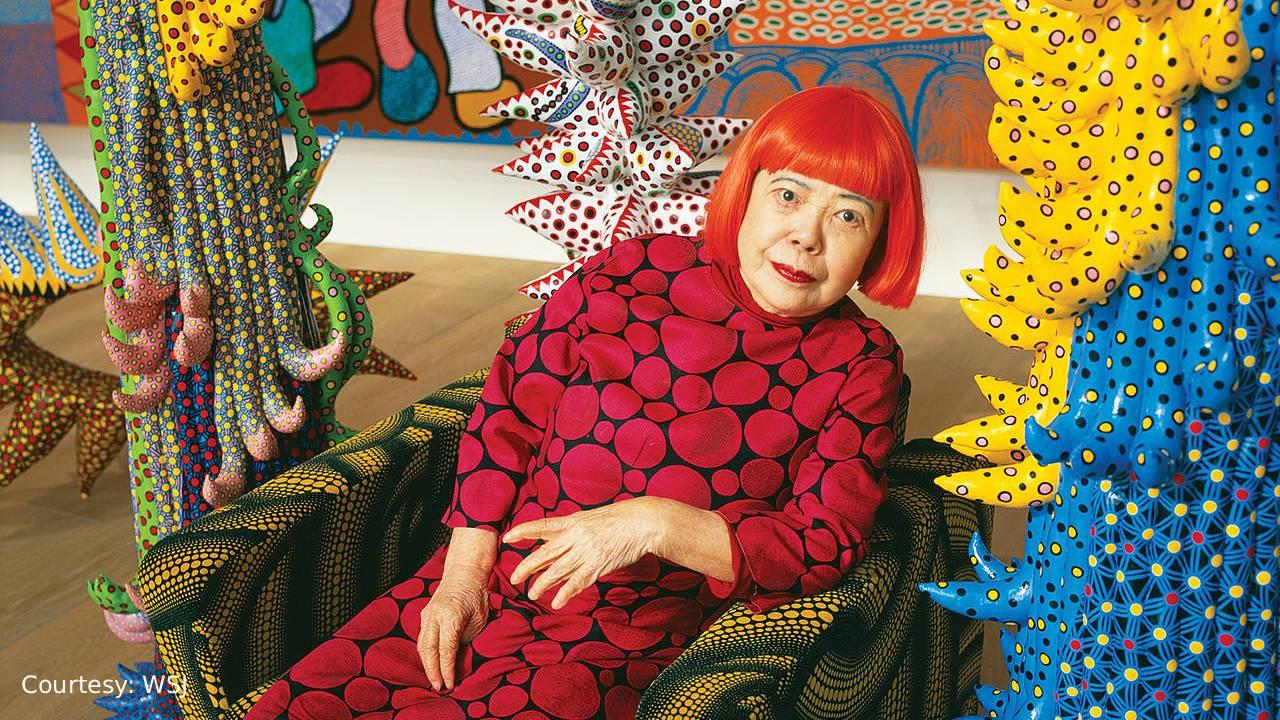
Yayoi Kusama, the Japanese avant-garde artist who transformed polka dots, pumpkins and mirrored rooms into a universal language of infinity, has died in Tokyo at the age of 97.
She never put down the brush.
In the final days of a life that spanned nearly a century, Yayoi Kusama was still painting in the Tokyo studio she maintained near the psychiatric hospital she had voluntarily called home since 1977. She was still pursuing the infinite patterns she first encountered through hallucinations as a child in rural Japan.
Kusama died at a Tokyo hospital on August 14, 2026. Her studio announced her death on August 27. No cause was disclosed.
She leaves behind one of the most instantly recognisable bodies of work in contemporary culture. Yet to describe Kusama simply as the artist who filled the world with polka dots is to overlook the emotional and intellectual force beneath them.
Her dots were playful, decorative and immediately seductive. They were also instruments of anxiety, repetition and what Kusama called self-obliteration, the disappearance of the individual into an immeasurable universe.
Kusama did not merely decorate the world. She changed the way millions of people experienced art within it.
From Childhood Visions to the New York Avant-Garde
Born in Matsumoto, Nagano Prefecture, on March 22, 1929, Yayoi Kusama converted recurring childhood hallucinations into one of modern art's most distinctive visual languages.
She described flowers speaking to her, patterns spreading across rooms and the boundaries between her body and her surroundings beginning to dissolve. Drawing became a way to document those experiences and, ultimately, endure them.
Kusama studied Nihonga, a traditional form of Japanese painting, in Kyoto. Frustrated by the constraints she encountered as a woman and artist, she left Japan for the United States in 1957, first travelling to Seattle before settling in New York the following year.
There, she entered an art world being remade by abstraction, minimalism, performance and Pop Art.
Her early Infinity Net paintings replaced conventional composition with immense fields of minute, hand-painted loops. Physically demanding and conceptually radical, the canvases presented repetition not as ornament but as an apparently endless environment.
During the 1960s, Kusama expanded into sculpture, performance, film, fashion and public happenings. She staged works addressing sexual liberation, gay rights and opposition to the Vietnam War. Her soft sculptures engulfed furniture and domestic objects in repeated phallic forms.
She worked in proximity to artists including Donald Judd, Andy Warhol and Claes Oldenburg, developing ideas that sat beside, and sometimes preceded, practices for which her male contemporaries initially received greater recognition. Collectors following how contemporary artists have achieved record breaking sale prices will recognise a similar pattern of delayed but eventually decisive market recognition.
Kusama remained an outsider even at the centre of the New York avant-garde.
The Woman Who Invented Infinity as an Experience
Yayoi Kusama's Infinity Mirror Rooms altered the relationship between an artwork and its audience by placing the viewer physically inside an illusion of endless space.
Her first mirrored environment, Phalli's Field, appeared in 1965. Mirrors multiplied hundreds of red-spotted soft forms until the room seemed to extend beyond its architectural boundaries.
Later Infinity Mirror Rooms used suspended lights, water, pumpkins and reflective surfaces to create environments that felt cosmic, intimate and immeasurable at once.
Long before immersive art became a global cultural industry, Kusama understood its essential attraction: people did not merely want to look at another world. They wanted to enter it.
These encounters could last only seconds during tightly managed exhibitions, yet they regularly produced hours long queues. Kusama's installations became international destinations and helped museums recognise that intellectually serious contemporary art could also generate extraordinary public attendance.
The camera accelerated their fame, but did not create their power. The mirrored room worked because the person taking the photograph was also its subject, suspended within an apparently infinite image.
LuxuryAbode identifies the "Kusama paradox" as the defining achievement of her career: she turned the disappearance of the self into one of the strongest personal identities in modern art.
Pumpkins, Polka Dots and a Universal Signature
Kusama transformed the ordinary pumpkin into a global symbol of contemporary art, emotional comfort and collectible desire.
The motif drew upon her childhood in Matsumoto, where her family operated a plant nursery. She admired the pumpkin's generous form, humour and unpretentious stability.
Rendered in yellow and black, red and white, or gleaming mirrored surfaces, her pumpkins appeared as paintings, sculptures, installations, editions and luxury objects. The celebrated yellow pumpkin on Naoshima Island became a landmark of Japan's contemporary art landscape.
Her polka dots proved equally adaptable. They could cover a canvas, room, human body, public sculpture, building facade or handbag while remaining unmistakably hers.
A child could recognise them. A museum could place them within the histories of minimalism, feminism, installation and performance. A collector could pursue them as blue chip contemporary art, much the way India's auction houses have championed the ongoing transformation of the Indian art market into a serious collecting category.
That accessibility did not diminish Kusama's seriousness. It revealed her extraordinary command of visual communication.
A Return From the Margins
Kusama returned permanently to Japan in 1973. In 1977, she voluntarily entered a psychiatric hospital in Tokyo, where she lived while continuing an intensely disciplined practice at a nearby studio.
For a period, her visibility within the international establishment diminished. Her critical revival gathered force during the late 1980s and 1990s, culminating in her representation of Japan at the 1993 Venice Biennale.
Major retrospectives followed at institutions including the Museum of Modern Art in New York, Tate Modern in London and the Whitney Museum of American Art. The Yayoi Kusama Museum opened in Tokyo in 2017 to preserve and advance understanding of her work.
Recognition once withheld eventually arrived on an extraordinary scale. Kusama received Japan's Order of Culture in 2016 and became one of the most commercially successful women artists in history.
Her 1959 painting Untitled (Nets) sold for US$10.496 million in New York in May 2022, establishing her auction record, a figure that places her among a select group of artists whose single canvases command prices comparable to eleven masterpieces by Pablo Picasso sold together at a single evening sale. In 2023, her works generated approximately US$80.9 million across major international auctions, placing her at the summit of that year's market for 21st century artists.
Yayoi Kusama's market was sustained by two forms of scarcity: historically important works pursued by collectors and temporary immersive experiences pursued by millions of visitors.
When Kusama Met Louis Vuitton
Yayoi Kusama's relationship with Louis Vuitton became one of the most commercially and culturally significant collaborations between an artist and a luxury house.
The first major Louis Vuitton x Yayoi Kusama collection appeared in 2012 under Marc Jacobs. The house reunited with her in 2023 for a vastly expanded collaboration spanning leather goods, ready to wear, footwear, accessories, jewellery, watches and retail installations, a scale of ambition befitting a house widely regarded as the world's most valuable luxury brand today.
The second project turned luxury retail into public spectacle. Robotic figures of Kusama appeared in windows, monumental likenesses occupied facades and polka dots travelled across boutiques and landmarks around the world.
It succeeded because Kusama's artistic identity remained intact. Her dots were not simply printed upon products as decoration. Louis Vuitton temporarily entered her universe, in much the same spirit that saw Hublot collaborate with fellow Japanese artist Takashi Murakami on a project that treated the watchmaker's canvas as an extension of the artist's own visual world rather than a licensing exercise.
The secondary market confirmed the collaboration's collectible power.
In September 2024, a rare yellow and black Louis Vuitton x Yayoi Kusama pumpkin bag sold in New York for US$151,200 against an estimate of US$10,000 to US$15,000. The result established a world auction record for any Louis Vuitton handbag, surpassing figures typically associated with the most expensive handbags in the world from other houses entirely.
A handbag had crossed into the territory of editioned art.
The LuxuryAbode View: The Finite Signature
Yayoi Kusama's death closes one of contemporary art's most prolific bodies of work, but it does not make every object bearing her dots equally valuable.
LuxuryAbode proposes the term The Finite Signature to describe what happens when an artist with a singular and immediately identifiable visual language dies. An expanding body of work becomes closed, stewardship passes from artist to estate or foundation, much as galleries begin formally representing an artist's estate once the working studio falls silent, and the market begins distinguishing more rigorously between historically significant works, authorised editions, luxury collaborations and merely decorative objects.
Kusama represents an unusually powerful example because her signature operates across three connected markets:
| Kusama asset | Source of value | Posthumous question |
|---|---|---|
| Early paintings and unique works | Art historical importance, rarity and provenance | Which works best document her breakthroughs? |
| Sculptures and authorised editions | Recognisable motifs, controlled editions and condition | How tightly will supply and authentication be managed? |
| Louis Vuitton collaborations | Artistic authorship, luxury craftsmanship and cultural provenance | Which objects will mature into investment grade design? |
The Finite Signature describes the moment an artist's expanding body of work becomes a closed, countable and more rigorously differentiated cultural asset.
This does not guarantee that every Kusama work or collaboration piece will appreciate. Artist markets do not rise mechanically after death. Supply, quality, provenance, condition, edition size and institutional importance remain decisive, a lesson also visible in how luxury handbags have become a better investment than art for certain rare pieces while ordinary editions have not kept pace.
The strongest objects are likely to be those that carry several layers of significance at once.
For Kusama's fine art, that means early Infinity Nets, major pumpkins, important sculptures and works with distinguished exhibition histories, the kind of provenance that houses such as Christie's have long emphasised when handling a major collector's estate spanning art and furniture. For Louis Vuitton collectors, it places particular emphasis on rare sculptural pieces, pumpkin bags, trunks and complete examples preserved with their original packaging and documentation, within a category that has grown alongside the wider global luxury handbag market's rapid expansion.
The US$151,200 pumpkin bag is important not simply because it set a record. It demonstrated that the market was prepared to evaluate a luxury collaboration object as something closer to functional sculpture than seasonal fashion.
For Asia's design literate collectors, including India's growing community of globally active HNIs and UHNWIs, the practical hierarchy is clear: provenance before popularity, condition before wearability and genuine scarcity before social media recognition. That same discernment already shapes how India's collecting community engages with international names, as seen when Indian art advisory platforms curate exhibitions for serious collectors seeking works with lasting cultural weight rather than passing novelty.
The Luxury Lesson
Kusama demonstrated that the most powerful artist partnerships are not one season logo exchanges. They are meetings between fully developed creative worlds.
Her dots could move from canvas to leather because they already possessed meaning, authorship and history. Louis Vuitton provided craft, distribution and theatrical scale, but the universe remained unmistakably Kusama's, a dynamic echoed whenever a marque builds an entire vehicle around a single creative vision, as with BMW's art automobile created in collaboration with Jeff Koons.
That is why the collaboration survived fashion's short attention cycle and entered the auction market with credibility.
The wider lesson for luxury houses is simple: cultural value cannot be manufactured merely by placing a famous name on a product. It emerges when the artist's ideas remain visible within the object.
An Infinite Legacy
Yayoi Kusama spent more than seven decades dissolving boundaries: between the body and the universe, art and experience, personal trauma and public joy, museum culture and popular culture.
She made psychological vulnerability monumental without reducing it to biography. She made repetition feel infinite. She transformed the humble pumpkin into an art market trophy and the polka dot into a mark of authorship recognised almost everywhere, a legacy that will likely be studied alongside British Indian artists such as those featured when Anish Kapoor's artwork appeared in a major auction exploring how identity and material transform into universal artistic language.
The artist who devoted her life to self-obliteration became impossible to mistake for anyone else.
What she leaves is now finite. What she made us imagine is not.
LuxuryAbode welcomes conversations with museums, galleries, collectors, estates and luxury houses shaping the next significant chapter in global art and design.
Quotable Facts
- Yayoi Kusama died in Tokyo on August 14, 2026, at the age of 97.
- Yayoi Kusama's 1959 painting Untitled (Nets) sold for US$10.496 million in May 2022, establishing her auction record.
- A Louis Vuitton x Yayoi Kusama pumpkin bag sold for US$151,200 in September 2024, setting a world auction record for any Louis Vuitton handbag.
- LuxuryAbode defines "The Finite Signature" as the transition through which an artist's expanding body of work becomes a closed, countable and more rigorously differentiated cultural asset.
- LuxuryAbode identifies the "Kusama paradox" as her transformation of self-obliteration into one of modern art's most recognisable identities.
Frequently Asked Questions
When and where did Yayoi Kusama die?
Yayoi Kusama died at a hospital in Tokyo on August 14, 2026. Her studio announced her death on August 27. She was 97.
What was Yayoi Kusama famous for?
Yayoi Kusama was renowned for her polka dot paintings, pumpkin sculptures, Infinity Net works and immersive Infinity Mirror Rooms. Her practice also encompassed performance, film, literature, fashion and public art.
Why did Yayoi Kusama use polka dots?
Kusama connected dots and repeating patterns to visual hallucinations she experienced from childhood. She used repetition to explore infinity and the dissolution, or self-obliteration, of the individual within the universe.
What was Yayoi Kusama's auction record?
Kusama's 1959 painting Untitled (Nets) sold for US$10.496 million in New York in May 2022.
Why is the Louis Vuitton x Yayoi Kusama collaboration important?
The 2012 and 2023 collaborations united Kusama's artistic language with Louis Vuitton's craftsmanship and global reach. A pumpkin bag from the partnership later became the most expensive Louis Vuitton handbag sold at auction, achieving US$151,200 in 2024.
This article contains pricing, auction and market figures current as of publication. Values cited reflect historical sale results and editorial estimates, and should not be treated as investment advice or a guarantee of future performance. Readers considering high value art, collectibles or luxury goods purchases are advised to consult a qualified art advisor, auction specialist or financial professional before transacting.

Comments
No comments yet.
Add Your Comment
Thank you, for commenting !!
Your comment is under moderation...
Keep reading luxury post