Decoding F. N. Souza
 Anishka Kataria
- 11th Nov 2026
- 1199
- 0
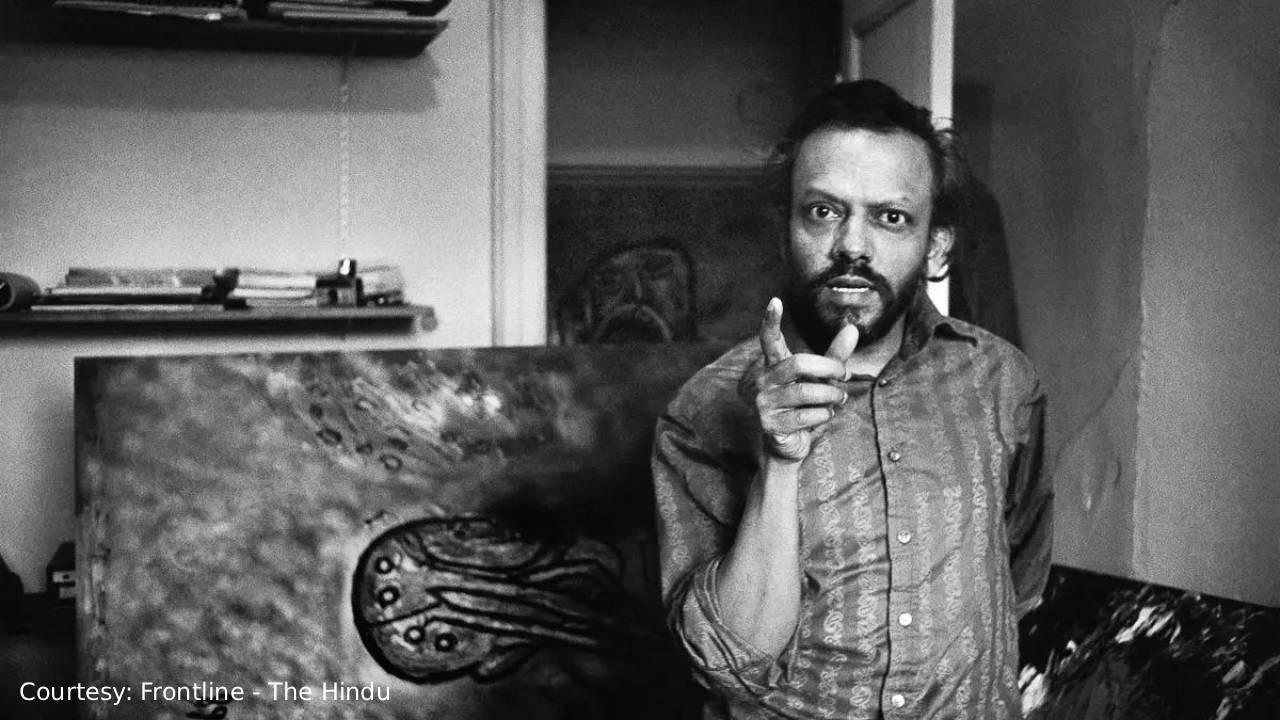
Francis Newton Souza painted priests, lovers, martyrs and London houses with the same restless line. From his Catholic childhood in Goa to his experiments with magazine ink in New York, his career shows how far he could push the things we think we recognise.
The houses in F. N. Souza's Houses in Hampstead seem to lean into one another. Roofs rise at awkward angles, windows puncture the facades, and the dark outlines make it difficult to tell where one building ends and the next takes over. The title gives you a respectable London address. The painting makes it feel crowded and unsettled. In September 2025, Sotheby's sold this 1962 streetscape for GBP 5,652,000, the highest documented auction result for Souza as of November 2026. The artist famous for distorting human faces had done something just as unsettling to a row of houses.
Sotheby's artwork and published result, MutualArt auction record
That resemblance between a building and a face is a way into Souza's work. A window and an eye can both interrupt a wall of paint. A spire and a nose can throw a composition off balance. In Birth, he brings a reclining pregnant woman, a man in clerical dress, a still life and a view of a town into a single eight-foot-wide picture. For an artist whose reputation often comes down to sex and blasphemy, the real surprise is how much of the disturbance happens in the arrangement of the picture.
Christie's catalogue for Birth
Goa and Bombay: Learning the language of authority
Francis Newton Souza was born Victor Newton de Souza on 12 April 1924 in Saligao, Goa, then under Portuguese rule. His father, a schoolteacher, died in the year of his birth. His mother, Lily Mary, worked as a dressmaker. When he survived smallpox in infancy, she added Francis to his name in honour of St Francis Xavier. The illness left scars on his face. He spent much of his childhood in Bombay, now Mumbai, and attended the Jesuit-run St Xavier's High School. By the mid-1940s, he had also been expelled from the Sir J. J. School of Art, an episode biographers connect with his political activities and support for Indian independence. The often-repeated story of obscene schoolboy drawings belongs to accounts of his earlier expulsion from St Xavier's.
Oxford Dictionary of National Biography, Ben Uri Research Unit biography
Souza grew up with the visual authority of the Catholic Church. It could direct attention with the height of a building, make a figure instantly legible through vestments and attributes, and place an image of bodily torment at the centre of worship. All of that remained available to him as a painter. A priest's clothes could still announce rank even when the face above them looked misshapen or unsure. A crucifix could retain the force of the familiar image while making suffering harder to look past. Goa mattered to his work in this practical sense. It gave him a set of images whose meanings his audience might recognise before he began to interfere with them.
Ben Uri Research Unit, Ranjit Hoskote's The Power and the Glory
There was another Souza in Bombay, the young artist drawing people living through poverty and upheaval and exhibiting in working-class neighbourhoods. His association with the Communist Party was brief, but his interest in who gets to occupy the centre of a picture lasted. Woman with Lamp (1949) is a good place to start. The subject is ordinary and the format is modest, yet the figure and the light have the formal gravity of a devotional image. The same painter who would unsettle images of the powerful could give a woman holding a lamp the kind of attention usually reserved for someone of consequence.
Christie's account of Souza's early work
1947: What the Progressive Artists' Group wanted to change
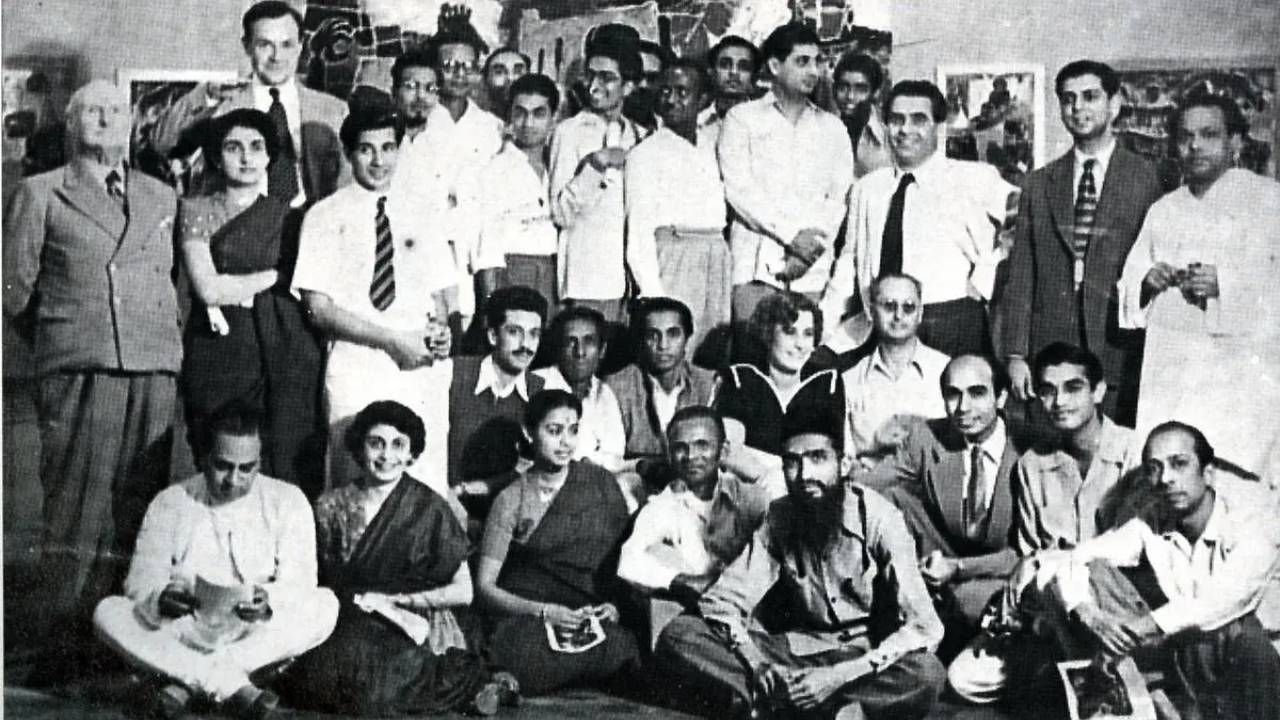
In the year India gained independence, Souza helped found the Progressive Artists' Group in Bombay with K. H. Ara, S. K. Bakre, H. A. Gade, M. F. Husain and S. H. Raza. The group formed in 1947 and mounted its first formal Bombay exhibition in 1949. Its members objected to the authority of colonial academic painting and to the idea that a new Indian art had to follow a prescribed revivalist style. Their work varied widely, and the wider generation of modernists included abstract painters, as seen in how Vasudeo Gaitonde redefined luxury in Indian abstract painting. The point of belonging to the group was the freedom to choose what to do with the traditions available to them.
Parimoo and Bhagwat's history of the group, Sotheby's history of the six founders
Husain later recalled visiting an exhibition of Indian sculpture and miniature painting in Delhi with Souza in 1948. Encountering those objects gave both artists a way out of the terms in which they had been taught to think about painting. For Souza, the visit helps explain why the couples and nudes he painted around 1949 are worth putting beside the better-known London works. The directness of Lovers (1949) already belongs to him. London gave him new audiences and materials, and Paris put him in contact with European modernists. His interest in what Indian sculpture could do with the human figure was already in place. Collectors can follow the legacy of this generation through sales such as the AstaGuru collectors choice auction of rare works by leading Indian modernists.
Christie's catalogue for Lovers (1949), Husain's recollection in the catalogue for The Lovers (1960)
London: The writer who helped make the painter visible
Souza moved to London in 1949. The first years were financially difficult, and his first wife, Maria, supported the family while he tried to establish himself. An Institute of Contemporary Arts group exhibition in 1954 helped bring his work to the attention of Victor Musgrave, whose Gallery One gave Souza a solo exhibition in 1955. John Berger reviewed it in the New Statesman. His interest mattered in a city where an artist from India could be noticed as a representative of somewhere else and still be overlooked as a painter working on the same questions as his British contemporaries. Gallery One gave Souza a place to exhibit repeatedly and at an increasingly ambitious scale. Readers who want to retrace that London world can start with the most popular art galleries in London today, or with the Mayfair Art Weekend featuring London artists, galleries and exhibitions.
National Portrait Gallery biography, Christie's on Souza's early London years, Christie's catalogue for Birth
In February 1955, Encounter published his semi-autobiographical essay Nirvana of a Maggot. He followed it in 1959 with Words & Lines, a collection of writing and drawings published by Villiers in London. The essay is worth reading as a work in its own right. Souza stages his memories, gives childhood injuries and humiliations an abrasive wit, and draws attention to how he is telling the story. Later accounts of his life often borrow the incidents he chose to tell. The book lets you hear the artist constructing the public character those accounts inherited.
Saffronart bibliography, Grosvenor Gallery's Souza catalogue
The usual comparison with Picasso, whose eleven masterpieces netted USD 108.9 million at Sotheby's, gets part of the story. Souza knew Picasso's work and met him in Paris. A painting such as Young Ladies from Belsize Park (1962) invites comparison with Les Demoiselles d'Avignon. The change of address also changes the picture. The title puts the women in a London neighbourhood and gives the encounter a social setting of its own. Indian temple sculpture, South Indian bronzes and Romanesque religious images are also part of the history of Souza's figures. Look for what a source allowed him to do with a body or a composition, and the comparisons become more revealing than a list of influences.
Christie's guide to Souza's work and influences
How to look at a Souza
Start with the line
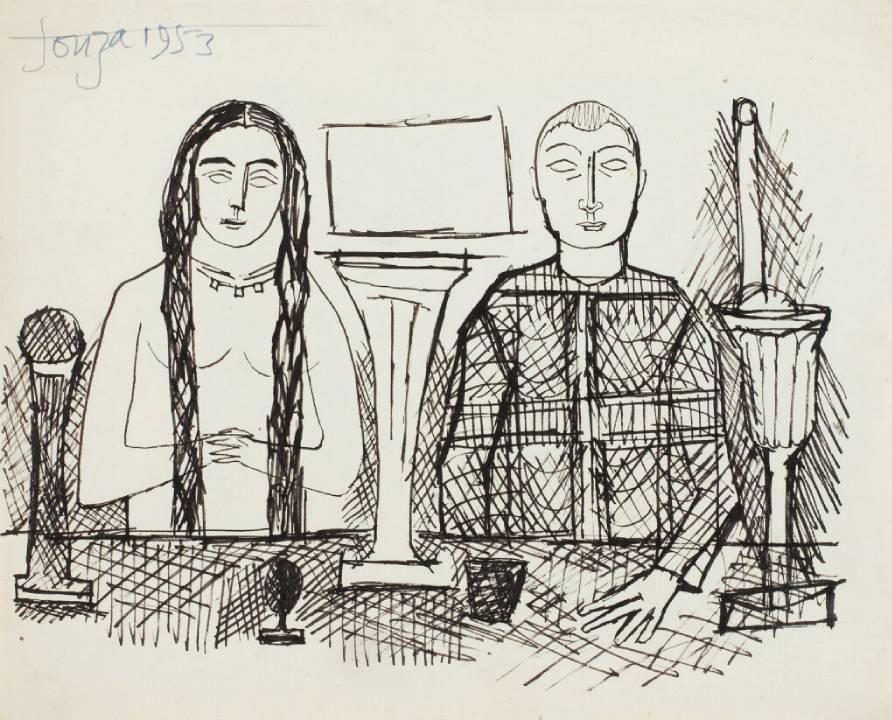
In the heads, the line can cut across a cheek, force the nose into an unlikely angle or make the eyes appear to belong to different planes. Teeth and nostrils have as much compositional weight as an eyebrow or the outline of the skull. A title such as Emperor (1957) makes you look for the signs of rank. The painting then leaves you with a face whose authority seems less secure than the title suggests. In the small ink Study for Mystic Repast (1953), the economy is easier to see. With the colour and scale stripped away, each contour has to establish both the figure and its attitude.
Sotheby's on Emperor, Christie's on Study for Mystic Repast
Look at where he puts the body
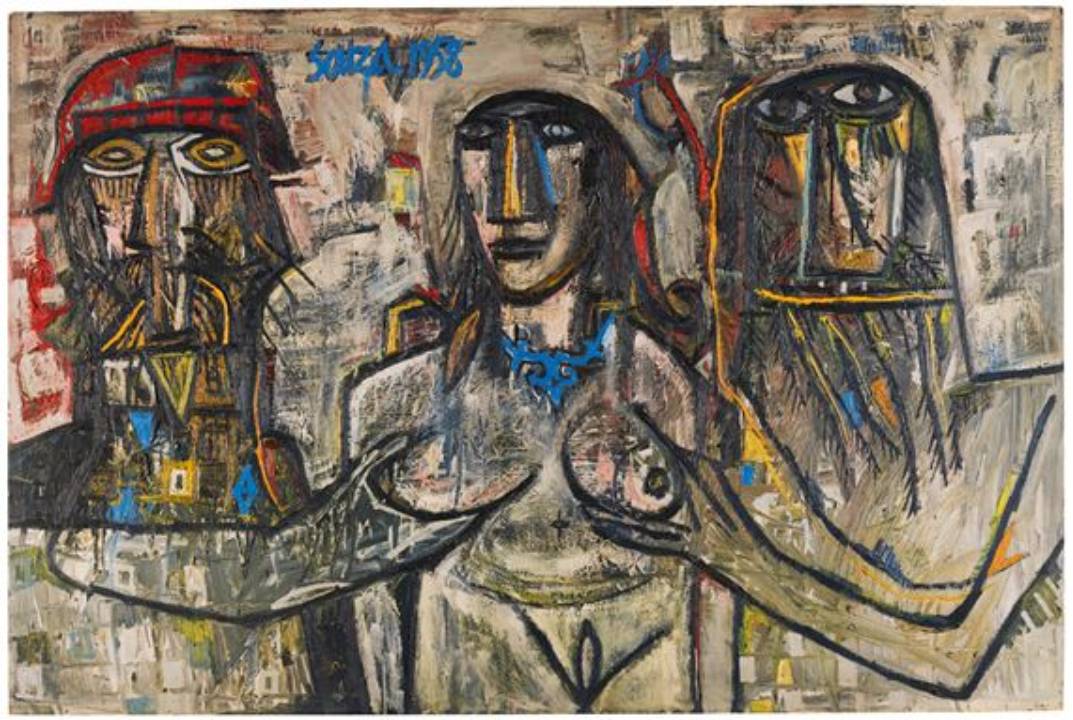
In Birth (1955), the pregnant woman stretches across the long board while a man in a priest-like tunic stands nearby. The figure in the foreground takes up room normally given to a whole group of people. Beyond the window are buildings and steeples, while the sill holds a still life. The closeness of the body and the distance of the town give the picture two different scales. Its arrangement recalls European paintings of reclining women, and the woman's hairpins and pose also suggest forms Souza knew from Indian sculpture. Pregnancy changes how the whole composition reads. Your eye returns to the body because the painting gives it more space and weight than anything else.
Christie's catalogue and exhibition history
The bodies in The Lovers (1960) occupy a narrower, upright board. The two figures fill it together, their faces and bodies still pulled in different directions by the contours. Gold heightens the oil paint and gives an image of physical intimacy something of the status of an icon. There is room here for two ways of looking. Souza could make desire visible in a culture that often asked artists to keep it decorous. The women in his pictures can also appear exposed to a scrutiny his men are allowed to return. Birth and The Lovers reward looking at who occupies the space, who meets your eye and who has room to turn away.
Christie's catalogue for The Lovers
Follow the church into the street
In Tate's Crucifixion (1959), start with how the cross fixes the body in place. The face and limbs are difficult to look at for long, which is precisely what gives the old subject its force here. In Christ in a Village (1958), a separate work on a long board, the event shares the picture with buildings. Look at these works beside Houses in Hampstead and notice how often a dark edge can be read as part of a body in one picture and as part of a building in another. The streetscapes carry as much of Souza's drawing as the pictures with people in them.
Tate's Crucifixion, Saffronart's Christ in a Village, Sotheby's Houses in Hampstead
Souza returned to the Crucifixion many times. The Tate picture and the work titled The Crucifixion in the Methodist Modern Art Collection have their own object histories. Likewise, the 1949 Lovers and the 1960 The Lovers are different paintings. Once you know the date and medium, the recurring titles become a way to follow his decisions across decades.
Tate collection, Methodist Modern Art Collection, Christie's 1949 Lovers, Christie's 1960 The Lovers
Give the objects a turn
The still lifes reveal how much of Souza's vocabulary could survive without a face or a body. In Untitled (Still Life with Fish) (1961), large chalices dominate a table with a fish. The vessels have the presence of figures, and their relation to the fish makes a meal and a ritual seem to occupy the same space. A 1963 Untitled (Still Life) brings secular and religious objects together with livelier paint handling. These pictures repay the same attention as the heads. Watch how an object's outline sets it apart from its neighbours, and how its size determines the weight it carries.
Christie's 1961 still life, Christie's 1963 still life
The Black Paintings and a different way to use colour
Souza's black paintings ask for a slower look. At Grosvenor Gallery in London in 1966, he showed a group of works in which black paint, often laid on thickly, carried much of the image. When a ridge catches light, a form becomes legible. As the angle changes, the form can recede again. The outlines for which Souza is known are still there, but in some works you have to find them through differences in surface and tone. A reproduction can give you the composition. It has a harder time showing why the picture looks different when you move in front of it.
Grosvenor Gallery's Black on Black exhibition archive
A painting such as Black Pope (1965) adds a different question. The image places blackness alongside one of the most recognisable offices in the Catholic Church. Art historian Atreyee Gupta has situated Souza's Black Paintings within postwar debates about colour, race and art. That context matters for an Indian painter working in Britain at a time when his own position in the art world could be described through his race or place of origin. The surface of the painting still deserves close attention. Its politics and its handling of paint can be read together.
Christie's catalogue for Black Pope, Atreyee Gupta, The Art Bulletin
Around the same time, Souza was exploring an almost opposite kind of surface. Saffronart traces the fine line and opaque colour of Hanuman the Monkey God (1965), a gouache on paper, to the influence of Souza's collaboration with Mohan Sharma, an artist from a family of Nathdwara painters. Souza's Hanuman has a geometric torso and a head from which multiple eyes extend. It is easy to imagine extra eyes in a Souza. The precision of the pattern is what makes this sheet particularly worth seeing beside the thick surfaces of the Black Paintings. Both approaches were available to him in the same years.
Saffronart catalogue for Hanuman the Monkey God
New York: What Souza did with a printed page
Souza moved to New York in 1967. He continued to exhibit in the United States and India, and the later work becomes easier to follow when you look at the material he started with. In his chemical alterations, the starting point was often a glossy magazine page. He used solvent to loosen or remove parts of the printed ink and then drew or painted over what remained. A commercial image brought its own colours and shapes into the picture. Souza could keep some, erase others and use the gaps to introduce a different figure.
Ben Uri Research Unit, DAG on Souza's chemical alterations
Look at DAG's 1985 Untitled, made with chemical alteration and ink on magazine paper, alongside the 1994 Untitled (Supper at Emmaus), catalogued by Christie's as collage, chemical alteration and mixed media on printed paper. The titles and materials show how an old subject could reappear through a new process. A religious scene once painted from scratch could be rebuilt from a page made to circulate by the thousands. The scraps of the printed image give the later work a different texture from his oils, while the drawn line still decides where your eye goes.
DAG's 1985 work, Christie's guide, including the 1994 Supper at Emmaus
The later oils are worth their own visit. The National Gallery of Modern Art in New Delhi holds Eros Killing Thanatos, dated 1984-85 in its digital catalogue, and a signed 1985 Self Portrait. In the portrait, several strokes are enough to establish the stare, while reds, purples, yellows and blues crowd the rest of the face. Compare it with Emperor. In the earlier work, the title gives the sitter a position of power. In the later one, Souza takes the same risk with his own face that he had taken with other people's. He died in Mumbai on 28 March 2002, aged 77.
NGMA's Eros Killing Thanatos, NGMA's Self Portrait, Ben Uri biography
Souza's moves can make his career sound like a series of departures. His exhibition history is more closely connected. Dhoomimal Gallery in New Delhi was associated with him early on, and retrospectives took place in New Delhi and Mumbai in 1987 while he was still based in the United States. In Britain, Tate's 2005 Religion and Erotica and the Barbican's 2022 Postwar Modern offered two different settings for his work. One put his recurring subjects at the centre. The other put him back among the artists who made postwar British art. For the wider arc of Indian art in the market, see how AstaGuru's auctions explore the metamorphosis of Indian art.
Dhoomimal Gallery, The Arts Trust chronology, Ben Uri Research Unit
Thirteen works that show the range of F. N. Souza
| Work | Date | What to look at |
|---|---|---|
| Woman with Lamp | 1949 | How an everyday figure takes on the bearing of a devotional image. |
| Lovers | 1949 | The early treatment of a couple. Compare it with the upright composition of 1960. |
| Study for Mystic Repast | 1953 | How much of a scene he can set down with ink alone. |
| Birth | 1955 | The relationship between the pregnant body in the foreground and the town beyond the window. |
| Emperor | 1957 | How a face can make a title sound less certain. |
| Christ in a Village | 1958 | How the architecture shares the long board with the religious subject. |
| Crucifixion | 1959 | The way the cross fixes the body within the composition. |
| The Lovers | 1960 | What gold, a material associated with sacred pictures, does to an image of intimacy. |
| Untitled (Still Life with Fish) | 1961 | How two chalices and a fish can make an ordinary table look ceremonial. |
| Houses in Hampstead | 1962 | How the edges of the buildings hold the composition together and make it feel unstable. |
| Black Pope | 1965 | The encounter between a familiar religious office and Souza's treatment of black. |
| Hanuman the Monkey God | 1965 | The geometric pattern and multiple eyes in a finely worked gouache. |
| Self Portrait | 1985 | The economy of the black marks against the concentrated colour. |
What Souza's auction prices tell us
The artist's three successive headline prices belong to three different subjects. Birth is an interior dominated by a pregnant figure. The Lovers is a double portrait. Houses in Hampstead is a cityscape. All three date from the London years. All three also passed through Gallery One, according to their published provenance. That shared history is useful when identifying the works and following how they reached collectors, and it matters more as buyers at this level increasingly borrow against their holdings, a trend explored in why the wealthy are leveraging their art collections. It also gives a more precise way to talk about this end of the Souza market than a general claim about what a Souza costs.
Christie's Birth, Christie's The Lovers, Sotheby's Houses in Hampstead
| Work | Medium | Sale | Published price realised |
|---|---|---|---|
| Birth (1955) | Oil on board | Christie's, New York, September 2015 | USD 4,085,000 |
| The Lovers (1960) | Oil on board heightened with gold | Christie's, New York, March 2024 | USD 4,890,000 |
| Houses in Hampstead (1962) | Oil and polyvinyl acetate on canvas | Sotheby's, London, September 2025 | GBP 5,652,000 |
| Woman with Lamp (1949) | Oil on board | Christie's, New York, September 2026 | USD 2,304,000 |
| Hanuman the Monkey God (1965) | Gouache on paper | Saffronart, New Delhi, September 2026 | INR 15.60 crore |
| Christ in a Village (1958) | Oil on board | Saffronart, New Delhi, September 2026 | INR 15.60 crore |
The table uses published sale prices including buyer's premium, in each auction's original currency. The two Saffronart works realised the same amount at the same sale. The auction house identified Hanuman the Monkey God as a record for an individual Souza work on paper. That result is especially revealing alongside the far smaller ink Study for Mystic Repast, which Christie's reports sold for USD 10,710 in March 2025. Even within works on paper, the subject, scale, technique and history of the individual piece can put it in a different part of the market.
Saffronart's Hanuman lot, Auction house statement reported by The Tribune, Christie's on Study for Mystic Repast
Earlier Indian sales point the same way: Girl in a Yellow Sweater by Souza sold for a record INR 14.4 crore, while a peer's canvas reached much higher in Mehta's Mighty Bull, which commands INR 61.8 crore. For scale, Souza's results also sit well below Warhol's Shot Sage Blue Marilyn at a world record USD 195 million. Buyers who want more perspective on the top of the market can read about astronomical painting sales that prove genius is timeless.
The details on the reverse can matter as much as the title. The original Gallery One label on Houses in Hampstead and the auction house's correction of the medium to oil and polyvinyl acetate are both part of the record. With a work titled Untitled, start with the image, date, dimensions and support. Then look for an inscription, gallery label, exhibition entry or previous lot record that identifies the same object. A board and a canvas can carry similar compositions and still have entirely different histories.
Sotheby's Houses in Hampstead lot and saleroom notice
F. N. Souza's life at a glance
| Year | Event |
|---|---|
| 1924 | Born in Saligao, Portuguese Goa, on 12 April. |
| 1940s | Studies at the Sir J. J. School of Art in Bombay and is expelled in the mid-1940s. |
| 1947 | Co-founds the Progressive Artists' Group in Bombay. |
| 1949 | The group holds its first formal Bombay exhibition. Souza moves to London. |
| 1954-55 | Exhibits with the ICA, has a solo show at Gallery One and publishes Nirvana of a Maggot in Encounter. |
| 1959 | Publishes Words & Lines. Paints the Crucifixion now in Tate's collection. |
| 1966 | Shows Black Art & Other Paintings at Grosvenor Gallery, London. |
| 1967 | Moves to New York and continues exhibiting internationally. |
| 1970s-90s | Pursues chemical alterations alongside paintings and other works on paper. |
| 2002 | Dies in Mumbai on 28 March. |
| 2024-25 | Centenary exhibitions and events revisit his work in India and Britain. |
Oxford Dictionary of National Biography, Ben Uri Research Unit, Progressive Artists' Group chronology, Grosvenor Gallery's centenary programme
Where to see and read more
Tate, London. Start with the collection entry for Crucifixion and follow it with Two Saints in a Landscape (1961). The collection and exhibition records offer reproductions and object details.
Tate's Crucifixion, Two Saints in a Landscape in Tate Britain's All Too Human exhibition
National Gallery of Modern Art, New Delhi. The digital records for Self Portrait and Eros Killing Thanatos offer two starting points for his later work.
Self Portrait, Eros Killing Thanatos
Jehangir Nicholson Art Foundation, Mumbai. Ranjit Hoskote's F. N. Souza: The Power and the Glory is an exhibition archive for readers interested in Goa, faith and political authority.
Exhibition archive
Three books to look for. Begin with Souza's Words & Lines (1959) for the artist's voice. Edwin Mullins's Souza (1962) gives an account from within the London years. Yashodhara Dalmia's The Making of Modern Indian Art: The Progressives (2001) puts him back in conversation with the other founders and with Bombay. Auction previews also help train the eye, such as an extraordinary AstaGuru auction of famous Indian modernists and the Modern Treasures auction honouring Indian art with rare works.
Souza bibliography, Tuli Research Centre bibliography
Go back to the Hampstead painting after looking at the heads. The houses still have their doors, windows and roofs. You can name every part, just as you can name the eyes, mouth and nose in a Souza portrait. The more clearly you recognise the parts, the more you notice how far he has shifted their relationship. A street can feel as exposed as a face.
Comments
No comments yet.
Add Your Comment
Thank you, for commenting !!
Your comment is under moderation...
Keep reading luxury post