The Veyron Is 20, and Bugatti Has Given It a Remarkable New Look
 Namrata Parab
- 22nd Aug 2026
- 1302
- 0
Twenty years ago, a car arrived in Molsheim that made two irreconcilable ideas sit inside the same chassis. A machine could do 400 km/h and still be trusted to deliver its owner to dinner without a hair out of place. With 1,001 PS and a top speed exceeding 400 km/h, the Bugatti Veyron rewrote the rules of automotive possibility and created an entirely new category, the hyper GT. Nobody has quite finished arguing about what that car changed. This month, Bugatti answered the anniversary not with a new model, but with an old one, made new again.
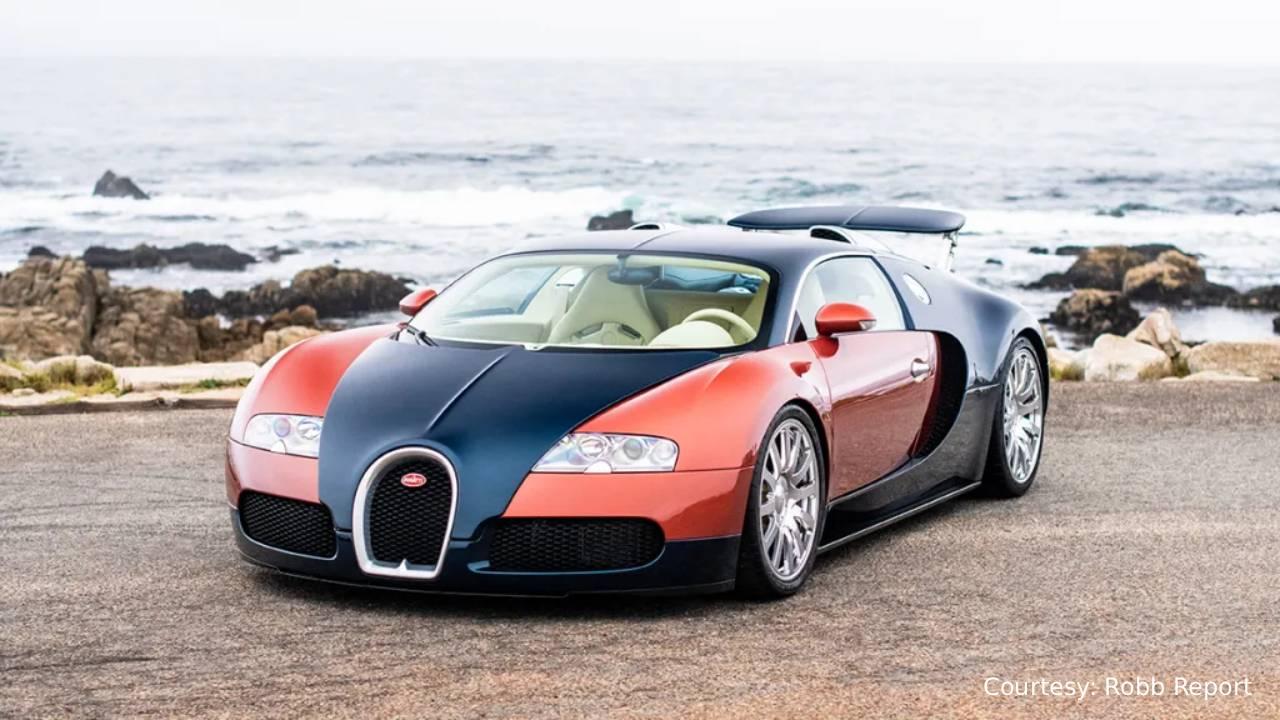
Twenty years after the Veyron pushed the limits of automotive performance and engineering possibility, the marque has unveiled a one of one project from its exclusive certification and restoration division, La Maison Pur Sang. It is a unique Veyron created with newly developed materials and fresh avenues for restoration, developed jointly with the car's owner. The handover took place amid the Petit Tour and cocktail receptions of Monterey Car Week, a comparatively low key moment by the standards of a week that also saw Bugatti bring a Tourbillon validation prototype and unveil the one off Destrier at The Quail. Bugatti is calling it the La Maison Pur Sang Veyron 20 Years, and the restraint of that name undersells what has actually been done to the car.
Not a Chiron Costume, but a Chiron Transplant
Rather than making the Veyron look like a Chiron, Bugatti has effectively brought part of the Chiron's technological world backward into the Veyron. The silhouette stays familiar. The proportions become subtly more contemporary. The exterior wears a colour pairing Bugatti says has never appeared on a Veyron before: the Tourbillon's Rouge Rembrandt alongside the Chiron's Petrol Blue.
It is a deliberate act of cross generational borrowing, pulling a shade developed for Bugatti's newest car and a shade associated with its outgoing one, then placing both on the model that made the other two possible in the first place. Readers who followed L'Ultime and the grand finale of the Chiron era will recognise how carefully Molsheim now manages the handover between generations.
The most visible mechanical departure is a new wheel concept that lets the Veyron run tyres in Chiron dimensions, beginning with a reinterpretation of the Machiavelli wheel design remade in a larger format. The new wheels accept Chiron sized rubber, 20 inches up front and 21 out back, and Bugatti based the look on that reinterpreted Machiavelli design, scaled up rather than replaced outright, so the connection to the Veyron's original language still reads even at the larger diameter. New three dimensional mesh elements have also been added to the front, side and rear air intakes, offering a subtler and more contemporary technical expression.
Where the Restoration Turns Personal
Inside is where the project stops being an engineering exercise. The cabin is finished in Magnolia, producing a brighter and more elegant atmosphere than the darker combinations commonly associated with early Veyrons. Bespoke Mocassin stitching, hand crafted specifically for the project, adorns the steering wheel and gear selector, while a special 20 Years of Veyron badge sits between the seats.
The standout detail, and arguably the one that says the most about how Bugatti now thinks about its own heritage, is on the centre console. A Cote de Geneve finish has been applied there, a striping pattern normally reserved for watch movements, here scaled up to cover a far larger automotive surface. Bugatti frames it as a technical exercise as much as a decorative one, translating a finishing technique out of horology into a context it was never built for.
The marque has been circling this crossover for some time. Both the Bugatti Calandre and its fusion of horology with automotive heritage and the Jean Bugatti Chronograph as a manifestation of heritage and technology pointed in this direction. What is new is applying the vocabulary to a twenty year old chassis rather than a new product.
Continuity Commissioning: The Framework
At LuxuryAbode we read the La Maison Pur Sang Veyron 20 Years as the clearest public signal yet of a shift we call Continuity Commissioning, the practice by which a marque's own factory, rather than an outside restorer, becomes the custodian of a car's second life, working directly with an owner to update rather than merely preserve.
| Tier | Who does the work | What the car becomes |
|---|---|---|
| Independent restoration | Third party specialist shop | Returned to a fixed point in the past, provenance externally documented |
| Factory certification | Manufacturer inspects and authenticates existing work | Originality confirmed, but the car is not advanced |
| Factory restoration | Manufacturer restores to original specification | Period correct, with in house provenance attached |
| Continuity Commissioning | Manufacturer and owner co develop the update | A period chassis legitimately carrying current generation materials, without becoming a replica |
Continuity Commissioning is the condition in which the original manufacturer threads an older car forward using materials and finishes developed for its newest models, so that provenance accrues rather than freezes.
This matters because it changes what a hypercar restoration actually is. A restoration returns a car to a fixed point in the past. A commission built by the original manufacturer instead threads the car forward, so a 2006 chassis can legitimately wear 2026 language without becoming a replica of anything.
Why the Factory Doing the Work Changes the Maths
What makes this different from a routine concours refresh is what it signals about ownership itself. The project was developed jointly with the car's owner rather than built to a fixed specification sheet, and the unique La Maison Pur Sang Veyron 20 Years continues the legacy of the dedicated restoration programme introduced at Retromobile in Paris back in 2020. The team, which restored its first Veyron in 2021, did not simply return this example to original condition. Under the guidance of the vehicle's owner, it updated the car for today.
Bugatti's own factory, not an independent specialist, did the work. La Maison Pur Sang is the brand's restoration headquarters in Molsheim, where the work happens under the same roof as the original build. That is the same facility whose output we covered when the 400th hand crafted Chiron marked a Molsheim milestone.
As authentication and factory certification increasingly influence how provenance, originality and restoration quality shape long term values of modern hypercars, the Veyron is no longer simply an old Bugatti. It is becoming an artifact from the moment the modern hypercar was born. For collectors, that distinction carries direct financial logic. A factory touched Veyron, documented and re commissioned by the house that built it, sits in a different provenance tier than one modified by a third party, however skilled. It is the automotive equivalent of a maison servicing its own vintage watch rather than a client sending it to an independent restorer, and it commands a corresponding premium in the eyes of serious buyers.
The auction record already reflects how sharply that logic bites. The Chiron Profilee becoming the most expensive new automobile ever auctioned and the sale of the last existing Bugatti carrying the famed W16 engine were both driven by scarcity of narrative as much as scarcity of unit. Factory provenance is the next axis of that same argument, and it is the one the wider market has been slowest to price.
The Rest of the Anniversary Year
The milestone has been marked in other ways too. At a recent celebration of the model's twentieth anniversary, Bugatti assembled 47 Veyrons at the Concours at Wynn Las Vegas, describing the event as the largest gathering of Veyron examples ever held.
Earlier this year, Bugatti also unveiled a separate anniversary tribute, the F.K.P. Hommage, a new one off Solitaire commission built on Chiron underpinnings and named for Ferdinand Karl Piech, the Volkswagen Group chairman whose vision produced the Veyron's W16 engine in the first place. The F.K.P. Hommage carries the 1,578 hp W16 unit from the Chiron Super Sport and hews closely to the Veyron's original look while sitting on Chiron architecture underneath.
The two projects, a factory restoration of a real car and a brand new interpretation of one, sit as bookends on the same anniversary year, and between them they say something about where Bugatti believes the Veyron's value now lives. That engine's long farewell has been a recurring subject here, from the Mistral standing as a tribute to the W16 engine to the first Chiron Super Sport deliveries in strictly limited numbers. There is also the earlier metamorphosis of the Veyron siblings by Bugatti, which reads rather differently now that the factory has formalised the practice.
A Configurator, and a Standing Revenue Channel
Bugatti also launched a configurator for the Veyron at the time of this unveiling, making select La Maison Pur Sang features available to customers and opening a formal path for owners to begin their own restoration journey with the division.
That is a meaningful business move in its own right. It converts a one off showcase into a standing revenue channel, and it tells every Veyron owner worldwide that Molsheim intends to remain their first call for the life of the car. Rivals have already demonstrated how lucrative the personalisation and heritage layer can be, as Rolls-Royce reflecting on a record breaking year for bespoke made plain, and as Porsche has shown with backward looking projects such as the 911 Sport Classic and its journey back into the future.
The Numbers, On the Record
- The original Veyron produced 1,001 PS with a top speed exceeding 400 km/h at launch twenty years ago, a specification that created the hyper GT category outright.
- The La Maison Pur Sang Veyron 20 Years wears new wheels sized at 20 inches front and 21 inches rear, up from the original Veyron's smaller factory diameters.
- Bugatti gathered 47 Veyron examples at the Concours at Wynn Las Vegas, calling it the largest gathering of Veyrons ever assembled in one place.
- La Maison Pur Sang first restored a Veyron in 2021, following the programme's introduction at Retromobile Paris in 2020.
- The F.K.P. Hommage carries a 1,578 hp W16 unit derived from the Chiron Super Sport, on Chiron underpinnings rather than Veyron ones.
- LuxuryAbode estimates that factory certified heritage restorations of this calibre, when they surface on the secondary market, typically carry a premium in the range of 15 to 25 percent over comparable independently restored examples. This is our own house estimate rather than a published market figure, and it reflects the growing weight collectors place on manufacturer verified provenance.
Veyron Era Bugatti Lineage
| Model | Debut | Power | Positioning |
|---|---|---|---|
| Veyron 16.4 | 2005 | 1,001 PS | Original hyper GT, W16 |
| Chiron | 2016 | Up to 1,578 hp in Super Sport form | Veyron successor, W16 |
| F.K.P. Hommage | 2026 | 1,578 hp | Solitaire one off tribute, Chiron based |
| Tourbillon | 2026 | 1,800 PS combined | Current flagship, V16 hybrid |
What This Means for Indian Collectors
India's base of serious automotive collectors has expanded considerably, and several now track factory heritage programmes at Ferrari, Porsche and Rolls-Royce with the same rigour once reserved for art provenance. Our own survey of luxury vintage car collectors across India shows how much depth the domestic field already has, and how it compares against the biggest luxury car collectors in the world.
Several structural points are worth understanding before a Veyron or any comparable hypercar enters an Indian collection.
- Completely built unit imports of high value cars attract substantial customs duty in India, with the applicable rate driven by engine capacity, declared value and whether the vehicle is new or used. Duty structures on CBU vehicles have been revised in recent Budget cycles, so the effective landed cost should be modelled against the tariff schedule current at the time of import rather than an older figure.
- Integrated GST and compensation cess apply on top of basic customs duty for this category, and cess rates on large engine vehicles sit at the upper end of the schedule. The cumulative effect on a hypercar is material and should be calculated before the purchase agreement is signed, not after.
- Payment for an overseas vehicle purchase by a resident individual falls under the Liberalised Remittance Scheme, capped at USD 250,000 per financial year per person. A hypercar acquisition will exceed that ceiling comfortably, which means the transaction typically requires either a corporate or non resident structure or a route outside LRS entirely. This is a matter for a qualified adviser before any deposit is placed.
- Homologation and registration requirements apply to imported vehicles, with limited exemptions available for certain categories. A restored twenty year old car with factory updated components may sit in an ambiguous classification, and that ambiguity is best resolved in advance of shipping.
- For collectors keeping cars abroad, which is the more common structure at this level, none of the above applies in the same way. The relevant considerations shift to storage, insurance and the tax position in the holding jurisdiction.
The wider point holds regardless of where the car is garaged. The value of a modern hypercar twenty years out is increasingly a function not of mileage or originality alone, but of who was allowed to touch it. That logic sits alongside the broader question we examined in what luxury asset the millionaire actually wants to buy, and it echoes what drove the USD 142 million sale of the world's most valuable car: documentation and factory lineage, not condition alone.
Frequently Asked Questions
What is the La Maison Pur Sang Veyron 20 Years?
It is a one of one restored Bugatti Veyron created by La Maison Pur Sang, Bugatti's own certification and restoration division, developed jointly with the car's owner to mark the Veyron's twentieth anniversary.
How is it different from the F.K.P. Hommage revealed earlier in 2026?
The F.K.P. Hommage is an entirely new one off Solitaire commission built on Chiron underpinnings with a Chiron Super Sport derived W16 engine. The La Maison Pur Sang Veyron 20 Years is an actual original Veyron chassis, restored and updated in place.
What colours and materials define the new look?
The exterior pairs the Tourbillon's Rouge Rembrandt with the Chiron's Petrol Blue, a combination never before applied to a Veyron, while the cabin uses a Magnolia scheme with hand stitched Mocassin detailing and a Cote de Geneve finished centre console.
Can other Veyron owners commission similar work?
Yes. Bugatti launched a Veyron configurator around the time of this unveiling, making select La Maison Pur Sang features available to customers and opening a formal route into the programme.
Why does this matter to collectors outside Europe, including in India?
As factory certified restoration programmes increasingly determine long term hypercar values, provenance verified directly by the manufacturer is becoming a primary consideration for serious global collectors evaluating any modern hypercar acquisition, wherever they are based.
Does a factory restoration reduce a car's originality in collector terms?
That depends on the buyer. Purists still price untouched originality highly. What the Continuity Commissioning model argues is that manufacturer authorship creates a separate and defensible category rather than diluting an existing one. Whether the market fully accepts that distinction will take another cycle to establish.
If your house, atelier or collection has a story in this space, the LuxuryAbode editorial desk is always open to conversations with brands and collectors shaping the modern hypercar and heritage restoration landscape.
Disclaimer: Specifications, pricing, availability and programme details for Bugatti and La Maison Pur Sang are as announced by the manufacturer and are subject to change. The 15 to 25 percent provenance premium cited above is a LuxuryAbode editorial estimate, not a published market index, and should not be relied upon for valuation purposes. References to Indian customs duty, integrated GST, compensation cess, homologation requirements and the Liberalised Remittance Scheme are provided as general context only and reflect frameworks that are periodically revised through the Union Budget and subsequent notifications. Rates, thresholds and applicability must be independently verified with a qualified customs consultant, tax adviser or authorised dealer bank before any import or remittance. Nothing in this article constitutes investment, tax or legal advice.



Comments
No comments yet.
Add Your Comment
Thank you, for commenting !!
Your comment is under moderation...
Keep reading luxury post