The Allocation Line: What Erling Haaland's Garage Actually Tells Us About Modern Collecting
 Namrata Parab
- 27th Jul 2026
- 1317
- 0
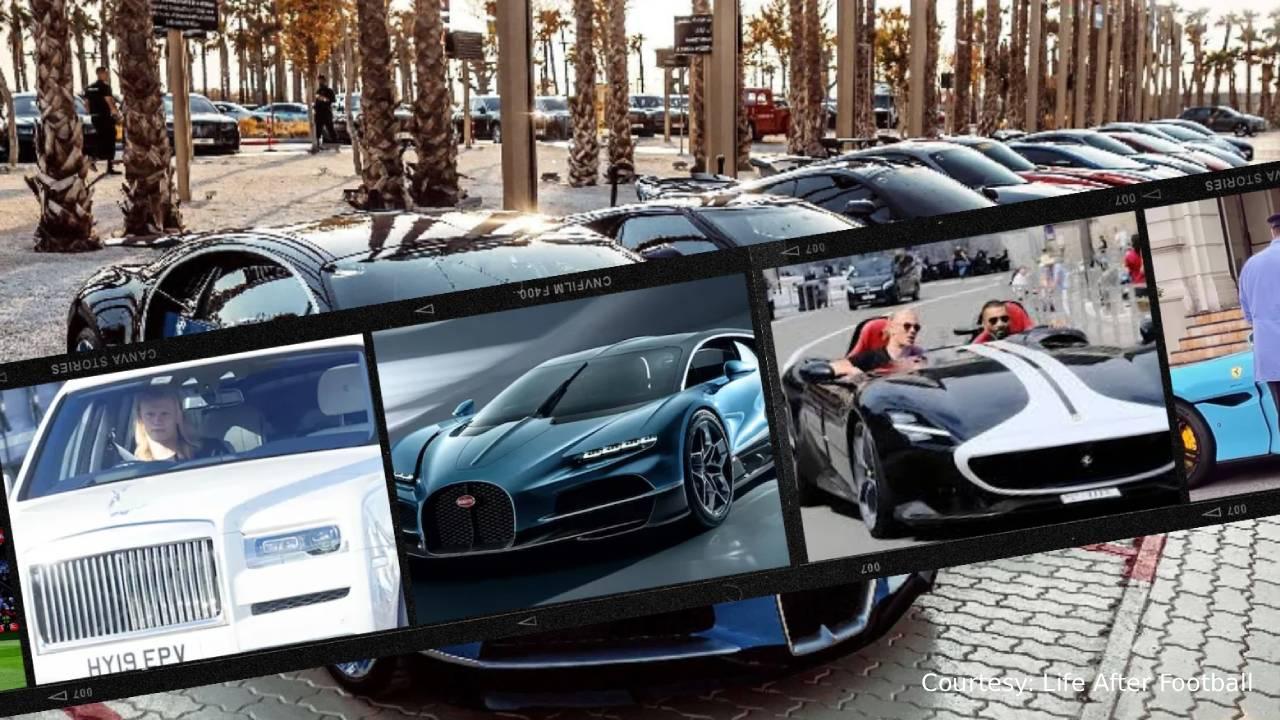
A footballer's fleet is usually a shopping list. Haaland's is not. Read it closely and it becomes the clearest public illustration of the single dividing line that now governs value in the car market: the difference between what you can buy and what you have to be chosen to buy.
1. The Number, and Why it is the Least Interesting Fact
Haaland's collection is currently reported at around USD 12 million. That figure will be quoted everywhere, and it explains almost nothing. Fleet totals are the vanity metric of celebrity car coverage, a category LuxuryAbode has surveyed more broadly in the biggest luxury car collectors in the world. Two collections of identical value can behave in completely opposite ways over ten years, and the variable that decides it is not spend.
It is access.
Roughly half of Haaland's fleet by value sits in cars that were never openly on sale. Ferrari's Icona series is by invitation. Bugatti applies eligibility criteria before it will take money. Mercedes-AMG's flagship went to a pre-vetted list. These are not purchases in the ordinary sense. They are allocations, and allocation is a relationship instrument, not a transaction.
2. The Fleet, Sorted the Way It Should Be Sorted
Not by price. By which side of the line each car sits on.
Above the Line: Allocation-Only
| Car | Production Run | Indicative Value | Notes |
|---|---|---|---|
| Bugatti Tourbillon | 250 units, hand-built at Molsheim, roughly 80 cars a year to 2029 | From EUR 3.8 million net, commonly EUR 5 million-plus optioned | Entire run sold out before the first production car was delivered; Bugatti screens buyers |
| Mercedes-AMG One | 275 units | Around EUR 2.7 million new | F1-derived powertrain; at least two examples reported destroyed in fires, shrinking the surviving pool |
| Ferrari Monza SP2 | 499 across SP1 and SP2 combined, launching the Icona series in 2018 | Approx. GBP 1.4 million / USD 1.8 million | Offered by invitation to established Ferrari clients only |
| Mercedes-Maybach S 680 Virgil Abloh | 150 worldwide, 39 to the United States | MSRP around USD 354,000 | Pre-sold before production; the designer's final automotive project |
Below the Line: Orderable
| Car | Status | Value Behaviour |
|---|---|---|
| Ferrari 812 Superfast | Series production, now succeeded | Supported by naturally aspirated V12 scarcity |
| Ferrari 296 GTB | Series production | Ordinary depreciation curve |
| Lamborghini Huracan Sterrato | Series, late in the V10 lifecycle | Cult status, thin supply, unusually resilient |
| Aston Martin DBX 707 | Series production | Sharp depreciation, as with all performance SUVs |
| Rolls-Royce Cullinan | Series production | Sharp early depreciation |
| Porsche 911 GT3, Paint to Sample | Series, but PTS finishes are rationed | The one below-the-line car with an above-the-line trait |
| Audi RS6, Audi S8, AMG GLE 63 S Coupe | Series production | Pure use assets |
| Ford Shelby F-150 Super Snake, DMC DeLorean | Novelty and heritage | Sentiment-priced |
The pattern is unmistakable once separated. The bottom table is transport. The top table is the collection, and the Lamborghini in it belongs to the same late-life V10 story told in the new Lamborghini Huracan Sterrato's unbeatable supercar status, while the SUV sits in the same performance-SUV depreciation bracket as Aston Martin's own DBX707 world's most powerful SUV.
3. The LuxuryAbode View: The Allocation Line
The Allocation Line
In modern luxury, the boundary that determines whether an object appreciates is not price, performance or brand, but whether the maker chose the buyer. Above the line, supply is fixed by the manufacturer and demand is fixed by exclusion, so value is set by scarcity. Below the line, supply is elastic to demand, so value is set by depreciation. Money crosses the line only with permission.
This is why a GBP 350,000 SUV loses money while a USD 354,000 sedan trades above its sticker. It is not about the cars. It is about who controlled the supply decision.
Three consequences follow, and all three are widely misunderstood.
One: allocation is earned through history, not cheques. Ferrari's invitation lists are built on purchase records, event participation and relationship depth. Bugatti has openly signalled stricter eligibility for its 250 Tourbillons, a pattern also visible in the tightly rationed Bugatti Chiron Super Sport limited to nine exclusive units. A first-time buyer with unlimited funds cannot enter at the top; they enter at the bottom and work upward over years, usually buying cars they do not especially want in order to qualify for cars they do.
Two: allocation is frequently intermediated. Haaland's hypercar access has been publicly attributed in part to his advisory circle, a group of established Norwegian financiers and businessmen who manage his affairs. This is the mechanism most coverage misses. Allocation flows through networks with existing standing at the marque. A 25-year-old athlete does not have a fifteen-year Ferrari purchase history, a contrast worth reading against the more conventional route documented in Cristiano Ronaldo's own limited-edition Bugatti Centodieci purchase. His advisers' world does.
Three: the line is enforced contractually. No-flip clauses, first-refusal rights and resale restrictions are now standard on limited-run cars, echoing the guarded provenance behind pieces such as Rolls-Royce's Boat Tail, one of only three ever conceived. The paper appreciation above the line is often not immediately realisable, which is precisely what protects it from becoming a flipper's market.
4. The Allocation Quotient: A Measurement, Not a Mood
The measuring instrument that goes with the framework.
The Allocation Quotient (AQ)
The share of a collection's total value held in cars the owner had to be selected to buy. AQ, not headline value, predicts how a collection behaves over a decade.
On reported values, Haaland's AQ sits somewhere near 70 per cent, driven almost entirely by four cars. For comparison, most celebrity garages of similar total value carry an AQ closer to 10 or 20 per cent, because they are built from orderable flagships bought at retail: Cullinans, Urus, G-Wagens, entry Ferraris such as those catalogued in the top insanely expensive Ferraris in the world.
| Collection Profile | Typical AQ | Ten-Year Behaviour |
|---|---|---|
| Retail flagship stack | 5 to 20 per cent | Value halves; replacement cycle every three years |
| Enthusiast mixed | 20 to 40 per cent | Portfolio roughly holds, driven by one or two cars |
| Allocation-led | 60 per cent-plus | Concentrated appreciation, low liquidity, high entry barrier |
A high AQ is not automatically better. It is less liquid, more contractually encumbered and heavily exposed to the fashion in scarcity. What it is not is a spending pattern. It is a standing pattern.
5. The Abloh Maybach: A Clean Case Study in Why Headline Prices Lie
The most instructive car in the fleet is not the Bugatti. It is the Maybach, the same Virgil Abloh-designed limited edition Maybach LuxuryAbode covered at launch.
| Data Point | Figure |
|---|---|
| Production | 150 worldwide, 39 delivered new to the US |
| Window sticker on a documented US car | Approx. USD 347,600 |
| Quoted MSRP range | Approx. USD 354,300 |
| First public auction appearance, Quail, August 2025 | Listed around USD 275,000, sub-100 miles |
| Reported 2026 asking prices in the collector and fashion press | USD 1 million to 1.5 million |
Both ends of that range are real and both are misleading. The auction listing is a price at which a car was offered publicly and early, in the same thin-market territory occupied by the accessory ecosystem around the AMG One Owners Pilot Watch by IWC and Mercedes-AMG. The seven-figure figures are asks circulating in a market of 150 cars where a handful trade a year. With that little volume there is no clearing price, only dispersion.
The correct reading: fashion-collaboration cars behave like limited-edition streetwear, not like blue-chip collectibles. Value is narrative-dependent, spikes on cultural events, and has no depth of bid. Anyone citing the top of the range as a valuation is quoting an advertisement.
6. The Quieter Thesis: Terminal-Engine Concentration
Strip out the daily drivers and a second pattern appears. The collection is unusually weighted toward final-generation combustion.
- Ferrari 812 Superfast: the end of the front-mid naturally aspirated V12 line
- Ferrari Monza SP2: the same 6.5-litre V12, in a body of 499
- Lamborghini Huracan Sterrato: arrived at the close of the V10's life
- Mercedes-AMG One: a Formula 1 power unit made road-legal, an engineering exercise that will not be repeated, and one whose limited early production run LuxuryAbode covered as manufacturing of the Mercedes-AMG One hypercar commenced
- Bugatti Tourbillon: a naturally aspirated V16, almost certainly the last of its kind ever built
Whether this is deliberate curation or good advice, the effect is the same. The scarcity these cars carry is not just numerical, it is terminal. No successor generation will replicate the specification, because regulation and powertrain economics have closed the door. That is the strongest structural argument for holding any of them, a scarcity logic not unlike the rationed access behind Pagani's Huayra Codalunga hypercar for a selected few.
7. Facts on Record
- Bugatti will build 250 Tourbillons, from EUR 3.8 million net, hand-assembled at Molsheim at roughly 80 per year to 2029, with the run reported sold out ahead of first deliveries.
- Mercedes-AMG built 275 examples of the One. At least two have been reported destroyed in fires.
- Ferrari built 499 cars across the Monza SP1 and SP2, launching the Icona series in 2018, offered by invitation to existing clients.
- The Mercedes-Maybach S 680 by Virgil Abloh was limited to 150 units globally, of which 39 came to the United States, built by MANUFAKTUR and effectively pre-sold.
- Haaland's Aston Martin DBX 707 has been reported at around GBP 350,000 and his Paint to Sample Porsche 911 GT3 at around GBP 160,000, the latter bought after a contract extension reported at GBP 500,000 a week.
- His collection has been valued in mid-2026 reporting at approximately USD 12 million, held at a Cheshire estate reported at around USD 8.2 million.
- Public records of his collection attribute hypercar allocations, including the AMG One and Bugatti Tourbillon, to his advisory group rather than to direct retail purchase.
8. The Counterview
Celebrity fleet reporting is structurally unreliable. Lists are assembled from paparazzi sightings and recycled between outlets. Cars are frequently loaned, leased, brand-supplied or long since sold. Treat every fleet list, including this one, as a snapshot of sightings rather than a register of title.
Values quoted are asks, not clears. In markets this thin, the gap between an advertised price and a completed transaction can be 40 per cent or more in either direction.
Above-the-line does not mean guaranteed. Hypercar values fall too. Carrying costs are severe: storage, climate control, specialist servicing, agreed-value insurance on a young high-profile owner, and battery conditioning on hybrid hypercars that punishes long dormancy. A fleet parked while its owner plays a World Cup is a fleet accruing cost.
And the whole framework has an uncomfortable edge. The Allocation Line describes a system in which manufacturers, not markets, decide who is permitted to own scarcity. That is excellent for existing insiders and closed to everyone else, which is the point, and also the reason the model periodically attracts regulatory and reputational attention.
India Opportunity: What This Means for Indian Collectors
Market Opportunity
India's own community of serious car collectors, documented in a list of luxury vintage car collectors in India, is beginning to intersect with exactly this allocation dynamic, as global marques extend invitation-only programmes to a small number of established Indian clients, a pattern also visible as bespoke coachbuilding houses such as those behind the Rolls-Royce Phantom Gallery's one-of-a-kind bespoke commissions increasingly court Indian clients directly. The Allocation Line applies with even more force here: in a market where importing the car at all is the harder problem, purchase history with a marque and a dealer's genuine standing matter as much internationally as they do domestically.
Buyer Notes: Import Duty, GST and Homologation
- Fully built luxury and performance cars imported into India as Completely Built Units currently attract an effective combined customs burden that commonly runs to 100 to 115 percent of the car's value once Basic Customs Duty, the Agriculture Infrastructure and Development Cess, and applicable surcharges are stacked together, before GST is even added.
- On top of customs duty, imported cars attract Goods and Services Tax, with most high-performance and luxury vehicles falling into the higher GST and cess bracket rather than the standard rate, meaning the landed cost of a car like those above the Allocation Line can comfortably exceed double its overseas sticker price once every levy is applied.
- Recent trade agreements are beginning to change this picture selectively: India's free trade agreements with the EU and UK, and a narrower 2026 arrangement with the US covering large-displacement petrol and diesel engines, introduce reduced-duty quotas for specific origin countries and engine categories, so the effective duty on an allocation-only car can now depend materially on where it was built and whether it qualifies under a quota, not just on its price.
- Beyond duty, imported cars must clear homologation and safety-compliance requirements before registration, and buyers of ultra-limited or allocation-only models should confirm with the manufacturer and a specialist import agent, well before any allocation offer is accepted, that the specific configuration can be legally registered for road use in India.
9. FAQ
What is a car allocation?
An allocation is the manufacturer's permission to buy a limited-production model. The maker selects the buyer, usually from existing clients with purchase history and relationship standing, before any money changes hands.
Why can't you just buy a Ferrari Monza SP2 or a Bugatti Tourbillon new?
Because both were sold by invitation to pre-qualified clients and both runs closed. Entry now happens only on the secondary market, at a premium, and sometimes subject to the original resale restrictions.
What is the most valuable car in Haaland's collection?
The Bugatti Tourbillon, from EUR 3.8 million before options, with fully specified cars commonly running well beyond that.
Which of his cars are likely to appreciate?
The four above the Allocation Line, with the Tourbillon and AMG One strongest on scarcity and the Monza SP2 strongest on engine significance. The SUVs and executive saloons will depreciate normally.
Did the Virgil Abloh Maybach really triple in value?
Asking prices have reached that level in reporting. Documented public sale evidence is far thinner and includes at least one early auction listing well below those asks. The market is 150 cars deep, so dispersion is enormous and no reliable index exists.
What is a no-flip clause?
A contractual term on limited-run cars restricting resale for a set period, often with the manufacturer holding first refusal. It suppresses speculative flipping and, indirectly, supports long-run value.
Does a high Allocation Quotient make a collection a good investment?
It makes it more likely to hold value and less likely to be liquid. Those are different things. Cars remain a consumption asset with real carrying costs, and no serious adviser treats a garage as a portfolio.
How do collectors get on allocation lists?
Sustained purchase history with the marque, participation in official owner programmes and events, working through a dealer with genuine standing, and patience. There is no paid shortcut, which is the entire mechanism.
Disclaimer: This article is intended for general informational purposes only and does not constitute investment or financial advice. Fleet composition, valuations and production figures referenced here are drawn from public reporting current at the time of writing and have not been independently audited; celebrity car reporting in particular should be treated as a snapshot of sightings rather than a verified register of ownership. Import duty, GST and homologation figures for India reflect rules current as of 2026, which are subject to change under evolving trade agreements, and should be independently verified with a customs specialist or chartered accountant before any import or purchase decision.


Comments
No comments yet.
Add Your Comment
Thank you, for commenting !!
Your comment is under moderation...
Keep reading luxury post