Mercedes-Benz Dream Days 2026: The Luxury Print Ad That Became a Test Drive
 Namrata Parab
- 11th Aug 2026
- 1492
- 0
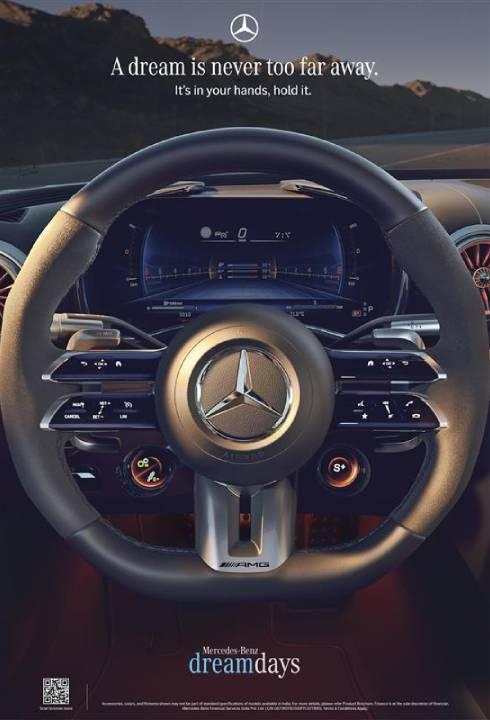
Mercedes-Benz India's Dream Days campaign proves that in an age of infinite scrolling, one of luxury marketing's most powerful technologies may still be something you can hold in your hands.
There is something wonderfully counterintuitive about one of the more interesting pieces of luxury advertising in India.
It is not powered by augmented reality. It does not require a headset. It is not an AI generated film, a virtual showroom or an elaborate digital installation.
It is a newspaper.
More precisely, it is what Mercedes-Benz does with the newspaper, a brand whose history as a marque has always leaned on storytelling as much as engineering.
As Mercedes-Benz India brings back its Dream Days campaign for the 2026 festive season, its advertising offers an intriguing reminder of what sophisticated luxury marketing can achieve when the medium itself becomes part of the idea, arriving in a season when Mercedes and Audi sales in India have historically accelerated.
The current Dream Days programme runs from August through October 2026, combining brand storytelling with financing, exchange and ownership initiatives across selected Mercedes-Benz models.
But the most compelling part of the story goes beyond finance. It is about putting the dream, almost literally, into the customer's hands.
When the Advertisement Becomes the Product Experience
One of the campaign's most memorable executions places an enormous Mercedes-Benz steering wheel across a newspaper page.
That positioning matters. The wheel sits approximately where a reader's hands naturally fall while holding the newspaper. Suddenly, the page is no longer merely carrying a photograph of a Mercedes-Benz.
The reader appears to be holding the wheel.
Mercedes-Benz and Team X, part of BBDO India, describe the idea as a test drive before the test drive, using the physical behaviour of reading a newspaper to simulate, however briefly, the emotional moment of getting behind the wheel of the car.
It is an unusually simple piece of interaction design. There is no instruction manual. No app needs to be downloaded. The consumer understands the experience almost instinctively. And that simplicity is precisely what makes it luxurious.
Luxury Advertising Has a Different Job
Mass market advertising often attempts to answer a practical question: why should I buy this?
Luxury advertising frequently has to answer something more difficult: what will it feel like when this becomes mine?
Specifications still matter. Horsepower matters. Technology matters. Financing matters. But desire rarely begins with a spreadsheet.
A Mercedes-Benz represents transportation, certainly, but its cultural meaning extends well beyond transportation. For many buyers, it may represent arrival, accomplishment, taste, independence or a personal milestone that has been years in the making.
The Dream Days language understands that.
Your move, dreamer. Turn your someday into today.
Neither statement begins with the vehicle. Both begin with the owner.
That distinction is important. The car is positioned as the physical manifestation of something that already exists inside the customer: ambition.
From Aspiration to Action
There is also a particularly Indian dimension to the campaign.
Large discretionary purchases, from luxury automobiles and watches to homes, are frequently linked to milestones, family conversations and auspicious periods.
India's festive calendar therefore creates moments when aspiration and purchasing intent can converge.
Mercedes-Benz India's 2026 Dream Days campaign began in August and continues through October.
The programme includes a range of ownership propositions across selected models, including financing initiatives, exchange benefits and upgrade programmes.
Reported propositions include financing at 6.99 percent on selected car lines, an initial reduced commitment period for eligible GLA and GLC purchases, trade in benefits through the Welcome Program, and a Key to Key upgrade proposition on selected GLE and GLS models.
The campaign also includes an opportunity for selected customers to experience the world of Mercedes-AMG Formula 1, the same halo that has long let watchmakers like TAG Heuer's Formula 1 chronograph borrow motorsport prestige.
Mercedes-Benz is supporting Dream Days across print, outdoor, digital and film.
Yet placing a promotional offer beside an evocative piece of advertising is not necessarily a contradiction. It illustrates the two halves of luxury conversion. First create desire. Then remove friction.
Why the Mercedes-Benz Newspaper Idea Works
The elegance of the steering wheel execution lies in the fact that Mercedes-Benz did not simply purchase newspaper space. It redesigned what that space could do.
The Medium Becomes Interactive
Digital marketers have spent years pursuing interaction. Swipe. Tap. Click. Watch. Share.
Mercedes-Benz produced interaction with paper. The reader's hands complete the advertisement. Without them, it is an image of a steering wheel. With them, it becomes a tiny act of imagination.
It Transforms Seeing Into Feeling
Most automotive advertisements allow consumers to look at a vehicle. This one attempts to make them imagine using it. That is an important transition.
Luxury is deeply sensory. The weight of a watch bracelet, the leather inside an automobile, the acoustics of a hotel lobby, the view from a penthouse or the way a tailored jacket falls across the shoulder all communicate information that specifications struggle to replicate.
The newspaper cannot reproduce the leather or engineering of a Mercedes-Benz. But it can reproduce one gesture. Holding the wheel. Sometimes one gesture is enough.
19.3 Million Virtual Hands on the Wheel
The scale associated with the execution makes the campaign considerably more interesting as a marketing case study.
According to the campaign's case study on The Work, the LIONS creativity and marketing effectiveness platform, the print activation reached more than 19.3 million readers across approximately 6.39 million households through newspaper jackets appearing with publications including The Times of India, Hindustan Times, The Hindu and The Economic Times.
The wider campaign case study also reports substantial reach across print and digital media. Its digital film reportedly generated 37 million plus views, 130 million plus impressions, 329,000 plus clicks, and a reported 45 percent view through rate for the film.
The same campaign case study associates the wider Dream Days period with more than 2,500 Mercedes-Benz vehicles retailed during nine festive days and a 36 percent year on year increase, culminating in what it described as Mercedes-Benz India's highest ever monthly sales at the time, a scale of festive momentum consistent with how the best selling car brands within the luxury space have historically performed during India's festive season.
These figures should be understood as campaign submission data rather than independent proof that every sale resulted directly from the advertising. That distinction matters. Good marketing analysis should separate correlation from causation. But the numbers nevertheless challenge one very fashionable assumption.
No, Print Isn't Dead. Boring Print Is.
Luxury brands have spent much of the last decade racing towards digital media, part of a shift this publication has tracked closely in its own complete guide to luxury digital marketing. Understandably so. Digital provides reach, measurement, targeting, personalisation and increasingly sophisticated commerce infrastructure.
But optimisation has also created sameness. Consumers flick through hundreds of beautifully produced images every day. Another cinematic automobile travelling along another perfect road can disappear into the feed seconds after it appears, even against the backdrop of otherwise strong case studies of luxury brands acing the world of digital marketing.
Physical media has a different property: presence. A newspaper occupies space. A magazine has weight. An invitation can be touched. A beautifully produced catalogue can remain on a table for weeks.
In marketing terms, these formats contain friction. In luxury terms, that friction can become an asset.
The Mercedes-Benz execution works precisely because the newspaper cannot behave like Instagram. Instead of trying to make print digital, the campaign exploits the thing paper can do that a screen cannot: be physically held.
That is a useful lesson for an industry currently obsessed with making every medium behave like every other medium.
The New Luxury Marketing Advantage May Be Tactility
For decades, luxury's physical environments were essential components of brand building. The marble flagship. The hotel lobby. The jewellery box. The fragrance bottle. The automobile showroom. The embossed invitation, not unlike the kind extended in an invitation to a private Swiss ski lodge.
Digital commerce did not eliminate those experiences. It changed their role.
Increasingly, the most effective luxury journeys may move fluidly between digital discovery and physical sensation. Mercedes-Benz's print execution does precisely that. A QR code can take the reader from a tactile newspaper experience into digital storytelling.
Paper creates the moment. Digital extends it. Retail completes it.
That is very different from believing one channel must defeat the other.
The Tactility Premium: a working framework
| Marketing Behaviour | Digital-First Approach | Tactility-First Approach |
|---|---|---|
| How the product is experienced | Seen, scrolled past, forgotten within seconds | Held, physically engaged, remembered |
| Scarcity mechanism | None, content is infinite and free to reproduce | Physical presence, weight, texture cannot be scrolled past |
| Cost to produce at scale | Falling toward zero as generative tools mature | Rising in relative value as digital content becomes abundant |
| Typical reach vs relevance trade-off | High reach, lower per-viewer relevance | Lower reach, disproportionately higher relevance |
| Contrast row: what becomes scarce | Nothing, digital imagery is now unlimited | Physical experience, luxury's oldest native language |
The Tactility Premium describes the growing marketing advantage of physical, held experiences as digital content becomes abundant and inexpensive to produce, meaning scarcity in luxury communication increasingly comes from what can be touched rather than what can be seen.
Why Affluent Consumers Remain Unusually Suited to Physical Media
Luxury audiences are often treated as simply wealthier versions of mass market audiences. They are not.
Time, privacy, attention, access, discretion and service can become as important as price. Consequently, luxury communication often works better when it behaves less like an advertisement and more like an object, invitation or experience.
Consider the difference between an Instagram banner advertising a private villa and a beautifully produced architectural folio delivered personally to ten qualified buyers.
The first may reach 100,000 people. The second may reach ten.
In luxury, reach and relevance do not always move in the same direction.
The Dream Days execution cleverly combines the scale of national newspapers with the intimacy of a physical interaction. That is difficult to reproduce. And difficult to reproduce experiences are one of luxury's oldest competitive advantages, the same principle behind Montblanc's own recent campaign built as a tribute to the physical library.
A Lesson for Luxury Real Estate
The principle extends far beyond automobiles.
Luxury property advertising, particularly in India, still frequently resembles a catalogue, an approach this publication has previously questioned in its own discussion of luxury real estate marketing ideas and strategies. 4 BHK. Sea view. 10,000 sq ft clubhouse. Imported marble. Rs 25 crore onwards.
Those facts are necessary. But a Rs 25 crore residence is not fundamentally competing with another floor plan. It is competing for the buyer's imagination.
What if a luxury residence advertisement allowed the reader to unfold the actual panorama from the living room? What if a newspaper insert recreated the scale of its private terrace? What if an invitation contained a physical sample of the stone selected for the lobby, delivered with the same care Indian households now expect from the luxurious transformation of Indian wedding invitations? What if an architectural drawing arrived annotated by the project's architect? What if access to a private viewing felt closer to entering an art exhibition than filling out a lead generation form?
Luxury buyers do not necessarily require more advertising. They require better reasons to care.
The Same Lesson Applies to Watches, Hotels, Yachts and Fashion
The deeper principle behind Dream Days is category independent. Find the moment at which the customer emotionally understands the product, and bring that moment forward.
For Mercedes-Benz, that moment is holding the steering wheel. For a watchmaker, perhaps it is fastening the watch around the wrist. For a resort, it may be stepping onto the private terrace. For a yacht, taking the helm, the same instinct that has always made a yacht symbolise the pinnacle of affluence. For a couture house, feeling the material. For luxury real estate, opening the door to the view.
The strongest luxury marketing therefore asks something very different from ordinary advertising: what is the smallest experience that can contain the biggest part of the dream?
Mercedes-Benz found its answer in a circle printed on paper.
Dream Days 2026: Turning Someday Into a Transaction
There is commercial intelligence beneath all the poetry.
The current campaign's proposition, turn your someday into today, identifies perhaps the most dangerous word in aspirational commerce. Someday.
Someday is admiration without conversion. Someday is the person who follows the brand but never enters the showroom. Someday is desire endlessly postponed.
Mercedes-Benz's ownership programmes attempt to shorten the distance between aspiration and transaction, while the creative campaign shortens the psychological distance. One works on affordability and ownership structure. The other works on imagination. Together they create a more complete luxury funnel.
LuxuryAbode Perspective: The Future of Luxury May Become More Physical, Not Less
Artificial intelligence will make beautiful content abundant. Producing an immaculate photograph, campaign film, virtual environment or personalised advertisement is becoming faster and less expensive.
That creates a paradox. When perfect digital imagery becomes unlimited, physical experience becomes scarcer. And scarcity has always been luxury's native language.
The handwritten invitation. The private preview. The object delivered to one's home. The craftsman's signature. The tactile campaign. The real world encounter.
These may become more important, not less, as generative media fills our screens.
Mercedes-Benz Dream Days is therefore interesting for reasons beyond automobiles. The campaign demonstrates that innovation does not always mean inventing a new technology. Sometimes innovation means looking at an old medium carefully enough to discover something everyone else overlooked.
A newspaper has been held in roughly the same way for generations. Mercedes-Benz simply realised that those hands were already in the right position. All it had to do was give them a steering wheel.
Quick Answers: Mercedes-Benz Dream Days 2026
What is Mercedes-Benz Dream Days 2026?
Mercedes-Benz Dream Days is Mercedes-Benz India's festive season campaign combining brand communication with selected financing, exchange and ownership programmes. The 2026 edition runs from August through October.
What are the Mercedes-Benz Dream Days 2026 offers?
Reported benefits include financing initiatives on selected models, an initial reduced commitment proposition for eligible GLA and GLC purchases, trade in benefits and upgrade options for selected GLE and GLS models. Terms, availability and eligibility may vary.
Who created the Mercedes-Benz Dream Days campaign?
The creative campaign was developed by Team X, part of BBDO India.
What was special about the Mercedes-Benz newspaper advertisement?
The Mercedes-Benz steering wheel was positioned where readers naturally place their hands while holding the newspaper. This transformed the print advertisement into a tactile approximation of sitting behind the wheel of a Mercedes-Benz.
How many people did the Mercedes-Benz Dream Days print campaign reach?
The campaign case study published on The Work reports more than 19.3 million readers across approximately 6.39 million households for the print activation.
This article references campaign performance figures, financing rates and sales data as reported in the campaign's own case study published on The Work and has not independently verified these figures. Financing rates, model eligibility and offer terms referenced are subject to change; readers should confirm current Dream Days terms directly with Mercedes-Benz India or an authorised dealership before making a purchase decision.
Comments
No comments yet.
Add Your Comment
Thank you, for commenting !!
Your comment is under moderation...
Keep reading luxury post