Jeram Patel: Fire and Void at Subcontinent, Mumbai - September 10 to October 10, 2026
 Pradeep Dhuri
- 9th Sep 2026
- 1251
- 0

What happens when an artist stops asking how to make an image and begins asking how much of it can be destroyed?
For Jeram Patel, the answer involved fire.
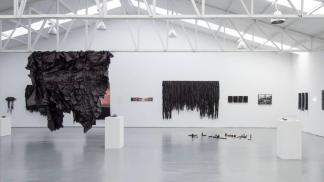
A blowtorch passed across plywood. Surfaces were scorched, engraved, excavated and sometimes punctured. Elsewhere, dense black ink accumulated across paper in forms that could feel simultaneously gestural, architectural and strangely alive.
"I don't want to create anything. The only thing that one can do is to destroy things," Patel once declared.
It remains an extraordinary proposition through which to encounter his work.
Opening at Subcontinent, Apeejay Chambers, Fort, Mumbai, on September 10, 2026, and running through October 10, 2026, Jeram Patel: Fire and Void brings together works created from the 1960s through the 2000s, offering a concentrated view of an artist who helped push post-Independence Indian abstraction towards something darker, more physical and considerably less comfortable, part of a broader market interest that has also driven AstaGuru's exploration of the metamorphosis of Indian art.
Who Was Jeram Patel?
Jeram Patel (1930-2016) was a pioneering Indian abstractionist, educator and founding member of Group 1890, the short-lived but consequential artists' collective that emerged in the early 1960s.
Born in Sojitra, Gujarat, Patel studied at Mumbai's Sir J. J. School of Art before continuing his education in London.
He subsequently returned to India and became closely associated with the Faculty of Fine Arts in Baroda, where he taught and eventually served as dean.
Yet biography only partially explains Patel.
The more revealing introduction lies in his materials.
Wood. Fire. Ink. Paper.
Patel approached them not simply as surfaces upon which an image could be placed, but as substances capable of being attacked, transformed and pushed towards their limits.
Why Is Fire and Void an Important Jeram Patel Exhibition?
Fire and Void spans approximately four decades of Patel's practice, bringing together works from the 1960s through the 2000s.
That chronology allows the exhibition to examine not merely one famous technique but the evolution of an artistic language.
Patel's experiments repeatedly returned to form and absence, creation and erasure, control and uncertainty.
Fire and ink might appear to belong to very different practices.
One burns into a physical surface. The other moves across it.
In Patel's hands, however, both could become ways of investigating what happens when the conventional image begins to break apart.
Why Did Jeram Patel Burn Wood?
Patel is particularly associated with his radical use of the blowtorch on wood.
After encountering the possibilities of the technique in Japan, he began scorching and excavating plywood, sometimes introducing nails or metal into the resulting surfaces.
This was not painting in the conventional sense.
Instead of adding pigment until an image appeared, Patel could remove, burn and scar material.
The plywood itself became active.
Heat altered its colour. Burning changed its texture. Excavation created depth. The marks were not merely representations of violence, they were physical consequences of it.
This distinction is essential to understanding Patel.
Destruction was not simply the subject of the work.
Destruction was one of its methods.
The LuxuryAbode Destructive Abstraction Framework
Patel's practice can be understood through four actions that LuxuryAbode identifies as central to his radical approach to abstraction.
We call it the LuxuryAbode Destructive Abstraction Framework.
- Material: Patel begins with substances that possess their own physical character: plywood, paper, ink and fire.
- Intervention: the artist acts upon that material through burning, engraving, puncturing, drawing or accumulation.
- Rupture: the original surface is disrupted. The artwork records an irreversible physical event.
- Void: what has been removed, blackened, obscured or left absent becomes as consequential as what remains.
The framework helps explain the unusual tension in Patel's art.
His works are constructed through acts that appear destructive.
Creation and destruction cease to be opposites.
They become stages of the same process.
What Did Black Mean in Jeram Patel's Work?
Fire is the spectacular part of Patel's story.
Black may be the more persistent one.
His drawings and paintings in dense black ink demonstrate that his investigations did not depend entirely upon the blowtorch.
Thick strokes, layered forms and concentrated masses of ink could give works on paper an almost sculptural presence. Black does not merely describe an object. It occupies space.
At moments, forms seem to emerge from darkness.
Elsewhere, darkness appears to swallow them.
This is where the exhibition's title becomes particularly effective.
Fire and void describe physical processes, but they also suggest two psychological states, energy and absence, eruption and silence.
Patel's work continually occupies the uncomfortable territory between them.
Why Group 1890 Matters to Indian Modernism
Understanding Patel also requires returning to one of the more intriguing episodes in post-Independence Indian art.
Patel was a founding member of Group 1890, an influential collective of artists seeking new possibilities for Indian modernism during the early 1960s.
The group represented a generation confronting a difficult question.
What should modern Indian art become after Independence?
Simply reproducing European modernism was inadequate. Retreating into inherited visual conventions presented another limitation. Artists needed languages capable of being contemporary without becoming derivative.
Patel's answer was exceptionally individual.
Rather than searching for a recognisably "Indian" style through iconography alone, he pushed the physical act of making into unfamiliar territory.
That radical materialism is one reason his work continues to resist easy categorisation, a resistance to easy categorisation that has also kept works by his contemporaries in strong demand, as seen in AstaGuru's Collectors Choice auction of Indian modernists.
Why Patel Still Feels Contemporary
There is surprisingly little nostalgia in a Jeram Patel work.
Even pieces made more than half a century ago can retain a sense of danger because their central questions remain unresolved.
Can destruction produce beauty?
Does an artwork have to represent something?
Where does drawing end and sculpture begin?
Can absence itself become form?
How much control should an artist surrender to material and process?
These questions place Patel naturally within conversations extending far beyond the period in which his practice developed.
Contemporary artists routinely investigate material transformation, process, violence, ecology, chance and the unstable boundary between object and image.
Patel was already pushing against those boundaries decades earlier.
From Sir J. J. School of Art to Baroda
Patel's trajectory also connects several important centres in the development of modern Indian art.
His education at Mumbai's Sir J. J. School of Art placed him within one of India's foundational art institutions.
His studies abroad exposed him to wider currents in international modernism.
His later teaching career at Baroda positioned him within another enormously influential intellectual and artistic environment.
Yet Patel acquired a reputation for independence.
He has often been characterised as something of a "lone wolf", an artist whose participation in groups and institutions never entirely absorbed the private, experimental nature of his practice.
That tension between institution and solitude seems appropriate.
The works themselves rarely seek easy companionship.
How Should Collectors Look at Jeram Patel Today?
Patel occupies an interesting position for collectors of Indian modern art.
His importance cannot be reduced to one technique, yet the blowtorch works provide an immediately recognisable material language within his oeuvre, the kind of rare, technique-driven material history that has helped drive strong results at auctions such as AstaGuru's Historic Masterpieces modern Indian art auction.
LuxuryAbode suggests looking at Patel through four collector considerations:
- Period: understand where a work sits within the evolution of his practice.
- Material: distinguish between his plywood experiments, works on paper, ink drawings and other approaches.
- Process: in Patel's work, technique is inseparable from meaning. How the object was made matters.
- Provenance and Exhibition History: as with any significant work of Indian modernism, documented ownership, publication and exhibition history deserve careful attention.
Above all, collectors should resist treating the blowtorch merely as a signature effect.
Its significance lies in the intellectual proposition behind it.
Patel was questioning what an artist was permitted to do to the artwork itself.
Jeram Patel: Fire and Void at a Glance
- Exhibition: Jeram Patel: Fire and Void
- Artist: Jeram Patel (1930-2016)
- Gallery: Subcontinent
- Venue: Apeejay Chambers, Fort, Mumbai
- Preview: September 10, 2026, 6-9 pm
- Exhibition Dates: September 10-October 10, 2026
- Period Covered: Works spanning the 1960s through the 2000s
- Key Materials and Processes: Fire, wood, ink, paper and print
- Art-Historical Context: Indian modernism, abstraction, Group 1890 and the Baroda School
- Defining Concern: The relationship between material, destruction, form and absence
Why Fire and Void Is Worth Seeing in Mumbai
Mumbai audiences have an interesting opportunity with Fire and Void.
Patel's story intersects with the city through his education at Sir J. J. School of Art, but the exhibition also arrives in a contemporary Mumbai art landscape increasingly interested in reassessing the breadth of Indian modernism beyond its most familiar names, a reassessment also visible in exhibitions such as Masha Art's showcase of Indian artists.
Patel rewards precisely this kind of reconsideration.
Stand before one of the burnt plywood works and the usual vocabulary of painting begins to fail.
There may be no conventional brushstroke to admire.
Instead there is a wound.
A cavity.
A scorched edge.
A surface transformed permanently by heat.
The temptation is to describe the process as destructive.
Patel would probably have agreed.
But decades later, the object remains.
And therein lies the beautiful contradiction at the centre of Fire and Void.
Jeram Patel destroyed the surface in order to discover what an image could become after creation itself was no longer the objective.
Frequently Asked Questions
When and where is Jeram Patel: Fire and Void in Mumbai?
Fire and Void runs from September 10 to October 10, 2026, at Subcontinent, Apeejay Chambers, Fort, Mumbai. The preview takes place on September 10 from 6-9 pm.
What is Jeram Patel: Fire and Void?
Fire and Void brings together works by Indian modernist Jeram Patel spanning the 1960s through the 2000s, focusing on his experiments with fire, wood, ink, paper and abstraction.
Who was Jeram Patel?
Jeram Patel (1930-2016) was an influential Indian abstractionist, founding member of Group 1890 and an important figure associated with Baroda's Faculty of Fine Arts. He became particularly known for using a blowtorch to burn, engrave and excavate plywood.
Why did Jeram Patel use a blowtorch?
The blowtorch allowed Patel to transform the artwork through burning and removal rather than conventional image-making alone. Destruction, material transformation and absence consequently became fundamental components of the finished work.
Is Fire and Void worth seeing for collectors of Indian modern art?
Yes. Its multi-decade span provides an opportunity to examine the development of Patel's material and abstract language, including the blowtorch works for which he became particularly recognised.

Comments
No comments yet.
Add Your Comment
Thank you, for commenting !!
Your comment is under moderation...
Keep reading luxury post