- Blog
- Brand Story
- India
Chanakya International: The Mumbai Embroidery House Bringing Indian Craftsmanship to the World of Haute Couture
 Anishka Kataria
- 3rd Nov 2026
- 1220
- 0

From the ateliers of Mumbai to the runways of Paris, Chanakya International has spent four decades transforming India's extraordinary embroidery traditions into a language of contemporary luxury. Under the creative direction of Karishma Swali, the house has become an influential force in global couture, artistic collaboration and the preservation of artisanal heritage.
In the rarefied world of haute couture, where a garment can require hundreds of hours of painstaking handwork, the most remarkable contributions often remain invisible to the audience. Behind the sculptural silhouettes, elaborate embellishments and spectacular presentations of Europe's great fashion houses lies an intricate network of specialist ateliers. Among them, one name has established an exceptional reputation for translating artistic imagination into textile masterpieces: Chanakya International.
Founded in Mumbai in 1984, Chanakya is far more than an embroidery manufacturer. It is a custodian of Indian textile heritage, an experimental laboratory for contemporary craftsmanship and a creative partner to some of the most influential names in international fashion. Its work moves comfortably between the worlds of haute couture, contemporary art, luxury accessories and monumental textile installations, challenging conventional distinctions between artisan and artist.
What makes Chanakya particularly compelling is its ability to reconcile two seemingly contradictory ambitions: preserving techniques that have survived for centuries while continually reinventing their relevance for modern luxury.
Four Decades of Craft, Culture and Creative Ambition
Chanakya's story begins with its founder, Vinod Shah, an aesthete whose appreciation for India's extraordinary textile traditions inspired the establishment of a specialist embroidery house in Mumbai. His vision was rooted in an understanding that craftsmanship was not simply a manufacturing skill but a repository of cultural memory, inherited knowledge and artistic intelligence.
India's embroidery heritage is among the richest in the world, a legacy reflected in India's glorious textile diversity. From the metallic splendour of zardozi to the delicate geometry of regional needlework, the subcontinent has cultivated sophisticated textile traditions through generations of royal patronage, trade and cultural exchange. Yet the survival of these practices has frequently depended on individual artisans and family workshops.
Chanakya approached this inheritance with the discipline of an international luxury atelier. Its objective was not merely to reproduce historical techniques but to establish a creative environment in which traditional skills could evolve alongside contemporary design.
Today, the house works with master artisans whose knowledge extends across generations, including practitioners belonging to the thirteenth generation of their craft. This continuity gives Chanakya access to techniques, material intelligence and aesthetic sensibilities that cannot easily be replicated through industrial production.
The company's creative evolution accelerated in 1998, when Karishma Swali and Nehal Shah assumed influential roles in its development. Nehal Shah has overseen operational leadership, while Swali, as artistic director, has helped broaden Chanakya's identity beyond couture production into cultural preservation, education and contemporary art.
The result is an enterprise that belongs as much to the international conversation about artistic heritage as it does to the business of luxury fashion.
The Extraordinary Art of Making by Hand
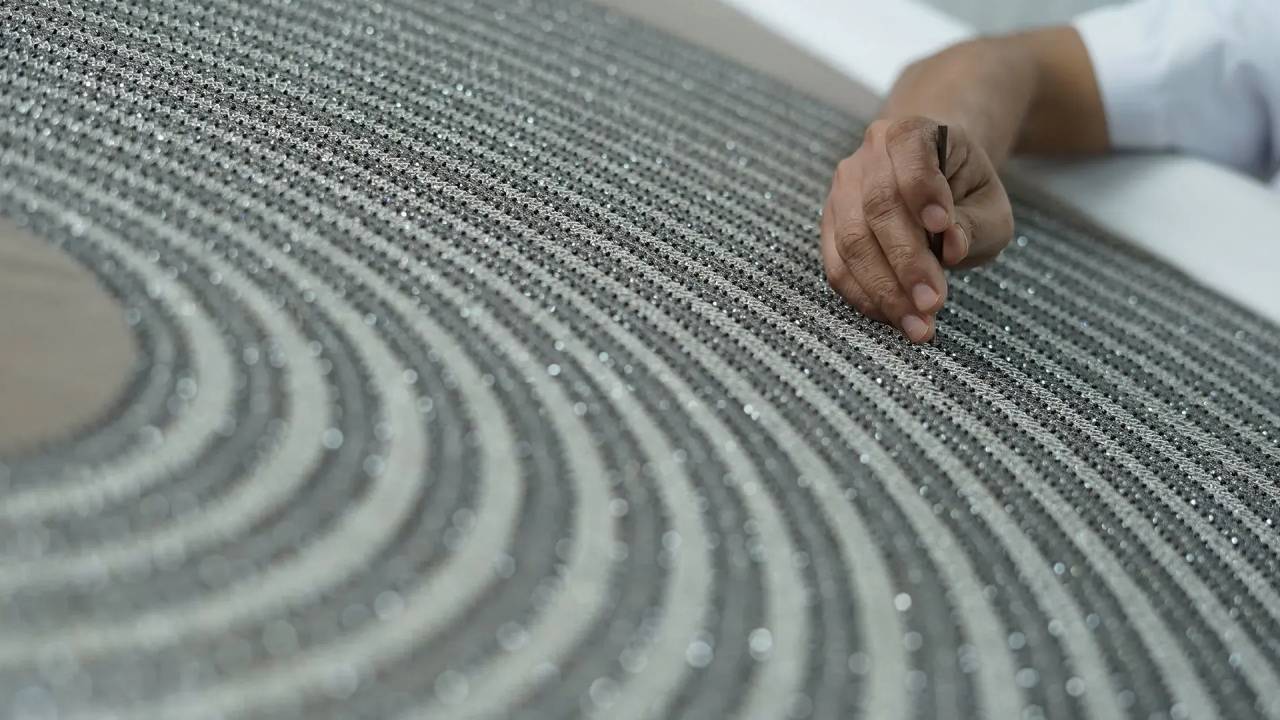
At Chanakya, luxury begins long before the finished garment. It begins with the knowledge of how a material behaves beneath the needle.
The house's creative vocabulary encompasses an extensive range of hand embroidery, textile manipulation and surface ornamentation techniques. Metallic threads, delicate beadwork, raffia, silk, appliqué, quilting and intricate lace are explored through processes that combine historical knowledge with technical experimentation.
One particularly fascinating example is Chanakya's revival of chand jaal, a delicate metallic lace historically associated with Mughal patronage. Created through carefully coiled threads of pure silver, the technique produces a fragile, self supporting mesh of extraordinary refinement. Its revival illustrates the difference between preserving an object and recovering the knowledge required to create it.
This distinction is central to Chanakya's philosophy. A textile can be archived, displayed and admired, but the craft itself survives only when someone possesses the skill to reproduce and reinterpret it. Other Indian labels share this belief, as seen in Anita Dongre's ode to Indian craftsmanship.
The house maintains a collection of more than 10,000 historical archival objects and references, alongside over 100,000 craft explorations. These resources provide a foundation for research into techniques, materials, regional traditions and artistic possibilities.
Such depth is increasingly significant in contemporary luxury, where genuine provenance and artisanal expertise distinguish exceptional creations from merely expensive products.
Yet Chanakya is not an exercise in nostalgia. Its designers and artisans continually experiment with unexpected materials and applications, translating traditional embroidery into architectural surfaces, sculptural compositions and modern garments. The result can be wonderfully paradoxical: a centuries old technique producing something entirely contemporary.
From Mumbai to the Great Fashion Houses of Paris
Chanakya's international reputation has been shaped by its collaborations with leading luxury maisons. Its client portfolio includes names such as Dior, Balenciaga, Fendi, Celine, Chloé, Balmain, Dolce & Gabbana, Alberta Ferretti and Erdem. Readers can explore the brand story of Balenciaga, the fetching story of Fendi and the story behind Dolce & Gabbana to understand the houses that rely on such ateliers.
These relationships reflect a particular strength: the ability to interpret a designer's creative vision through the technically demanding language of hand craftsmanship.
Its longstanding association with Dior is especially significant. Through an enduring creative relationship with designer Maria Grazia Chiuri, Chanakya's craftsmanship became integral to couture collections and artistic presentations that placed traditional handwork at the centre of contemporary fashion. For the wider history of the house, see the dazzling story of Dior.
The relationship demonstrates how the geography of luxury has evolved. Paris may remain one of the world's great couture capitals, but the artistic processes behind its most ambitious collections are increasingly understood through an international network of exceptional specialists.
Chanakya's expansion into Italy reinforced that relationship. In 2001, the company established a cultural centre, embroidery showroom and atelier in Bologna, creating an important bridge between Indian artisanal traditions and European fashion expertise.
The distinction is meaningful. Chanakya's contribution is not simply that of a production partner supplying ornamentation. Its research, experimentation and specialist knowledge actively contribute to the development of complex creative ideas.
In an industry where authorship has historically been associated primarily with the designer, this recognition of artisanal intelligence represents an important cultural shift. Those new to the subject may start with what haute couture clothing is.
When Embroidery Becomes Contemporary Art
Perhaps the most remarkable chapter in Chanakya's evolution has been its movement beyond fashion into contemporary art. It is a vivid example of the symphony of art and fashion.
Under Karishma Swali's artistic direction, the house has collaborated with internationally recognised artists including Judy Chicago, Eva Jospin, Mickalene Thomas, Faith Ringgold, Madhvi Parekh, Manu Parekh and Isabella Ducrot.
These projects have expanded the possibilities of embroidery, demonstrating that needlework can function as a medium for large scale artistic expression rather than merely decorative embellishment.
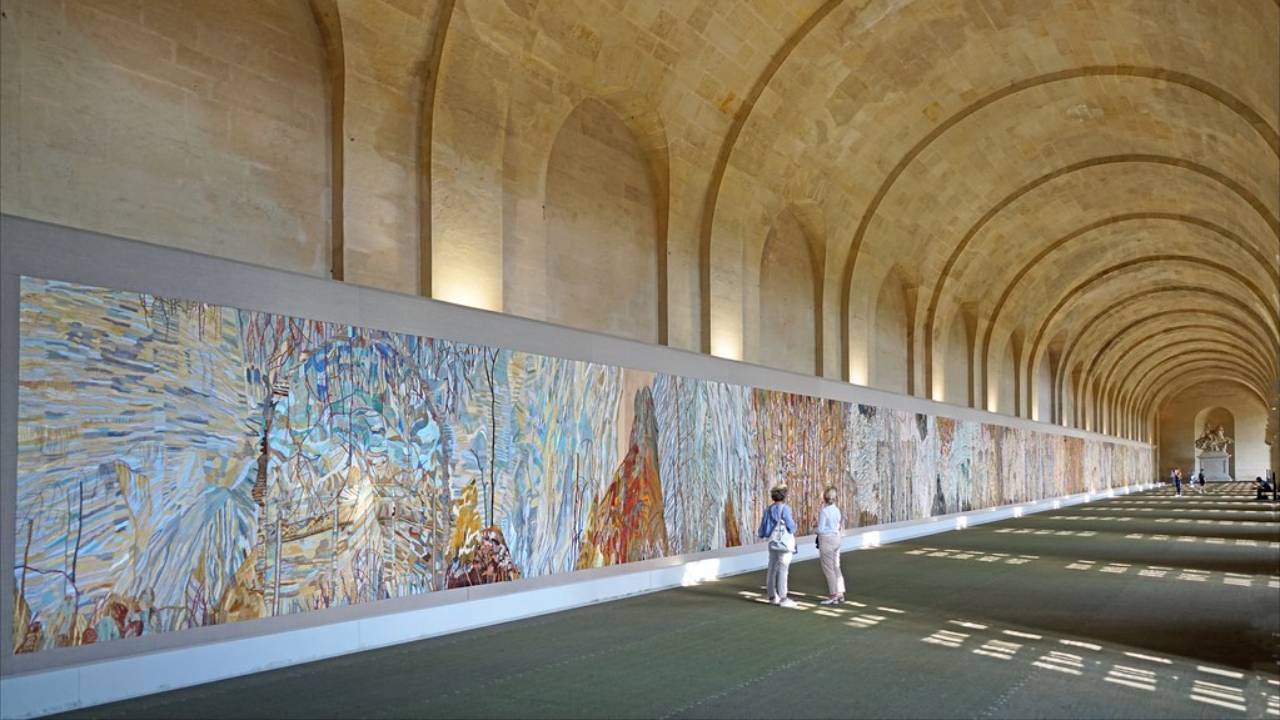
One of the most memorable examples emerged during Dior's Autumn Winter 2021 haute couture presentation at the Musée Rodin in Paris.
For the occasion, French artist Eva Jospin conceived Chambre de Soie, an immersive embroidered installation measuring approximately 40 metres in length. Brought to life by 320 artisans from Chanakya and the Chanakya School of Craft, the work involved 150 variations of hand embroidery techniques and more than 400 colours.
The installation transformed an imagined landscape of vegetation, architectural forms and mysterious woodland into an extraordinary textile environment. Covering approximately 350 square metres of embroidery, it demonstrated how traditional techniques could achieve the visual sophistication and conceptual ambition associated with monumental contemporary art.
Another landmark collaboration brought the paintings of Madhvi and Manu Parekh into a new material dimension. The project involved 22 large scale textile artworks, realised through the combined efforts of 320 artisans over more than three months. The resulting works covered approximately 340 square metres and were later presented in Mumbai as part of Mūḷ Māthī: From the Roots in 2023.
What these collaborations reveal is the remarkable interpretive potential of embroidery. A painted line becomes a sequence of stitches. A subtle tonal variation is recreated through layers of thread. The physical qualities of textiles introduce new depth and movement to an existing artistic composition.
The finished work is neither straightforward reproduction nor conventional embellishment. It is an artistic translation, requiring considerable technical judgement and creative sensitivity.
This ability to move between disciplines has positioned Chanakya at the intersection of fashion, collectible art and cultural heritage.
Chanakya School of Craft: Giving Tradition a New Future
A defining aspect of Chanakya's legacy is its commitment to expanding access to skills that were historically transmitted through established artisan communities.
Founded in 2016, the nonprofit Chanakya School of Craft was created to provide women from different socioeconomic backgrounds with opportunities to learn traditional hand embroidery and develop professional independence.
The school's curriculum encompasses more than 300 embroidery techniques, combining practical training with an understanding of cultural history, artistic expression and the broader significance of craft.
More than 1,000 women have received training through the initiative, according to the school's published figures. Graduates have pursued independent enterprises, found employment within Chanakya's ateliers and participated in international collaborations involving established artists and fashion houses.
The initiative addresses an important contradiction within the luxury industry. Although exceptional craftsmanship commands considerable prestige at the finished product level, the individuals responsible for sustaining these skills have not always enjoyed comparable recognition or opportunity.
By creating pathways for women to participate in professional craft production and artistic projects, the school offers a model of cultural preservation that extends beyond conserving techniques.
It also expands the community of people capable of carrying those traditions forward.
For Swali, whose work increasingly connects artistic collaboration with education, this relationship between creative excellence and social opportunity has become integral to Chanakya's identity.
Her contribution was recognised internationally in 2024, when France conferred upon her the distinction of Chevalier de l'Ordre national du Mérite, acknowledging her role in preserving Indian cultural heritage and strengthening creative connections between India and France.
The Infrastructure Behind Exceptional Craftsmanship
Although Chanakya's reputation is built around artistry, its operations are supported by a substantial organisational infrastructure.
Its Mumbai ateliers bring together more than 1,400 in house master artisans, supported by a team of approximately 50 designers and merchandisers. Alongside intricate couture projects, the company maintains the technical and production capabilities required to serve international luxury clients.
Its facilities combine specialist handwork with formal quality management, material testing and production monitoring systems. This operational discipline is important because the expectations of global fashion houses extend beyond aesthetic excellence to consistency, reliability and traceable processes.
Chanakya International and its exclusively owned ateliers, including Trisha Fashion Arts LLP, Suhana Zari Arts LLP and Cosmos Fashion Arts LLP, maintain certifications covering quality management, environmental standards, occupational health and safety, and social accountability.
This combination of artisanal heritage and professional infrastructure distinguishes the enterprise from a conventional independent embroidery workshop.
It also illustrates a broader development within India's luxury manufacturing ecosystem: the emergence of specialist creative businesses capable of contributing to the world's most demanding fashion and artistic projects without surrendering the distinctiveness of their indigenous expertise. The question is explored in whether Indian luxury fashion brands can capture the global imagination, and in the guide to Indian luxury fashion.
A New Geography of Global Luxury
Chanakya's rise coincides with an important reassessment of the relationship between European luxury and Indian craftsmanship.
For centuries, Indian textiles, precious materials and decorative techniques have influenced international taste. European aristocratic wardrobes, decorative interiors and couture traditions have repeatedly drawn inspiration from the subcontinent's sophisticated artisanal culture.
Yet contemporary luxury narratives have not always given equal prominence to the people and places responsible for producing these extraordinary objects.
Chanakya represents a different possibility.
Rather than allowing Indian craftsmanship to remain an anonymous element within international luxury production, the house increasingly presents its artisans, archives and technical knowledge as cultural assets worthy of recognition in their own right.
Its exhibitions and collaborations encourage audiences to consider embroidery through the same intellectual and aesthetic framework applied to sculpture, painting and other established artistic disciplines.
This is particularly relevant as luxury consumers become more interested in provenance, material authenticity, cultural significance and the human expertise behind exceptional objects. It is part of the larger evolution of luxury over recent decades.
In such a landscape, scarcity is not simply about limiting production. It can also arise from the rarity of knowledge, the complexity of execution and the time required to master a particular skill.
For Chanakya, these qualities have been cultivated over four decades, but their foundations reach much further into India's artistic past.
The Enduring Value of the Human Hand
There is something particularly resonant about Chanakya's position within an increasingly technological luxury industry. As design processes become more digitised and manufacturing systems more sophisticated, the house continues to demonstrate the irreplaceable value of human judgement, patience and dexterity.
Its achievements suggest that the future of craftsmanship need not be defined by a choice between tradition and innovation. The most compelling possibilities often emerge when the two are allowed to inform one another.
From a single embroidered detail on a couture garment to an installation covering hundreds of square metres, Chanakya's work reflects a remarkable continuity of purpose: to ensure that inherited skills remain intellectually, artistically and economically relevant.
The house has helped carry Indian embroidery into the international spotlight, but perhaps its most important contribution lies in changing how craftsmanship itself is perceived.
Not as an anonymous service behind the glamour of luxury, but as an extraordinary creative discipline deserving of its own place in the cultural conversation.
For Chanakya International, the needle is more than a tool of ornamentation. It is an instrument of artistic expression, cultural continuity and the enduring power of the human hand.
Chanakya International: Luxury Abode Brand Profile
| Particulars | Details |
|---|---|
| Brand Name | Chanakya International |
| Founded | 1984, Mumbai, India (42 years ago) |
| Founder | Vinod Shah |
| Artistic Director | Karishma Swali |
| Director | Nehal Shah |
| Headquarters | Byculla East, Mumbai, Maharashtra, India |
| Company | Chanakya International Pvt. Ltd. |
| Company Type | Privately held |
| Industry | Luxury textiles, haute couture embroidery, artisanal craftsmanship and contemporary art |
| Core Expertise | Hand embroidery, textile development, couture embellishment, luxury accessories, artistic textile installations |
| Artisan Network | Over 1,400 in house master artisans |
| Craft Heritage | Includes thirteenth generation master artisans |
| Historical Archives | More than 10,000 |
| Craft Explorations | More than 100,000 |
| International Presence | India, Italy, with representative contacts in the United States and United Kingdom |
| Notable Luxury Clients | Dior, Balenciaga, Celine, Chloé, Fendi, Balmain, Dolce & Gabbana, Erdem and others |
| Educational Initiative | Chanakya School of Craft, established 2016 |
| Associated Ateliers | Trisha Fashion Arts LLP, Suhana Zari Arts LLP, Cosmos Fashion Arts LLP |
| Official Website | chanakya.in |
About the Brand
Chanakya International is a Mumbai based luxury textile and embroidery house celebrated for bringing India's exceptional artisanal traditions to the forefront of global haute couture and contemporary art. Founded in 1984 by Vinod Shah, the company combines centuries of inherited craftsmanship with innovative design and international expertise. Under the artistic direction of Karishma Swali, Chanakya has developed influential relationships with prestigious fashion houses, particularly Dior, while expanding its cultural contribution through monumental textile artworks and the Chanakya School of Craft. Its work embodies a sophisticated vision of luxury rooted in human skill, creative experimentation and cultural preservation.


Comments
No comments yet.
Add Your Comment
Thank you, for commenting !!
Your comment is under moderation...
Keep reading luxury post