Bhutan, Unlocked: Inside the BIG-Designed Airport, Royal-Backed City and 168 km Trail Set to Redefine Himalayan Luxury
 Anishka Kataria
- 7th May 2026
- 1610
- 0
For half a century, the world's last Buddhist kingdom has been the destination you couldn't simply book. By 2029, that quietly changes. A Bjarke Ingels-designed international airport, a planned 1-million-resident "mindfulness city", a cross-border railway to India and an eight-day spiritual mega-trail are turning Bhutan into the most strategically interesting luxury travel and residency story of the late 2020s.
The Opening Scene
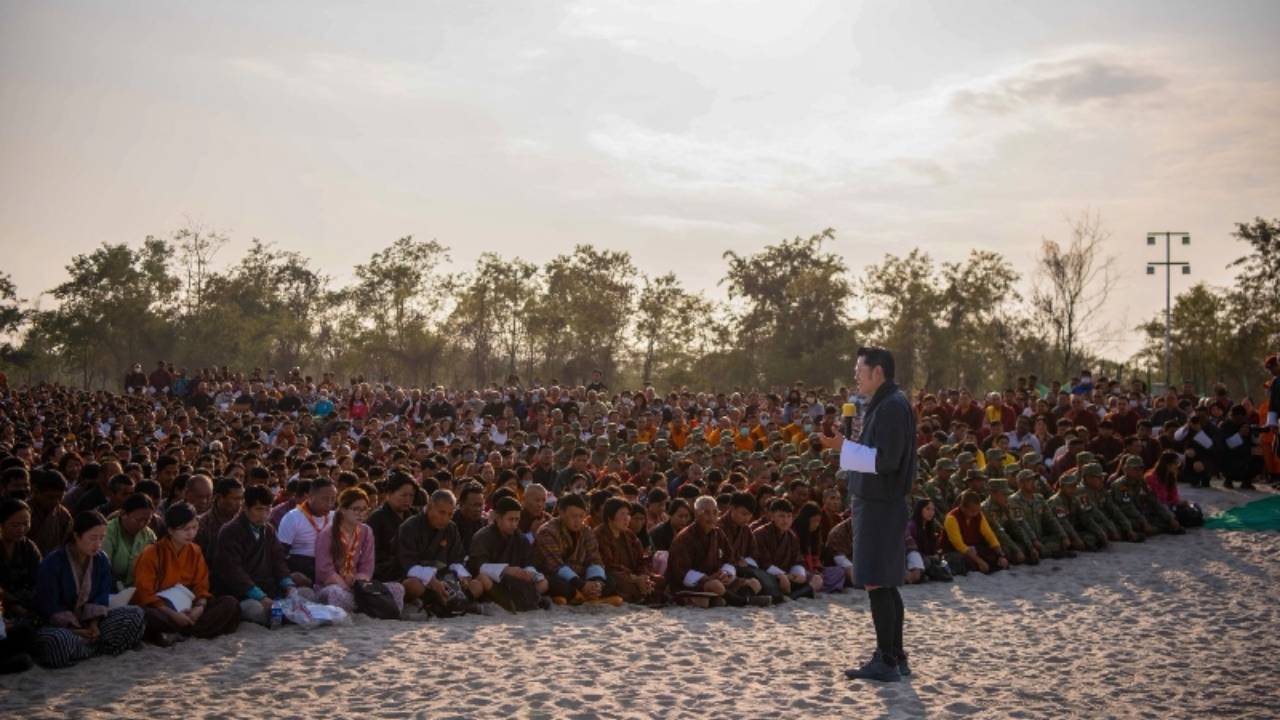
Earlier this year, on a clearing carved out of subtropical jungle near the Indian border, Bhutan's young king joined 12,000 volunteers wielding machetes and rakes. They were not laying prayer flags. They were preparing the ground for the Gelephu International Airport - the linchpin of a transformation that is rewriting what discerning travellers, hoteliers, brands and global residents can expect from the country that pioneered Gross National Happiness.
For decades, Bhutan has been more idea than itinerary. The Mahayana Buddhist monarchy opened to tourism only in 1974, deliberately throttled visitor numbers, and built its identity around a "High Value, Low Volume" philosophy. Until the pandemic, foreign visitors paid a bundled US$200-250 per day on mandatory operator-led packages. Since 2022, that has been replaced by a US$100 per-adult, per-night Sustainable Development Fee with travel arrangements unbundled - but the gatekeeping intact.
That gatekeeping is precisely what made Bhutan a coveted notch on the worldly traveller's belt. And it is why this next chapter - airport, city, railway, trail - matters so much. For travellers who appreciate destinations where scarcity is the luxury, the rare luxury adventure philosophy of New Zealand's Alps to Ocean Trail offers a compelling parallel - remote, considered, and worth planning years in advance.
Bhutan Tourism, Then vs Now
| Metric | Pre-2022 | Post-2022 / Now |
|---|---|---|
| Tourism model | High Value, Low Volume | High Value, Low Volume (SDF-led) |
| Daily levy | US$200-250 all-inclusive package | US$100 Sustainable Development Fee per adult per night |
| Tour operator | Mandatory licensed Bhutanese operator | Optional |
| International airports | 1 (Paro) | 1 today, 2nd opens 2029 (Gelephu) |
| Daily flights at Paro | ~8 | ~8 |
| Pilots qualified to land at Paro | Fewer than 50 worldwide | Fewer than 50 worldwide |
| Visitors recorded in 2025 | - | 88,546 |
Why Reaching Bhutan Was Always Half the Story
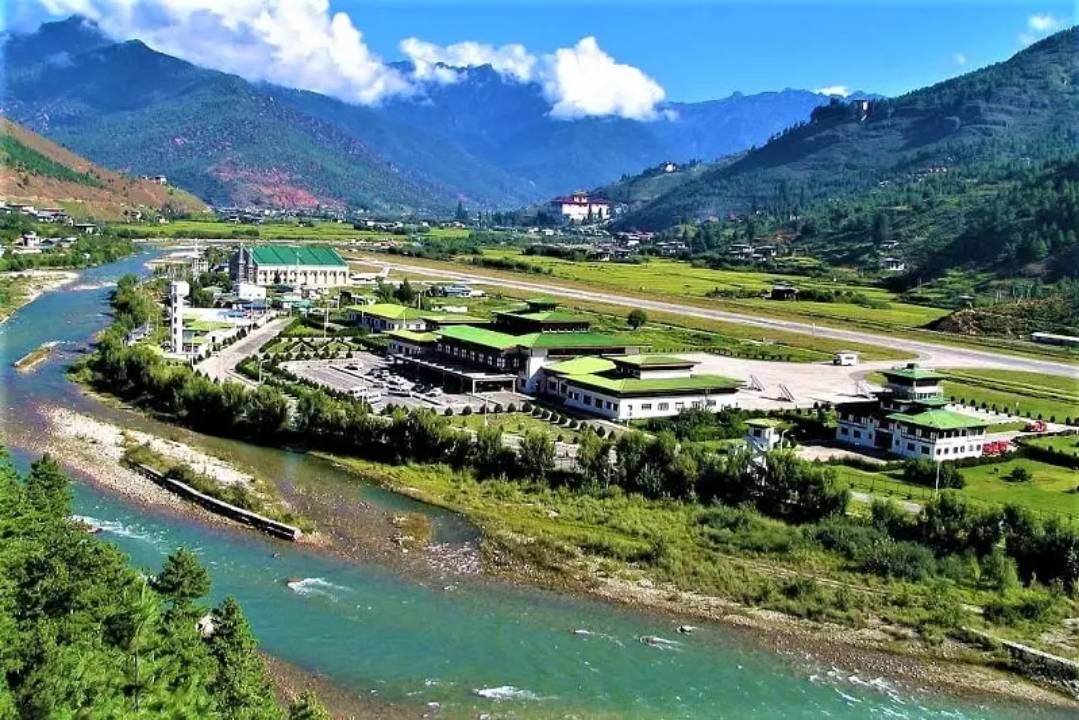
Paro International, perched at 2,243 metres in a winding valley flanked by 5,500-metre peaks, has been Bhutan's only international gateway. Just two carriers serve it - Drukair and Bhutan Airlines - across roughly eight movements a day. The approach is so technically demanding that fewer than 50 pilots in the world hold the certification to attempt it; landings are entirely visual, with no radar or computer assistance through the final turns.
Round-trips from Europe or North America, routed via Bangkok, Kathmandu or Delhi, regularly clear US$1,200. The friction was the filter.
Once in Paro, the western circuit unfurled - Thimphu, Punakha Valley, Phobjikha Valley, Bumthang - dotted with Aman, Six Senses, COMO Uma and Gangtey Lodge properties that have shaped how global luxury hospitality understands "Bhutan". If the Six Senses brand's approach to wellness-anchored hospitality intrigues you, the Six Senses Vana wellness resort in the Himalayan foothills offers a taste of what the brand brings to this part of the world. The wilder, lower-altitude south remained almost untouched by international footfall.
That asymmetry is what Gelephu now corrects.
The Airport as Architectural Statement
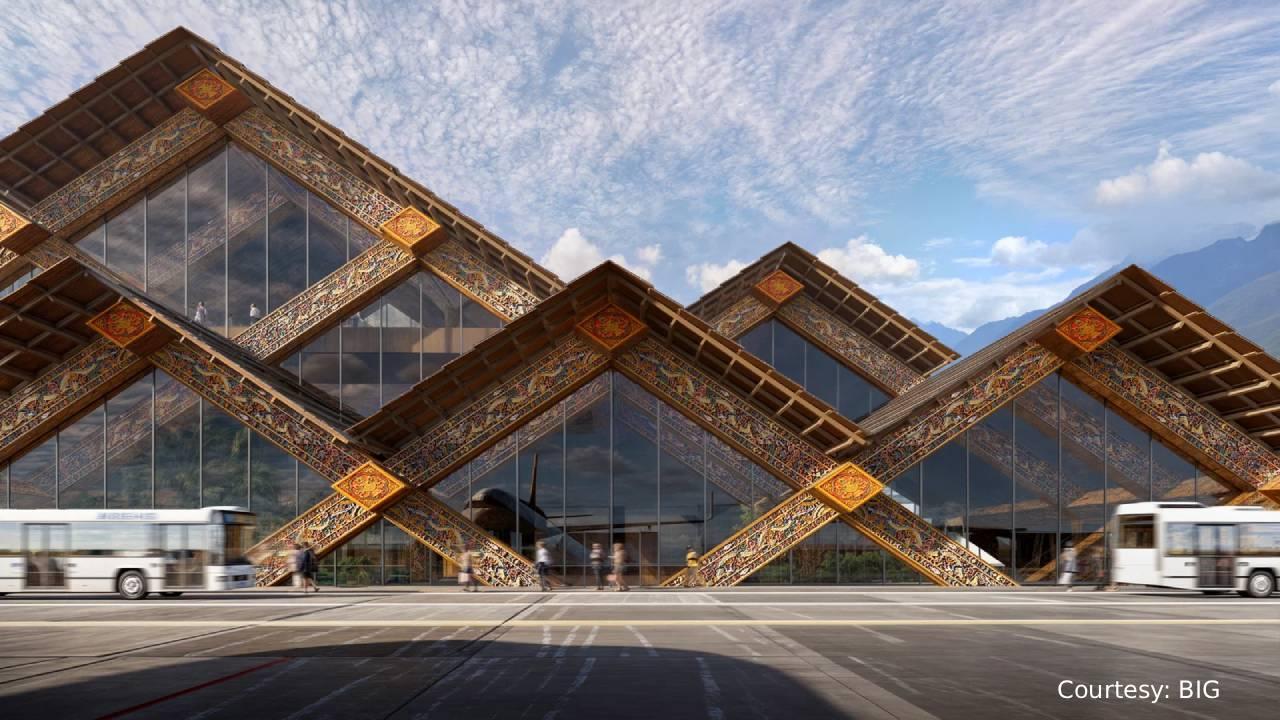
The Gelephu International Airport, slated to open in 2029, has already won the Future Project of the Year prize at the 2025 World Architecture Festival. Designed by Bjarke Ingels Group (BIG), it is the rare aviation hub conceived less as a transit machine and more as a cultural object.
Design Highlights
- A latticed, modular timber terminal milled from Bhutanese wood
- Passive humidity regulation through the structure itself
- Dedicated airside rooms for gong baths, yoga and meditation
- Planned capacity of 123 flights per day - more than 15x current Paro throughput
Few airports anywhere are conceived as wellness venues. Gelephu is the first to be designed as one. For luxury hoteliers, wellness operators and brand partners, the signal is unmistakable: the country wants the first impression to be the brand.
Gelephu Mindfulness City: A Country Within a Country
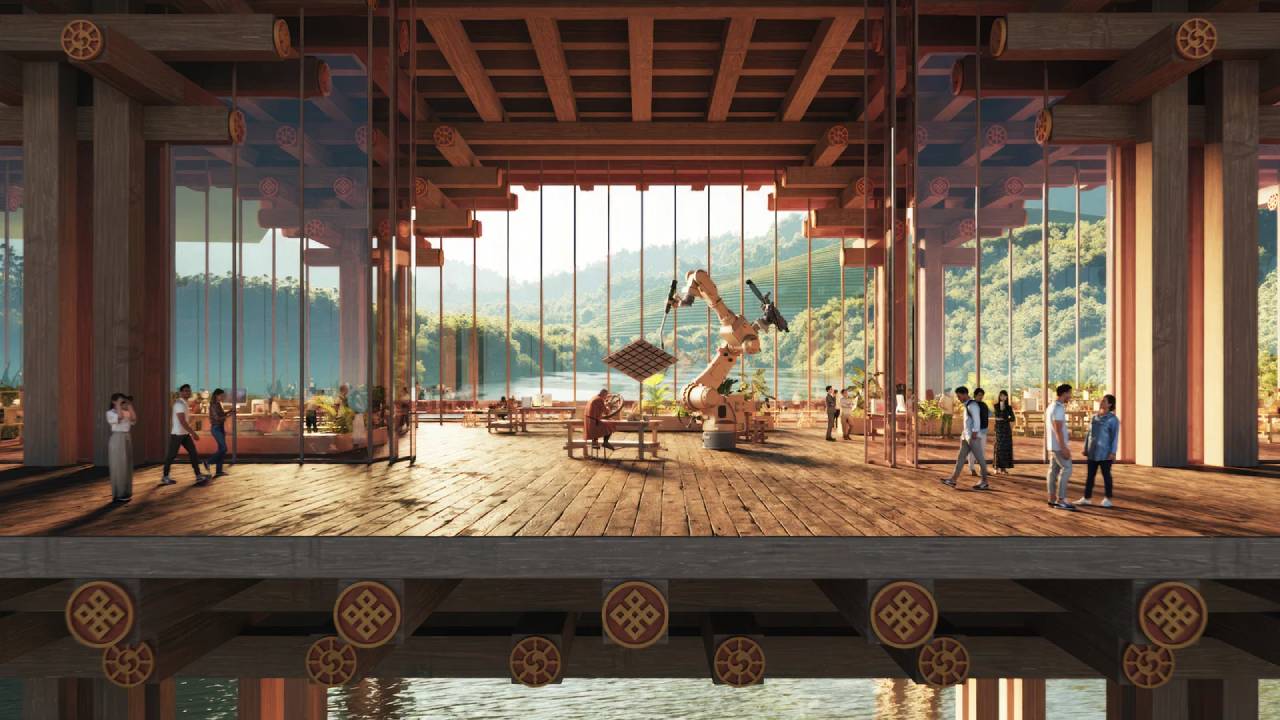
The airport's true purpose is to feed Gelephu Mindfulness City (GMC) - a special administrative region conceived more than a decade ago by King Jigme Khesar Namgyel Wangchuck and accelerated by the pandemic.
GMC is being built as an independent city inside the kingdom, blending business-friendly incentives for international companies with sustainability and Buddhist spirituality as non-negotiables. The long-range vision: a city that could host one million Bhutanese and foreign residents by 2060.
Its Governor is Dr Lotay Tshering, the physician-statesman who served as Bhutan's prime minister through the pandemic. Regional tourism director Tshering Dolkar has positioned Gelephu as a stopover destination - the strategic idea being that, instead of routing through Bangkok or Hong Kong, future travellers fly through Gelephu and stay for a few nights of jungle safari or silent retreat.
Buddhist masters have already been invited to submit proposals for retreat centres and temples inside GMC. The country's Central Monastic Body has tabled a plan for a dzong - the traditional monastic-administrative fortress typology - with guest accommodation and spaces for sacred dance and study.
For affluent global readers exploring alternate residencies, second-home portfolios and family-office relocations, the appetite here is straightforward. Few jurisdictions on earth combine a constitutional monarchy with a globally respected sovereign, carbon-negative national status, a Buddhist cultural and regulatory framework, direct proximity to India, a BIG-designed airport, and land-use planning governed by mindfulness principles. For a sense of how India's own luxury real estate landscape is evolving for those in adjacent markets, our guide for investors on India's rising luxury real estate market is essential reading.
The New Geography of Bhutanese Luxury
| Region | Western Circuit (Paro-Thimphu-Punakha-Phobjikha-Bumthang) | Southern Circuit (Gelephu and Royal Manas) |
|---|---|---|
| Altitude | 1,200-3,800 m | 200-1,500 m, subtropical |
| Flagship experiences | Tiger's Nest, dzongs, alpine treks, prayer flags | Big-cat safaris, rafting, fly fishing, hot springs, retreats |
| Hospitality format | Five-star lodges (Aman, Six Senses, COMO, Gangtey Lodge) | Eco-camps, homestays, Manas River Lodge fly-fishing camp (opened 2024) |
| Climate | Temperate alpine | Lush, fragrant, subtropical |
| Headline wildlife | Black-necked cranes, takin | Bengal tigers, one-horned rhinos, Asian elephants, golden langurs, white-bellied heron |
| Cuisine signature | Ema datshi, red rice | Lhotshampa thali and dal traditions, ema datshi |
| Best fit for | First-time visitors, monastery-and-dzong itineraries | Wildlife purists, wellness retreatants, regenerative-travel seekers |
The southern fringes are flanked by two national parks, including Royal Manas - the country's first - home to elephants, tigers, rhinos, clouded leopards, golden langurs and more than 360 bird species. Roughly half the global population of the critically endangered white-bellied heron lives within Bhutan's borders.
This is also the part of Bhutan that history left wild on purpose. Malaria, monsoons, elephants and tigers concentrated Bhutanese settlement in the middle valleys for centuries. When the British attempted to push into the area in the 1860s, they were repelled in the five-month Duar War. The south stayed feral.
For a global luxury traveller increasingly bored of curated Africa, Bhutan's south arrives at a near-perfect moment. It is one of the few "raw jungle" frontiers left, and it is being opened with a wellness-and-sustainability frame rather than a colonial-safari one. Brands already pioneering this regenerative ethos include those covered in our report on Raffles Udaipur's benchmark-setting eco-luxury approach - an instructive template for what Bhutan's south could become.
The Lotus-Born Trail: Slow Luxury, Reimagined
The flagship hiking product attached to the new airport is the Lotus-Born Trail - a 168 km, eight-day route opening in 2028 that links Gelephu's lowland jungles to the spiritual highlands of central Bhutan.
Trail Snapshot
- Length: 168 km
- Duration: 8 days
- Vertical gain: roughly 3,500 m
- Start: subtropical jungle, golden-langur and one-horned rhino territory
- Finish: alpine ridgelines via rhododendron forests
- Cultural overlay: traces the route of Guru Rinpoche, who brought Buddhism to Bhutan
For brands in soft-luggage, technical apparel, premium hiking footwear, hydration tech, satellite communications and mindful wellness, this trail will become one of the most-walked, most-photographed luxury slow-travel routes in Asia within 18 months of opening. There are precedents - the Camino, Kumano Kodo, Bhutan's own Trans-Bhutan Trail - but none combine architecture-prize airport, special administrative city and royal patronage in a single ecosystem. For a sense of how other world-class trails are being positioned as luxury experiences, our coverage of why New Zealand's Alps to Ocean Trail is a rare luxury adventure draws instructive parallels.
What Else the South Will Offer
- White-water rafting on Bhutan's longest river network (with operators including Paddle Bhutan)
- A newly opened tiger trail inside Royal Manas National Park
- High-end fly fishing at Manas River Lodge - Bhutan's first such property, opened 2024
- Eco-lodges and hot-spring retreats with deep Bhutanese provenance
- A revitalised Old Town in Gelephu, with Lhotshampa thali kitchens, an art-filled streetscape painted by the VAST collective, and a Heritage Village showcasing the country's 13 zorig chusum traditional crafts (basket weaving, thangka painting and more)
Why Brands and Investors Are Watching
Three structural shifts make Bhutan one of the most strategically interesting luxury markets of the late 2020s.
First, aviation capacity unlocks. Today's single Paro runway, with its eight daily flights and pilot scarcity, has been the single biggest brake on Bhutanese tourism's growth. A 123-flight-a-day airport in Gelephu effectively decouples the country from that constraint while preserving the Sustainable Development Fee as a quality filter.
Second, India-Bhutan integration. A 69 km railway from Gelephu to Assam, designated a special railway project by the Indian government, will create the country's first-ever rail link and give Bhutan a soft southern overland gateway from one of the world's largest tourism source markets. For Indian HNW travellers - already a substantial share of Bhutan's visitor mix - this is transformative. Our guide to 7 key trends shaping the evolving Indian luxury buyer reveals just how adventurous and experiential-minded this demographic has become.
Third, a new asset class. GMC is, in effect, a sovereign-backed mindfulness city. For private capital looking for ESG-aligned destination assets, hospitality, wellness, education and technology plays under a Buddhist regulatory framework, GMC is a category of one.
Key Numbers at a Glance
| Data Point | Value |
|---|---|
| Year Bhutan first opened to tourism | 1974 |
| Sustainable Development Fee | US$100 per adult, per night |
| Paro Airport altitude | 2,243 m |
| Surrounding peaks | Up to 5,500 m |
| Daily flights at Paro | About 8 |
| Visitors recorded in 2025 | 88,546 |
| New airport opening year | 2029 |
| New airport designed by | Bjarke Ingels Group (BIG) |
| Planned capacity, Gelephu International | 123 flights / day |
| 2025 World Architecture Festival recognition | Future Project of the Year |
| GMC long-range residency target | 1,000,000 by 2060 |
| Lotus-Born Trail length | 168 km |
| Lotus-Born Trail opening | 2028 |
| Bhutan-India railway | 69 km Gelephu-Assam line |
| Royal Manas National Park bird species | 360+ |
| Share of global white-bellied heron population in Bhutan | Roughly 50% |
| Traditional Bhutanese craft disciplines (zorig chusum) | 13 |
The Verdict for the Discerning Traveller
Bhutan's calculation has always been counter-intuitive: build scarcity, charge for it, and use the proceeds to protect what makes the place valuable in the first place. The remarkable thing about Gelephu is that it doubles down on this logic rather than abandoning it. There will be more flights, but the SDF stays. There will be more access, but the design grammar - timber, mindfulness, dzong typology - remains unmistakably Bhutanese. There will be a city, but it is being incubated as an independent administrative region with sustainability and spirituality written into its operating system.
For affluent travellers, the next five years are the window. A pre-2029 visit to Gelephu will carry the rare prestige of having seen the south before the airport opened. Post-2029 itineraries will be the new global benchmark for mindful luxury travel. For those already thinking about what 2025 luxury travel trends look like according to insiders, Bhutan's arc maps directly onto the deeper shift toward meaning, slowness, and sovereignty of experience.
For brands, the calculus is sharper still. There has not been a country-scale luxury rebuild this thoughtful since Aman first co-authored modern Bhutan two decades ago. The list of categories with white space inside GMC is long: regenerative hospitality, architectural masterplanning, wellness IP, slow-fashion craft revival, sustainable aviation, premium F&B with Lhotshampa and Drukpa heritage, fine jewellery using Himalayan provenance, conservation finance. The Atmosphere Core group's expansion into Himalayan heights with Atmosphere Kufri signals that serious hospitality operators are already reading the same map.
For Indian and global investors, GMC is the rarest of things - a sovereign-backed planned city built around mindfulness, in one of the most stable, lowest-corruption monarchies in Asia, with a 69 km railway umbilical to India's eastern frontier.
The hermit kingdom is no longer a hermit. It is, however, still firmly in charge of who walks through the gate.
For partnerships, hospitality collaborations, branded retreats, residency intelligence and bespoke Bhutan itineraries built around Gelephu, GMC and the Lotus-Born Trail, write to the LuxuryAbode editorial desk.
Comments
No comments yet.
Add Your Comment
Thank you, for commenting !!
Your comment is under moderation...
Keep reading luxury post