AstaGuru's Iconic Masters Auction Brings Together Landmark Works by Raza, Husain and India's Modern Masters
 Suhas Kataria
- 10th Aug 2026
- 1360
- 0
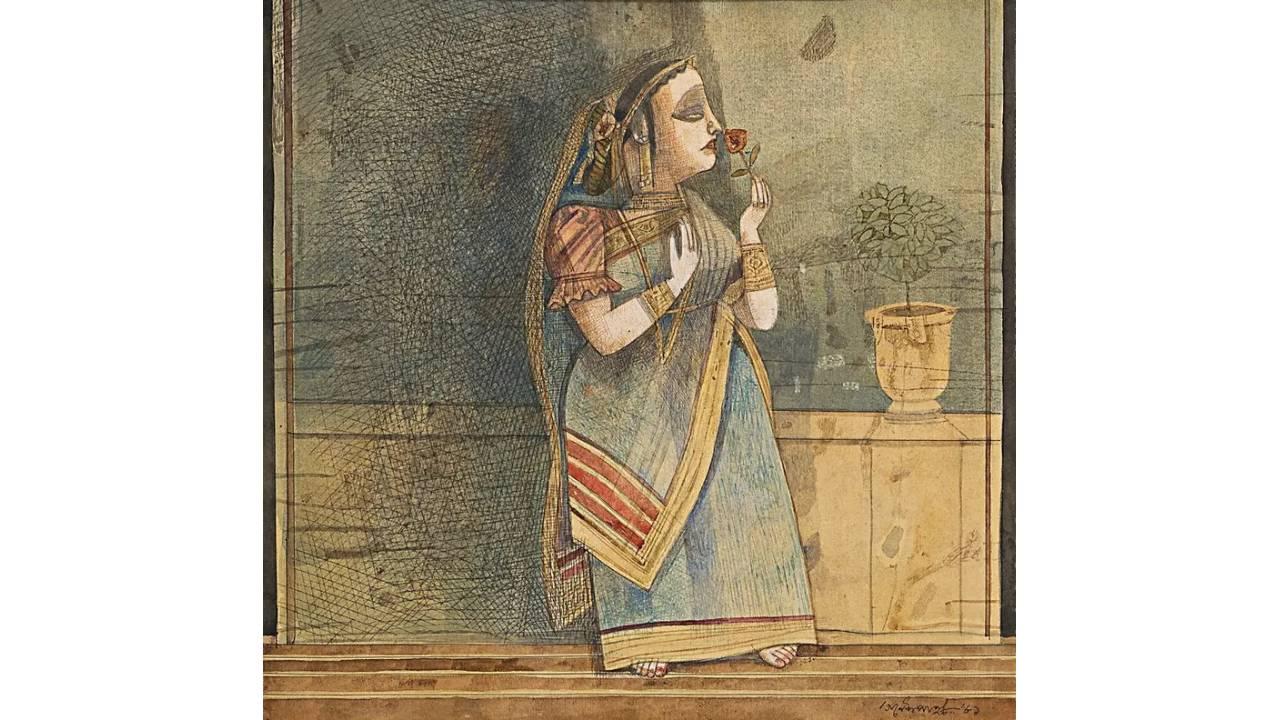
There are auctions that assemble important names, and there are those that reveal how an artistic movement evolved. AstaGuru's forthcoming Iconic Masters sale belongs firmly to the latter category, continuing a run of catalogues through which the house has repeatedly explored the metamorphosis of Indian art across modern and contemporary auctions.
Taking place online on 11 and 12 August 2026, the auction brings together significant works by S H Raza, M F Husain, Ram Kumar, Hemendranath Mazumdar, Krishen Khanna, Arpita Singh, J Swaminathan, Sakti Burman and Satish Gujral, among others. Collectively, the catalogue charts more than a century of Indian artistic production through abstraction, figuration, landscape, mythology and intensely personal narrative.
For collectors, however, the importance lies not simply in the roster of artists. Several works capture pivotal periods, recurring motifs and less frequently encountered aspects of practices that helped define modern Indian art.
Which Are the Most Important Works in AstaGuru's Iconic Masters Auction?
At the centre of the sale is S H Raza's Jala Bindu from 1990, alongside a monumental circa-1970 diptych and significant horse and Our Planet Called Earth works by M F Husain, artists whose works have anchored AstaGuru sales before, including its own Collectors Choice auction of exceptional Indian modernist works.
Arpita Singh's 1999 Untitled canvas provides an important counterpoint through its intimate exploration of memory and domesticity, while Hemendranath Mazumdar's Shadow presents collectors with the considerably rarer prospect of encountering an early watercolour by an artist better known for his oils.
Together, these works make the auction less a survey of famous names than a study of how some of India's most consequential artists developed distinctive visual languages.
S H Raza's Jala Bindu: When Geometry Became Philosophy

Leading the auction is Lot 35, S H Raza's Jala Bindu, painted in 1990 during the artist's celebrated Bindu period.
The Bindu represents one of the defining developments in post-Independence Indian modernism. By this stage in his career, Raza had moved decisively beyond the landscapes and expressionistic works of his earlier decades, arriving at a visual language that brought European abstraction into dialogue with Indian philosophy.
In Jala Bindu, geometry is not simply compositional. The central bindu functions as a source of energy, creation and cosmic order, around which colour and geometric forms achieve a carefully calibrated equilibrium. Raza transformed the fundamental vocabulary of abstraction, circles, squares, triangles and colour, into an exploration of metaphysical ideas. It was the culmination of an artistic and spiritual enquiry that had occupied him for decades.
Works from this mature Bindu period have consequently become central to an understanding of Raza's legacy and remain among the most closely followed parts of his oeuvre among serious collectors.
M F Husain at Monumental Scale
If Raza supplies the auction's meditative centre, M F Husain provides much of its energy.
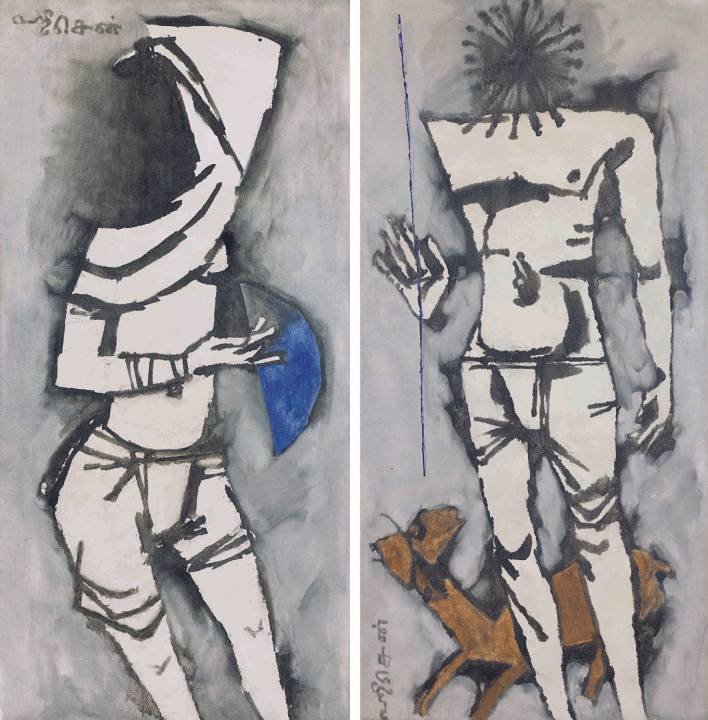
The diptych format is particularly important. Its scale allows Husain to orchestrate several visual episodes simultaneously, demonstrating the narrative ambition that made him one of twentieth century India's defining artists. Works of this scale and format are less frequently encountered at auction, giving the painting particular significance within the sale.
Why Did the Horse Become One of Husain's Greatest Motifs?
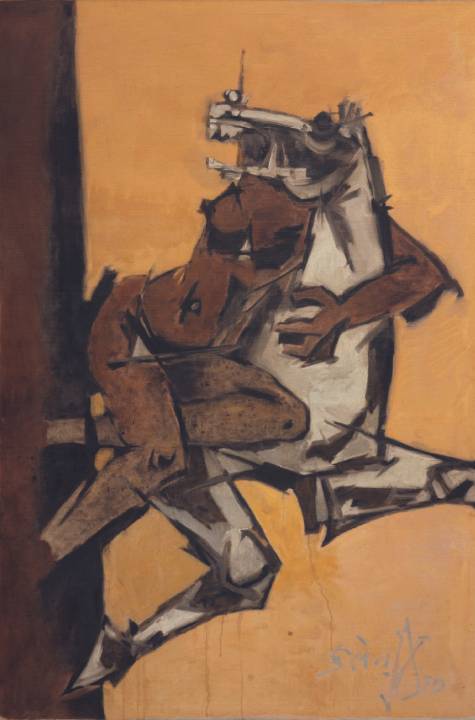
For Husain, the horse was never simply an animal study. Across decades of his practice, it became a remarkably adaptable vessel for movement, vitality, freedom and elemental force. The Untitled work offered by AstaGuru demonstrates precisely why the motif became so powerful. Sweeping brushwork gives the composition its immediacy, while the economy of Husain's line turns movement itself into part of the subject. Few motifs in modern Indian art are as immediately associated with a single artist as Husain's horses.
Husain Looks Beyond India in Our Planet Called Earth
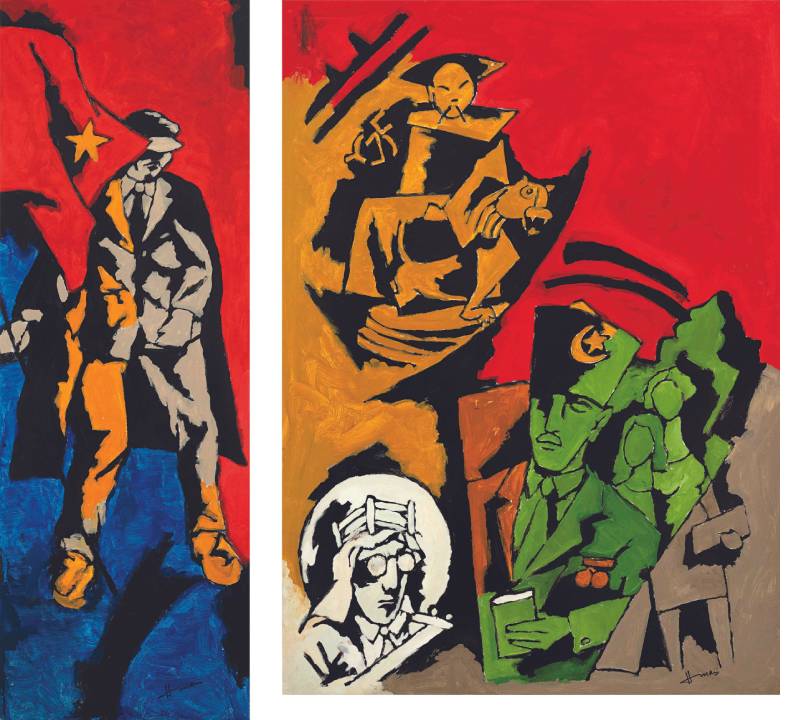
Another particularly significant Husain offering comes with Lot 44, OPCE 5 and OPCE 8, presented as a rare paired work from his Our Planet Called Earth series.
Here, Husain's concerns move beyond individual figures or national narratives towards something more expansive. The series confronted the political, environmental and cultural realities of a rapidly changing planet, using history, symbolism and contemporary events to consider humanity's collective trajectory. The works also carry notable exhibition history, having been shown internationally in Paris and Dubai.
For collectors interested in Husain beyond his most commercially recognisable motifs, the pair illuminates the intellectual breadth of his later practice and his sustained engagement with events beyond India's borders.
Arpita Singh and the Intimate Geography of Memory
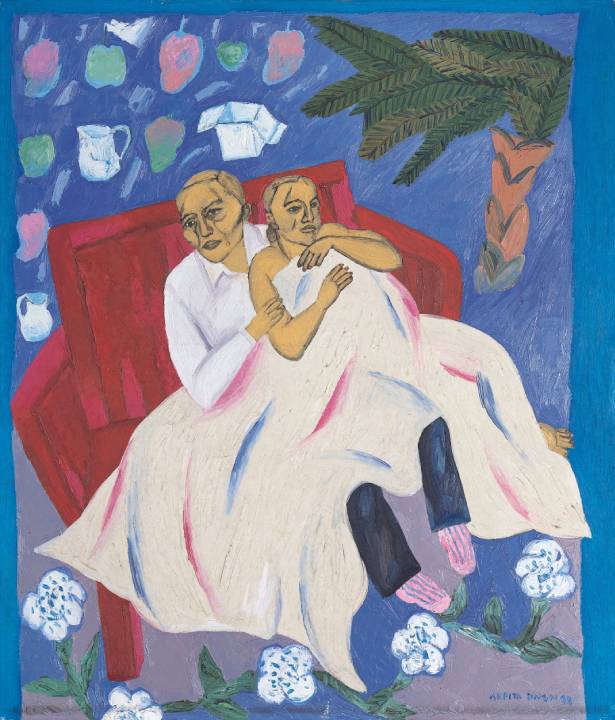
Lot 49, an Untitled canvas painted by Arpita Singh in 1999, shifts the register once again.
Singh's work inhabits a psychological territory where domesticity, memory, intimacy and the external world overlap. Her compositions can initially appear personal and almost playful, yet their layered imagery frequently carries far more complex emotional and social undertones.
The 1999 painting belongs to her mature period and displays the richly coloured, densely layered visual vocabulary for which her work has become recognised. Its presence also broadens the auction's narrative of Indian modernism beyond the monumental gestures commonly associated with its most famous male protagonists, towards the intimate and psychological terrain that Singh made distinctly her own.
A Rare Hemendranath Mazumdar Watercolour Emerges
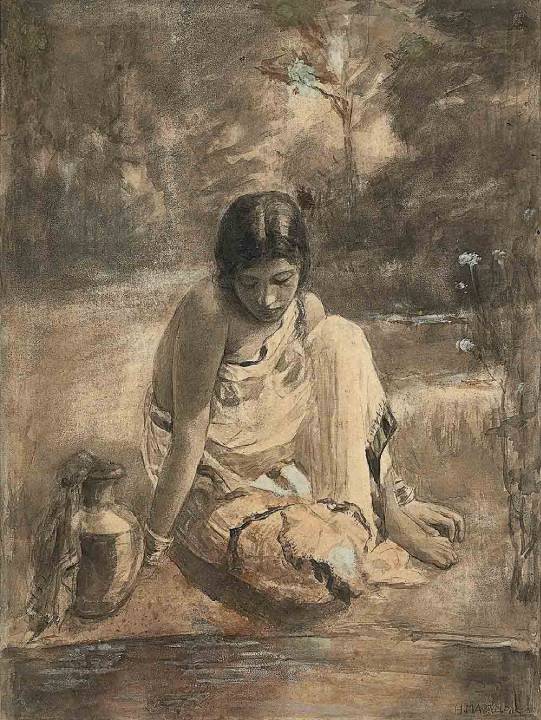
Among the quieter discoveries in the catalogue is Lot 8, Hemendranath Mazumdar's Shadow.
Mazumdar is particularly associated with his accomplished oil paintings, making an early watercolour such as Shadow an unusual proposition. Its significance is strengthened by its documented history. The work has been published in period and contemporary scholarship and has remained within the family by descent.
Rather than displaying the more familiar side of Mazumdar's practice, Shadow reveals a restrained, introspective quality and provides an opportunity to examine an artist through a medium less commonly associated with his market. For established collections, such deviations from an artist's best known body of work can often be precisely what makes an acquisition compelling, a rarity dynamic AstaGuru has surfaced before in sales built around rare works by otherwise well known iconic artists.
Krishen Khanna and J Swaminathan Expand the Story
The catalogue extends beyond its principal highlights.
Krishen Khanna's Bandwallas, a triptych, belongs to one of the artist's most recognisable bodies of work. His recurring bandwallas, musicians simultaneously central to public celebration yet frequently peripheral to its social hierarchy, became a powerful vehicle through which Khanna examined ordinary life, labour and human dignity.
A work from J Swaminathan's Bird, Tree and Mountain series presents an entirely different conception of Indian modernism. Swaminathan's symbolic landscapes developed through his engagement with folk, tribal and indigenous traditions, rejecting the idea that modern Indian art needed to derive its intellectual legitimacy exclusively from Western modernism.
Bird, mountain and tree become archetypal forms within a sparse visual cosmology, an approach that remains fundamental to understanding Swaminathan's contribution to Indian art, and one that sits comfortably alongside the breadth AstaGuru assembled in its own Modern Odyssey auction spanning Bawa to Bendre.
The LuxuryAbode Collector's Lens: Four Things That Make an Auction Work Historically Important
For collectors evaluating an established modern master, the artist's name is only the beginning. LuxuryAbode identifies four factors that can distinguish an important work from one that is merely representative, a distinction worth applying whenever a sale's outstanding results are reported after the gavel falls.
| Factor | What It Means | Example in Iconic Masters |
|---|---|---|
| Period | Does the work belong to a pivotal phase in the artist's development? | Jala Bindu, 1990, Raza's mature Bindu period |
| Motif | Does it contain imagery or ideas fundamental to the artist's visual language? | Husain's horse, the diptych's fragmented narrative |
| Rarity | Is the scale, medium, series or configuration difficult to encounter? | Mazumdar's Shadow, an early watercolour by an oil painter |
| Provenance | Does the work carry meaningful ownership, publication or exhibition history? | OPCE 5 and 8, exhibited in Paris and Dubai; Shadow, documented family descent |
| Contrast row: what this determines | A representative work carries the artist's name alone | A historically important work combines two or more of the factors above |
The Collector's Lens holds that a work's historical importance is determined by the intersection of period, motif, rarity and provenance, rather than by authorship alone, and that the strongest acquisitions typically combine several of these qualities at once.
That distinction is particularly relevant to Iconic Masters. Jala Bindu carries period and motif significance, Husain's circa-1970 diptych adds unusual scale and format, the Our Planet Called Earth works possess series and exhibition importance, and Mazumdar's Shadow combines medium rarity with documented provenance. It is this intersection, rather than authorship alone, that makes an auction catalogue genuinely interesting from a collecting perspective, and it is the same lens worth applying whenever the wider business of luxury auction houses is under discussion.
Why the Iconic Masters Auction Matters
Indian modernism cannot be reduced to a single movement or aesthetic.
Raza searched for the metaphysical through abstraction. Husain constructed sweeping visual narratives from mythology, history and contemporary life. Swaminathan questioned inherited definitions of modernism. Khanna found profound human narratives in everyday figures. Arpita Singh created psychological worlds from memory, domestic experience and social observation.
Seen together, their works demonstrate that the strength of modern Indian art lies precisely in its plurality, a plurality global benchmarks reinforce by comparison, whether it is eleven Picasso masterpieces netting over USD 108 million at a single Sotheby's sale or the market discipline that has long defined Christie's own secret to market leadership.
AstaGuru's Iconic Masters auction therefore offers more than an opportunity to acquire established names, continuing a run of significant sales that has previously included the house's own Historic Masterpieces auction of iconic Indian creations. At its strongest, the catalogue presents individual works as evidence of the ideas, transitions and experiments through which the canon of modern Indian art was formed.
For collectors increasingly looking beyond signature alone towards rarity, provenance, period and art historical significance, that distinction matters.
Iconic Masters Auction: At a Glance
- Auction: Iconic Masters
- Auction House: AstaGuru
- Dates: 11-12 August 2026
- Format: Online auction
- Key Artists: S H Raza, M F Husain, Arpita Singh, Hemendranath Mazumdar, Krishen Khanna, J Swaminathan, Ram Kumar, Sakti Burman and Satish Gujral
- Key Works: Jala Bindu (1990), M F Husain's circa-1970 Untitled diptych, OPCE 5 and OPCE 8, Arpita Singh's 1999 Untitled and Hemendranath Mazumdar's Shadow
Frequently Asked Questions
When is AstaGuru's Iconic Masters auction?
AstaGuru's Iconic Masters auction will be conducted online on 11 and 12 August 2026.
Which artists feature in the Iconic Masters auction?
The sale includes works by S H Raza, M F Husain, Ram Kumar, Arpita Singh, Hemendranath Mazumdar, Krishen Khanna, J Swaminathan, Sakti Burman and Satish Gujral, among others.
What is the leading work in the auction?
One of the principal highlights is S H Raza's Jala Bindu from 1990, an important example from the artist's mature Bindu period.
Which M F Husain works are being auctioned?
Major Husain works include a monumental circa-1970 Untitled diptych, an Untitled composition centred on his celebrated horse motif, and OPCE 5 and OPCE 8 from the Our Planet Called Earth series.
Why is Hemendranath Mazumdar's Shadow significant?
Shadow is an early watercolour rather than one of the oil paintings for which Mazumdar is best known. Its rarity is complemented by documented publication history and family provenance.
This article discusses artworks offered at auction for informational purposes only and does not constitute investment or valuation advice. Details of lots, provenance and exhibition history are drawn from AstaGuru's own auction materials as reported and have not been independently re-verified. Prospective bidders should consult AstaGuru directly and undertake independent due diligence before bidding.

Comments
No comments yet.
Add Your Comment
Thank you, for commenting !!
Your comment is under moderation...
Keep reading luxury post