Argentina's Solar Train Through the Quebrada de Humahuaca: What It Actually Costs, How It Really Works, and Whether It Deserves the Hype
 Namrata Parab
- 16th Jul 2026
- 1512
- 0
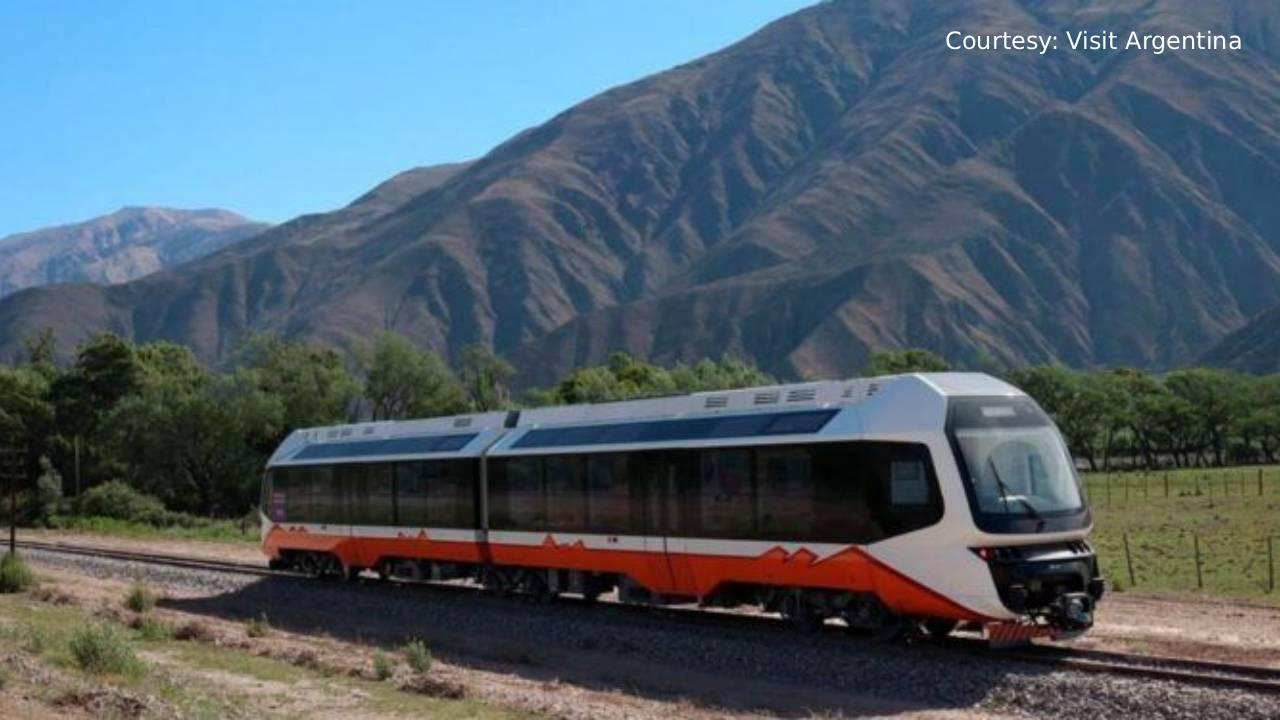
There are precisely two solar-powered passenger trains operating anywhere on the planet. The first, in Byron Bay, Australia, runs three kilometres along a coastal strip: a converted 1949 railcar covering a distance most people could walk in 35 minutes. The second, which entered service in June 2024 in northwest Argentina's Jujuy Province, covers 42 kilometres through a 10,000-year-old UNESCO World Heritage gorge at 2,000 metres above sea level, connecting six Andean villages on batteries recharged by the Atacama sun.
The Tren Solar de la Quebrada de Humahuaca is, in terms of ambition and operational scale, the only solar train on earth that functions as a genuine travel experience rather than a novelty shuttle. It is also, as of mid-2026, still working through significant growing pains: oversold tickets, weather-related service interruptions, and a route that covers barely a seventh of the 300-kilometre network originally promised. Whether it is worth a detour from Buenos Aires, Salta, or a wider South American itinerary depends on what you expect from it and how you structure the trip around it.
This is what the tourism marketing does not tell you.
The Hardware: Chinese Engineering at Andean Altitude
The trains were manufactured by CRRC Tangshan, China's largest rolling stock producer, under a contract signed with the Government of Jujuy Province in May 2022. Two six-axle articulated railcars were delivered, the first Chinese new-energy light rail vehicles exported to any foreign country's transport network.
Each two-car unit runs on lithium iron phosphate batteries with a combined capacity of 352 kilowatt-hours, recharged at a dedicated solar photovoltaic facility at one of the stations. The batteries can be fully recharged in approximately 25 minutes, providing a theoretical range of 100 to 120 kilometres, more than enough for the current 42-kilometre route and back. Maximum operating speed is 60 km/h, though the service typically runs between 30 and 50 km/h to allow sightseeing. Each train seats 70 passengers, with a theoretical standing capacity that can push the number to 140. The carriages feature panoramic glazing on both sides and the roof, facial recognition access systems, interactive information terminals, and an exterior livery designed to echo the geological palette of the Quebrada itself.
| Specification | Detail |
|---|---|
| Manufacturer | CRRC Tangshan, China |
| Contract signed | May 2022, Government of Jujuy Province |
| Battery type and capacity | Lithium iron phosphate, 352 kWh per two-car unit |
| Recharge time | Approximately 25 minutes |
| Theoretical range | 100 to 120 kilometres |
| Maximum speed | 60 km/h, typically operated at 30 to 50 km/h |
| Seated capacity | 70 passengers per trainset, up to 140 with standing |
| Route length | 42 kilometres, Volcan to Tilcara |
| Entered service | June 2024 |
The track uses the historic metre-gauge Ramal C of the General Belgrano Railway, originally built between 1891 and 1908 to connect Buenos Aires with La Quiaca on the Bolivian border. Passenger services on this line ceased in March 1993 during the Menem-era privatisations. The track sat abandoned for nearly three decades before Jujuy Province received a 30-year concession in 2017 and began rehabilitation, initially with rails and sleepers donated by Trenes Argentinos Infraestructura.
The total project cost for the current phase was estimated at ARS 1.3 billion (at 2021 values) plus the CRRC rolling stock contract, which media reports placed at approximately US$17 million inclusive of the two trainsets and station infrastructure. The battery-and-solar architecture places it in the same technological lineage as solar powered yachts moving towards the mainstream, where stored photovoltaic energy has quietly become viable for serious passenger use rather than demonstration projects.
The Route: Six Villages, 42 Kilometres, One Day
The train operates between Volcan (elevation 2,084m) and Tilcara (2,461m), with intermediate stops at Tumbaya, Purmamarca, Maimara, and La Posta de Hornillos. The entire Quebrada de Humahuaca, a 155-kilometre-long valley carved by the Rio Grande through the High Andes, was designated a UNESCO World Heritage Site in 2003, recognised as a cultural itinerary spanning more than 10,000 years and forming part of the Qhapaq Nan, the ancient Inca road network. Travellers who plan itineraries around protected sites, from the Quebrada to a luxury hotel built within a UNESCO World Heritage Site, will find the designation is doing real work here rather than serving as a marketing badge.
Four services run daily between 08:00 and 20:00. A single ticket is valid for multiple rides throughout the day, effectively a hop-on, hop-off pass. The non-stop journey between the two termini takes approximately two hours. The intended experience, though, is to disembark at each village, explore, and catch a later train onward.
Volcan (km 0)
The departure point. A large old railway station converted into an artisans' centre. The town itself is functional rather than charming: a cement factory dominates the skyline. This is where you park if self-driving, and where bus transfers from Salta and San Salvador de Jujuy arrive.
Tumbaya (km 8)
The smallest and quietest stop. Themed around religiosity and indigenous community life. The station has a cafe. Most visitors pass through quickly unless visiting during Easter week, when pilgrims process to the Virgin of Punta Corral.
Purmamarca (km 17)
The marquee stop. The Cerro de los Siete Colores, the Hill of Seven Colours, is here, along with Purmamarca's handicraft market and colonial plaza. One critical operational detail the brochures understate: the station is approximately three kilometres from the town centre. You will need a taxi or a 35-minute walk.
Maimara (km 27)
Known for the Paleta del Pintor (Painter's Palette), a hillside of geological striations in ochre, green, copper, and violet. Maimara is also an emerging micro wine region and tastings are available, a proposition familiar to anyone who has followed why vineyard tourism has become an elite travel obsession in India and elsewhere.
La Posta de Hornillos (km 33)
A colonial-era staging post on the historic route between Buenos Aires and Upper Peru.
Tilcara (km 42)
The most developed tourist town in the Quebrada. Home to the Pucara de Tilcara, a pre-Columbian fortress and one of the most important archaeological sites in northwest Argentina. Also the location of the Garganta del Diablo (Devil's Throat) waterfall, though reaching it requires a taxi from the station.
What It Actually Costs
Pricing operates on a tiered system that distinguishes sharply between foreign visitors and Argentine residents.
| Ticket category | Price |
|---|---|
| Foreign visitors (standard ticket) | USD 45 |
| Argentine residents | ARS 33,000 |
| Residents of Jujuy Province | ARS 15,000 |
| Argentine children (under 12) | ARS 25,000 |
| Argentine retirees (with ID) | ARS 20,000 |
| Children under 1 | Free (no seat) |
For international visitors, USD 45 buys an all-day hop-on, hop-off pass across the entire route. This is not expensive by any standard: the Belmond Hiram Bingham to Machu Picchu costs upward of USD 500 one-way, Switzerland's Glacier Express starts at CHF 157 for second class, and even India's Vistadome on the Araku Valley route runs to INR 2,500-plus for a shorter ride through less dramatic scenery. Measured against the genuinely rarefied end of the category, where a journey on the La Dolce Vita Orient Express through Italy is priced as a hotel rather than a ticket, the Tren Solar is close to a rounding error.
Packaged experiences cost more. The 360-degree Experience (full route with transfers from Salta or San Salvador de Jujuy and local guides at each stop) is sold through authorised agents like Dexotic at approximately USD 75 to 90 depending on departure city. The 180-degree Experience (shorter round-trip from Purmamarca) is a budget alternative for those short on time.
What is not included in any ticket: food (only a 500ml water bottle is permitted onboard), luggage beyond 3 kg in a bag no larger than 45 x 35 x 25 cm, and any local transport between stations and town centres.
The New Experiences: Wine Train and Night Sky
Two developments in 2026 have substantially changed what the solar train offers.
Tren del Vino launches on July 26, 2026: a dedicated wine tourism experience combining the train journey with guided tastings and bodega visits along the emerging Jujuy wine route. The timing is deliberate. The Ruta del Vino Jujuy was named best wine route at the WineXplorers Awards 2026 and received three additional distinctions, putting Jujuy's high-altitude vineyards (above 2,000m) on the global wine tourism map alongside the far better known Mendoza and Salta appellations. Maimara is the focal point, where small-scale producers are cultivating Malbec, Torrontes, and Tannat at altitudes that fundamentally alter tannin structure and aromatic intensity. The formula of rail plus terroir is one that established regions have long monetised, much as the glorious wine tours near Auckland did for New Zealand's north.
Cielo en Movimiento (Sky in Motion) runs between June and September 2026: a night-time experience built around astronomical observation. At 2,000 to 2,400 metres in a semi-arid valley with minimal light pollution, the Quebrada offers some of the clearest skies in the southern hemisphere. The experience includes an evening train ride, guided stargazing with commentary on Andean astronomical traditions, dinner under the stars, and stories connected to how indigenous Quechua and Aymara communities read the sky as an agricultural and ceremonial calendar. It follows a category that luxury operators identified early, notably the astro-tourism offering that added a new dimension to luxury in Hawaii.
These additions signal a strategic shift. The solar train is moving from a transport curiosity into an experience platform, using the railway as infrastructure for curated events that monetise the region's assets: wine, sky, archaeology, and gastronomy. Argentine cuisine itself travels well, as diners who have encountered the aromas of Argentina brought to a Ritz-Carlton kitchen will already know.
The Honest Assessment: What Works and What Does Not
What works well. The train itself is genuinely impressive: modern, silent, clean, and comfortable, with panoramic glass that does justice to the landscape. The hop-on, hop-off model is intelligent and respects traveller autonomy. The scenery is extraordinary, with geological formations dating back millions of years producing colour gradients you will not see anywhere else on earth. The villages are authentic, not theme-parked for tourists, and Indigenous Quechua culture is alive here, not curated for display.
What does not work well, as of mid-2026. Capacity is a real constraint. With only two trainsets seating 70 each and four daily services, the system handles a maximum of roughly 560 passenger-journeys per day. Tripadvisor and local reviews from 2025 document repeated cases of oversold tickets: travellers who purchased months in advance arriving to find their reservations cancelled or reassigned. One August 2025 incident involved a system migration to a new booking platform that left confirmed passengers without seats. Service disruptions from heavy rain are not uncommon. The Quebrada experiences its wet season from January through March, and extended rainfall can compromise track conditions on certain sections, resulting in bus substitution for part of the route.
The Purmamarca station distance is a genuine inconvenience and poorly communicated. Some stations lack basic facilities. And the strict 3 kg luggage limit with no onboard food or drink beyond water is austere: appropriate for a commuter tram, less so for a six-hour tourism experience.
The LuxuryAbode View: The Capacity Ceiling
The recurring failure of experience-led rail projects in emerging destinations is not engineering. It is arithmetic.
| The Capacity Ceiling | Reading |
|---|---|
| Hard limit | Two trainsets, 70 seats each, four services: roughly 560 passenger-journeys per day |
| Stated ambition | 230,000 annual users projected by the Jujuy government |
| Implied requirement | Approximately 630 journeys per day, every day of the year |
| Consequence | Demand is managed by overselling and cancellation rather than by supply |
| Fix | Rolling stock, not marketing. More trainsets or more services, or the projection stays theoretical |
The Capacity Ceiling: when an experience is celebrated faster than its fleet can grow, the constraint stops being technical and becomes reputational. Every oversold ticket is a permanent reader lost, and no volume of awards, wine trains or stargazing dinners repairs the arithmetic underneath.
The Bigger Picture: A 300-Kilometre Railway That May Never Come
The current 42-kilometre route is Phase 1 of a three-stage plan to reactivate the entire 300-kilometre San Salvador de Jujuy-to-La Quiaca railway. Phase 2 would extend the line from Tilcara to Humahuaca. Phase 3 would push it to La Quiaca on the Bolivian border, reconnecting Argentina's rail network with Bolivia's for the first time since 1993. In the most ambitious version, this would form part of a transnational heritage corridor linking Argentina, Chile, and Bolivia along the ancient Qhapaq Nan route.
The Latin America Development Bank (CAF) approved a US$75 million loan for the project. The Jujuy government projected 230,000 annual users, 600 direct and indirect jobs, ticket revenues of approximately US$2.26 million per year, and an additional US$500,000 from selling surplus solar energy to the grid.
None of Phases 2 or 3 have broken ground. The original project scope has been delayed repeatedly since its 2016 announcement. Construction on the current 42-kilometre section alone took six years. Political transitions in Jujuy, where Governor Morales, who championed the project, left office in December 2023, add uncertainty. The CAF loan is contingent on provincial legislative approval, and Jujuy's fiscal capacity to service major infrastructure debt is limited.
Experienced observers of Argentine infrastructure will recognise the pattern. The train that exists today is real and worth experiencing. The train that is promised for tomorrow should be treated as aspirational until construction physically begins. Contrast this with state-backed projects elsewhere, such as the five-star train elevating luxury travel in Saudi Arabia, where sovereign funding removes the financing question entirely.
How to Build a Trip Around It
Getting there
Fly to Salta (Martin Miguel de Guemes International Airport) or San Salvador de Jujuy (Gobernador Horacio Guzman International Airport) from Buenos Aires. Both airports receive multiple daily domestic flights. Volcan, the train's southern terminus, is approximately 90 minutes by road from Jujuy city and about 2.5 hours from Salta. For those arriving privately, the region sits within the same circuit served by operators who fly guests to a luxury lodge in South America on a private jet.
Best season
April through November (the dry season). The Quebrada's colours are at their most intense under clear dry-season skies. Avoid January and February entirely, as heavy rains can close roads and disrupt train service.
Where to stay
The Quebrada's accommodation is charming but not ultra-luxury. El Manantial del Silencio in Purmamarca is the closest thing to a high-end boutique property: a white monastic-style building with 19 rooms, a spa, award-winning restaurant, and views directly onto the Hill of Seven Colours. Las Marias Hotel Boutique in Tilcara and Hotel Huacalera in Huacalera are solid alternatives. None of these properties would satisfy a traveller accustomed to Aman or Belmond standards. This is a destination where the landscape itself is the luxury and the accommodation is comfortable rather than sumptuous. Travellers unwilling to compromise on the room may prefer to anchor the wider trip around the best luxury rentals in Chile and Brazil and treat Jujuy as a two-night excursion.
Booking strategy
Book tickets well in advance through authorised sellers. The Dexotic platform is the primary online booking agent. Do not assume availability on arrival. For the Tren del Vino (launching July 26, 2026) and Cielo en Movimiento experiences, early booking is essential given capacity constraints.
Combine with
The Salinas Grandes (vast salt flats accessible via the Cuesta de Lipan from Purmamarca, about 90 minutes' drive), the Calilegua Cloud Forest national park, and the emerging Jujuy wine route. From Salta, extend to the Calchaqui Valley wine region or connect to the Tren a las Nubes. Overland crossings to the Atacama Desert in Chile (via the Jama Pass) and to southern Bolivia (via La Quiaca to Villazon) are viable for the adventurous. The itinerary fits neatly into the shift toward slower, place-led journeys identified in recent commentary on evolving luxury travel trends.
What It Means
The Quebrada Solar Train is interesting not because it runs on solar power. That is an engineering detail, not a travel experience. It is interesting because it represents a model of infrastructure-led tourism development in which the transport itself becomes the organising principle for a region's economic life. The train connects villages that were dying. It creates a reason for a ceramicist in Tumbaya or a winemaker in Maimara to invest in their craft because there is now a reliable flow of visitors. It uses renewable energy not as a marketing gimmick but because Jujuy has 300 days of sunshine per year and sits adjacent to the Cauchari Solar Park, one of the largest photovoltaic installations in Latin America.
The model is imperfect. The capacity is too small. The booking infrastructure is unreliable. The promised expansion remains hypothetical. But as a proof of concept, that a small, solar-powered railway through a UNESCO gorge can anchor a credible tourism economy in one of Argentina's poorest provinces, the Tren Solar is worth watching, and worth riding.
Frequently Asked Questions
How much does the Argentina solar train cost for foreign tourists?
The standard ticket for non-Argentine visitors is approximately USD 45 as of early 2026, which provides all-day hop-on, hop-off access across the full 42-kilometre route between Volcan and Tilcara. Packaged experiences including transfers from Salta or Jujuy city cost USD 75 to 90 through authorised agents.
Is the solar train in Argentina really powered by solar energy?
The train runs on lithium iron phosphate batteries manufactured by CRRC Tangshan of China, with a capacity of 352 kWh. These batteries are recharged at a solar photovoltaic facility at one of the stations, utilising Jujuy Province's exceptional solar resources (approximately 300 days of sunshine annually). The train does not have solar panels on its roof generating traction power directly. It is battery-electric, with the batteries charged from solar infrastructure.
What is the best time of year to ride the Quebrada de Humahuaca solar train?
April through November, during the dry season. The gorge's geological colours are most vivid under clear skies, and the risk of service disruptions from heavy rain is minimal. The wettest months, January and February, should be avoided entirely.
How long does the solar train journey take in Jujuy?
A non-stop end-to-end journey from Volcan to Tilcara takes approximately two hours. However, the intended experience is to stop at each of the six stations, explore the villages, and continue on a later service. Most travellers spend a full day on the route.
Can I do a wine tour on the Argentina solar train?
Yes. The Tren del Vino launches on July 26, 2026: a dedicated wine tourism experience combining the solar train journey with guided tastings and bodega visits along the emerging Jujuy wine route, which was named best wine route at the WineXplorers Awards 2026.
How does the Argentina solar train compare to the Byron Bay solar train?
The Byron Bay Solar Train in Australia, which launched in December 2017, holds the Guinness World Record as the first solar-powered passenger train. However, it operates on a 3-kilometre coastal route with a 10-minute one-way journey. Argentina's Tren Solar covers 42 kilometres through a UNESCO World Heritage gorge, carries 70 seated passengers per trainset versus Byron Bay's 92, and operates four daily services over a 12-hour window. In terms of scale, route significance, and travel experience, the two are not comparable.
Disclaimer: all fares, project costs, loan values, passenger projections, launch dates and operating details cited in this article are as published or reported at the time of writing and are subject to change without notice. Ticket prices in Argentine pesos are particularly sensitive to currency movement and inflation. Indian travellers should note that outbound tour packages and foreign exchange remittances may attract TCS under the Liberalised Remittance Scheme, and rates vary by transaction type and threshold. Nothing here constitutes travel, tax or investment advice. Readers should confirm fares, schedules, service status and applicable levies with authorised operators and a qualified adviser before booking.


Comments
No comments yet.
Add Your Comment
Thank you, for commenting !!
Your comment is under moderation...
Keep reading luxury post