What Does a Luxury Yacht Charter Really Cost? A Complete Guide Beyond the Weekly Rate
 Pradeep Dhuri
- 9th Sep 2026
- 1162
- 0

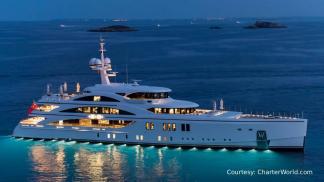
The number on the brochure is never the number on the invoice. A 45-metre motor yacht advertised at €180,000 a week on the French Riviera in August does not cost €180,000 for the week. It costs somewhere between €270,000 and €320,000, once the four line items nobody puts on the homepage are added in. Almost every first-time charterer discovers this at the worst possible moment: after they've already agreed verbally to the base rate.
This isn't an industry secret exactly. It's an industry convention that relies on the buyer not asking the second question. Brokers are not hiding anything, the contract discloses everything, but the discipline of reading a MYBA or CYBA charter agreement line by line before signing is not something most first-time charterers, however wealthy, have had reason to develop. This is the guide that closes that gap: what the base rate actually buys, what gets added on top, and what the true week-long cost looks like once every line item is in, building on the groundwork laid out in this definitive guide to luxury yacht chartering.
The Base Charter Fee: What It Actually Covers
The advertised weekly rate covers exclusive use of the yacht and its crew, full stop. On the French Riviera in 2026, indicative ranges run roughly €65,000-180,000 for a 30-40 metre motor yacht and €160,000-350,000 for a 40-55 metre superyacht, depending on season, yacht age, and whether the week falls around an event like the Monaco Grand Prix or Cannes Film Festival, when port fees alone can add 15-20% on top of everything else below, a coastline whose old-world glamour is also captured in this profile of Hotel Negresco on the French Riviera.
What the base rate does not cover: fuel, food, docking, communications, water toys usage beyond what's onboard, or crew wages beyond their salary (gratuities are separate). That's the entire point of the next section.
APA: The Second Invoice Nobody Mentions First
The Advance Provisioning Allowance is a pre-paid operational fund, paid roughly four weeks before embarkation, that the captain draws down against for fuel, provisioning, port and marina fees, and miscellaneous onboard costs. It is standard practice across the Mediterranean and increasingly the Caribbean, and it is not optional.
The percentage depends on yacht type: sailing yachts and catamarans typically run 20-30% of the base fee, motor yachts 30-40%, sometimes higher on fuel-intensive, fast-planing hulls doing long-distance itineraries. On a €150,000 base week, that's an additional €45,000-60,000 for a motor yacht, transferred upfront, before the boat has left the dock.
The captain maintains itemised records, and any unused balance is refunded at the end of the charter, typically within days. Well-planned itineraries with efficient cruising patterns often return 10-25% of the APA. Ask your broker for a line-item APA estimate before booking, not a single percentage figure. Brokers who can't produce one are a signal worth noting.
VAT: The Line Item That Varies by Coastline, Not by Yacht
Value-added tax applies to charters embarking in EU waters, and the rate depends entirely on where the charter starts, not on the yacht's flag or the guests' nationality. Italy applies 22% (with reduced effective rates of 6.6-8.8% possible for itineraries spending time in international waters), Spain 21%, France 20%, and Greece and Croatia offer reduced effective rates (roughly 5.2-13% for Greece under qualifying conditions, 13% for Croatia) for compliant charters. Turkey and Montenegro, both non-EU, charge 0% VAT, which is a meaningful part of why both have grown as charter bases over the past decade, a shift also explored in this look at Bodrum's rise as a popular ultra-luxury yacht base.
This is the single most consequential line item for anyone comparing quotes across two Mediterranean itineraries: identical yachts, identical weeks, different embarkation ports, and the tax bill alone can differ by 15-20 percentage points of the base fee.
Gratuities: 10% Is the Benchmark, Not the Ceiling
Crew gratuities are customary rather than contractual, calculated on the base charter fee alone, never on APA or VAT. The Mediterranean benchmark is 10% for a satisfactory week, with a 5-15% range depending on service quality; MYBA treats 10% as the fair standard outcome. The Caribbean and Bahamas run higher, typically 15-20%, reflecting a more American tipping convention among that market's charter base. On a 40-metre yacht with a crew of seven, gratuities alone typically run €10,000-20,000 for the week, handed to the captain on the final morning for distribution.
Delivery, Repositioning, and the Costs That Depend on Where You Actually Want to Go
If the yacht isn't already based where you want to start your charter, someone pays to move it there, and that someone is the charterer. Delivery and redelivery fees cover fuel and crew time to relocate the vessel before and after your dates, and they can be substantial for yachts repositioning across ocean basins (Caribbean to Mediterranean for the summer season, for instance). These fees are sometimes quoted separately and sometimes buried inside a slightly higher base rate for popular embarkation points, which is itself worth asking your broker to unbundle, a decision that also shapes how charterers select among the top luxury yachts currently available to charter.
The Worked Example: A 45-Metre Motor Yacht, One Week, French Riviera, August
| Line item | Rate applied | Cost |
|---|---|---|
| Base charter fee | Advertised rate | €180,000 |
| APA (35%, motor yacht) | 35% of base | €63,000 |
| VAT (France, embarkation port) | 20% of base | €36,000 |
| Gratuities (10% benchmark) | 10% of base | €18,000 |
| Total | €297,000 |
The base rate, on its own, understated the real cost by 65%. This is not an unusual result, it is the typical result, and it is the calculation every charter contract enables you to do before signing, provided you ask for the APA percentage and confirm the VAT jurisdiction upfront rather than after the invoice arrives.
The Angle Nobody in the Charter Industry Explains to Indian Charterers
For an Indian resident wiring funds directly to a foreign yacht broker or charter company, the payment falls under the Reserve Bank of India's Liberalised Remittance Scheme, capped at USD 250,000 (roughly ₹2.1-2.2 crore) per person per financial year, cumulative across all outward remittance purposes. On amounts remitted above ₹10 lakh in a financial year, Tax Collected at Source applies, and the rate that applies depends entirely on how the payment is classified.
Booked through a registered Indian tour operator as part of a packaged holiday, a charter may qualify for the concessional 2% TCS rate applicable to overseas tour packages under the 2026 Budget revision. Wired directly to a foreign charter company or broker as a standalone payment, outside a packaged tour structure, it is far more likely to be treated as a general LRS remittance, attracting 20% TCS on the amount above the ₹10 lakh threshold. On a ₹1 crore charter payment, that distinction alone is worth roughly ₹18-19 lakh in upfront tax collection, fully creditable against final tax liability when filing ITR, but a meaningful cash-flow difference in the meantime. This structuring decision, tour package versus direct remittance, is worth raising with a chartered accountant before wiring funds, not after.
The Insight
The yacht charter industry doesn't conceal its true costs, MYBA and CYBA contracts disclose every line item in writing, it simply relies on charterers not doing the arithmetic before they commit emotionally to a yacht and a week. The pattern holds across every category of ultra-luxury spending: the headline number is real, but it is never the number that matters. What separates an experienced charterer from a first-time one isn't budget, it's the habit of asking for the APA percentage, the VAT jurisdiction, and the gratuity expectation in the same conversation as the base rate, before a broker has any reason to volunteer them unprompted.
FAQ
How much does it really cost to charter a yacht for a week, beyond the advertised rate?
Budget for the base rate plus roughly 30-40% APA, 15-22% VAT (if embarking in EU waters), and a 10% gratuity, which typically brings total cost to 55-70% above the advertised weekly figure.
What is APA in yacht chartering and who decides how much it is?
Advance Provisioning Allowance is a pre-paid fund covering fuel, food, and port fees during the charter, set as a percentage of the base fee (20-30% for sailing yachts, 30-40%+ for motor yachts) and managed by the captain, with any unused balance refunded after the trip.
Do I have to pay VAT on a yacht charter in the Mediterranean?
Yes, if the charter embarks in EU waters; the rate depends on the country of embarkation, ranging from roughly 13% in Croatia to 20-22% in France and Italy, while Turkey and Montenegro charge 0% as non-EU jurisdictions.
How much should I tip yacht charter crew?
The Mediterranean benchmark is 10% of the base charter fee for satisfactory service, calculated on the base fee alone (not APA or VAT), rising to 15% or more for exceptional service; Caribbean charters typically run higher, at 15-20%.
Does TCS apply if I pay for a yacht charter directly from India?
Yes, on amounts above ₹10 lakh remitted under the Liberalised Remittance Scheme in a financial year, TCS applies at 20% for a direct remittance to a foreign charter company, or potentially 2% if structured through a registered tour operator as part of a packaged holiday; the classification materially changes the upfront tax outlay.
Are there yacht charter costs beyond APA, VAT, and gratuities I should budget for?
Yes: delivery and redelivery fees if the yacht must reposition to your embarkation point, event-period port fee surcharges (Monaco Grand Prix, Cannes Film Festival can add 15-20%), and personal extras like restaurants, tours, and event tickets ashore, none of which are covered by the APA.

Comments
No comments yet.
Add Your Comment
Thank you, for commenting !!
Your comment is under moderation...
Keep reading luxury post