- Blog
- Food and Wine
- Italy
Veuve Clicquot's Chasing the Sun: Why a 248-Year-Old Champagne House Spent Milan Design Week 2026 on a Knitted Cooler
 Pradeep Dhuri
- 14th Jun 2026
- 1483
- 0
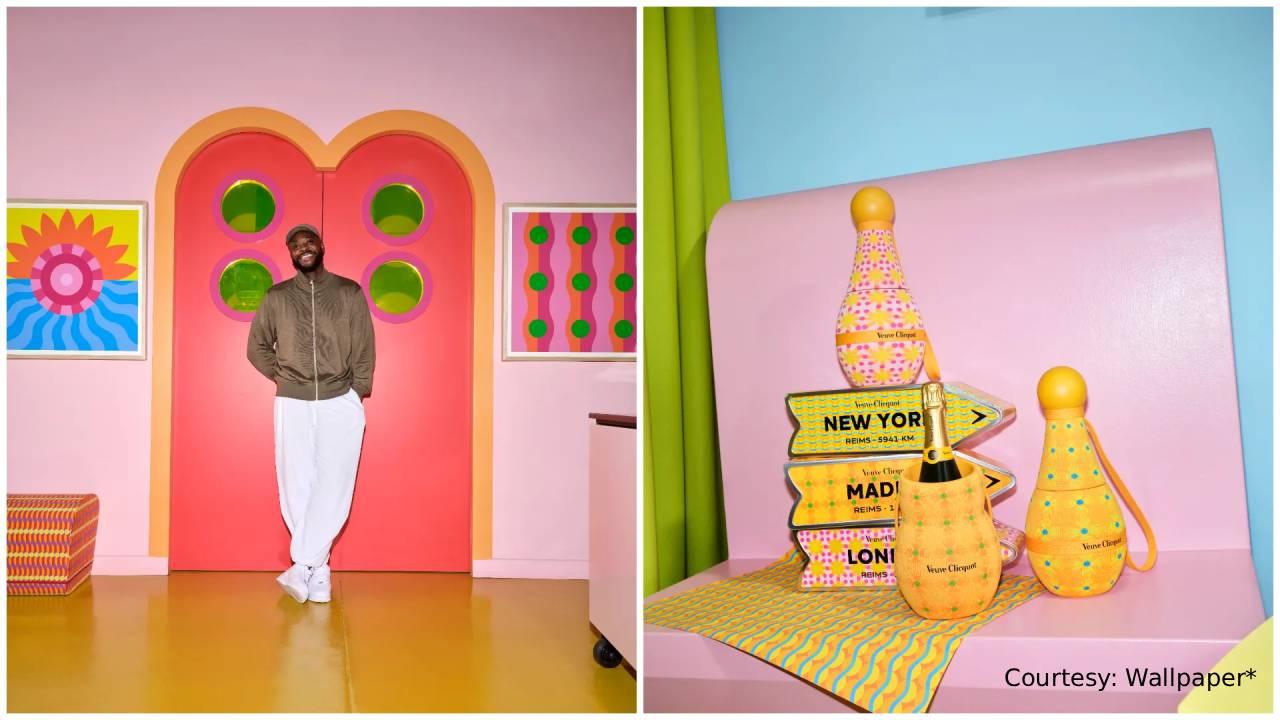
For one week in April, the most photographed object in Milan's Brera district was not a chair, a lamp, or a concept car. It was a yellow knitted bag shaped like a West African gourd, designed to keep a bottle of champagne cold for ninety minutes.
This is worth pausing on. From 21 to 26 April 2026, Veuve Clicquot occupied the Mediateca Santa Teresa at Via della Moscova 28 with "Chasing the Sun," an installation and limited-edition collection made with British-Nigerian artist and designer Yinka Ilori. The mainstream design press covered it as what it appeared to be: a joyful, sun-coloured activation by a likeable artist. That coverage is accurate and almost entirely beside the point.
What actually happened in Milan is a piece of brand engineering that the wealthy should understand, because it is aimed squarely at how they gift, what they keep, and what they are willing to pay a premium for — a textbook demonstration of what truly defines a luxury brand. A champagne house with nothing left to prove spent a Salone-week budget not on the wine, but on the packaging — and on turning that packaging into an object you are not supposed to throw away. This is the gift economy operating at its most deliberate, and it is more interesting than the press releases suggest.
What Chasing the Sun Actually Is
Strip the language back. Ilori, a British-Nigerian designer sometimes called the "architect of joy," built a colourful installation inside a former baroque church, centred on a mono-colour seating area topped with a sun-like globe. Alongside it sat a café and a boutique. The Clicquot Café poured Yellow Label and Rosé against an all-day menu; the boutique sold the collection for the full week. For anyone wanting to place the cuvées in context, our comprehensive guide to champagne and sparkling wines is a useful primer.
The collection itself reinterprets three of the house's existing gifting formats. The Sun Holder is a reworking of the champagne bucket, shaped like a gourd and decorated with a hands-holding-the-sun motif, made from recycled materials using 3D knitting technology. The Sun Totems reinterpret the gourd as a portable drinking-and-cooling vessel, also 3D-knitted from recycled materials — part of a broader move toward upcycled luxury that tells a timeless story. The Clicquot Arrow — the brand's arrow-shaped gift box, modelled on a road sign that notionally points back to the cellars in Reims — returns in three new Ilori patterns. Smaller pieces round it out: a sun-motif bottle stopper and four charms made from grape-derived material.
The functional claim is modest and worth quoting honestly: the Sun Totem keeps a bottle fresh for up to 90 minutes. A standard ice bucket does the same for less. Nobody buying this is buying refrigeration.
The Number That Explains Everything: The Object Outlives the Bottle
Here is the strategic core, and the design trade openly said it. The Sun Totem is described by sellers as the kind of object "people keep for years after the bottle is empty." That sentence is the entire business case.
A bottle of Yellow Label is consumed in an evening and forgotten. A sculptural cooler with an artist's name attached sits on a shelf, gets re-used at the next dinner, and quietly advertises the house every time it appears. Veuve Clicquot has been running this play for over a decade — the Ice Jacket, the fridge-shaped clutch, the various Arrow editions, and its mesmerizing immersive brand pop-ups — but Chasing the Sun is the most design-credible version yet, because Ilori is a genuine name in the object world, not a logo licensed onto a sleeve. The credibility works the same way a limited edition with a serious artist collaborator lifts a watch beyond its movement.
The economics are favourable to the house. The champagne inside the gift sets is the same non-vintage Yellow Label sold everywhere. The margin uplift comes from the accessory, which costs a fraction of its retail premium to produce and converts a perishable purchase into a durable brand artefact. The buyer pays for the wine, the design, and the right to display both — an idea taken to its logical extreme by a champagne bottle conceived as a piece of art.
The Shadow Price: What These Objects Really Cost
Veuve Clicquot has not published a global price list for the collection, and the gift sets sell through third-party merchants at varying markups. The figures below are informed estimates built from standard Yellow Label pricing and the typical premium the house charges for its limited-edition coolers. Treat them as a directional breakdown, not a quote.
| Item | Champagne content | Estimated ex-tax retail (intl.) | What you are paying for |
|---|---|---|---|
| Yellow Label, plain bottle | 750ml Brut NV | $55-70 / ~₹7,000-9,500* | The wine |
| Sun Totem gift set | 750ml Yellow Label + totem | $95-115 / ~₹13,000-16,000* | Wine + collectible cooler |
| Sun Holder gift set | 750ml Yellow Label + bucket | $100-125 | Wine + larger display piece |
| Clicquot Arrow (Ilori pattern) | 750ml, boxed | $75-90 | Wine + designer gift box |
| Bottle stopper / charms | none | accessory pricing, est. $25-60 | Pure collectible |
*Indian retail of plain Yellow Label varies sharply by state excise and is itself inflated by import duty — see below.
The honest read: the accessory premium on the Sun Totem set is roughly $40-55 over the bare bottle. For that, you get a 3D-knitted upcycled object from a named designer in a limited run. Whether that is "worth it" is the wrong question. It is priced exactly where a gift should sit — expensive enough to signal thought, cheap enough to send several, the same sweet spot mapped out in our guide to choosing the best luxury gifting brands.
The India Problem Nobody Puts in the Brochure
For an Indian UHNW reader, the relevant fact is not the Milan retail price. It is that you almost certainly cannot buy this collection through an official Indian channel, and bringing it in is punishing.
India levies one of the world's steepest tariff walls on imported champagne. The basic customs duty on imported wine and sparkling wine has long sat at 150%, before state-level excise, VAT, and label-registration costs stack on top — the kind of friction worth understanding alongside everything you need to know about luxury tax. This is why a bottle that retails for $60 abroad routinely lands on an Indian shelf — where it is sold at all — at a multiple of that. The Sun Totem set, as a champagne-plus-accessory SKU, is taxed on the landed value of the whole unit, so the design premium gets taxed too.
Three practical realities follow for the Indian buyer:
The official route barely exists. The collection's confirmed retail footprint after Milan runs through outlets such as the renovated La Samaritaine department store in Paris and Printemps Haussmann, with worldwide distribution to follow — but India is not a market where LVMH champagne accessories arrive promptly or completely. Expect the cuvées before the coolers, if at all.
The carry-back route has limits. India's customs allowance for alcohol carried by a returning traveller is small — in the region of two litres — and a champagne gift set plus your duty-free bottle can exceed it. Anything beyond allowance is dutiable on arrival, and the duty is not trivial.
The grey route is where it ends up. In practice, single bottles of limited Veuve editions reach Indian collectors through informal channels at opaque markups. For the accessories specifically, the realistic acquisition is to buy in Paris, London, Dubai or Singapore and carry them home — the totem is light, packable, and exactly the kind of object that survives a suitcase.
For the diaspora reader in London, Dubai or Singapore, none of this applies — the collection is on your high street, at face value. That asymmetry is itself the point: the same object that is a $100 impulse gift in Mayfair is a logistics exercise in Mumbai.
Why This Is a Wine-Trade Signal, Not a Design Story
Read past the colour and Chasing the Sun tells you where premium champagne marketing is heading. The house is not selling sparkling wine here; it is selling membership in an aesthetic, anchored to a collectible object and an artist's credibility — an evolution of the new luxury of experiences over hedonism. The activation was potent enough that trend forecasters named Ilori's saturated yellow one of the defining colours of Milan Design Week 2026 — free, durable brand equity earned through design rather than advertising, a reminder of the spellbinding influence of aesthetics on luxury.
This matters to anyone who buys champagne seriously. Non-vintage Yellow Label is a commodity in the literal sense — vast volumes, stable wine, no scarcity. A house cannot raise the price of a commodity indefinitely. What it can do is attach scarcity to everything around the bottle: the box, the cooler, the artist, the week in Milan. The wine stays the same; the experience around it appreciates. That is the lever Veuve Clicquot is pulling, and it is the same lever every aspirational luxury category is reaching for.
The genuinely sharp observation is who this is for. It is not for the collector buying vintage La Grande Dame to cellar. It is for the far larger pool of buyers who want a luxury gesture that reads as considered and current. Chasing the Sun is engineered for that buyer with precision — and the fact that it works is the most instructive thing about it.
FAQ
How much does the Veuve Clicquot Sun Totem cost?
Veuve Clicquot has not published a single global price. Based on standard Yellow Label pricing and the house's typical limited-edition premium, the Sun Totem gift set (bottle plus cooler) sits at an estimated $95-115 internationally, roughly $40-55 above a plain bottle. Prices vary by merchant and market.
What is Veuve Clicquot Chasing the Sun?
It is a 2026 limited-edition collection and installation created with designer Yinka Ilori, unveiled at Milan Design Week from 21 to 26 April 2026. It reinterprets the house's gifting objects — a Sun Holder bucket, Sun Totem coolers, and the Clicquot Arrow box — in sun-themed colours, made from upcycled materials using 3D knitting.
Who designed the Veuve Clicquot Milan Design Week installation?
British-Nigerian artist and designer Yinka Ilori MBE, known as the "architect of joy" for his bold, optimistic use of colour. The installation occupied the Mediateca Santa Teresa in Milan's Brera district.
Can you buy the Chasing the Sun collection in India?
There is no reliable official Indian retail channel at launch. India's 150% basic customs duty on imported champagne, plus state excise, makes formal import expensive, and accessory SKUs typically reach Indian buyers via carry-back from abroad or informal channels. The simplest route is to buy in Paris, London, Dubai or Singapore.
Is the Veuve Clicquot Sun Totem worth it?
As refrigeration, no — it cools a bottle for about 90 minutes, no better than an ice bucket. As a gift or collectible, it is priced where considered gifts sit: enough design and scarcity to signal thought, made by a credible designer, and built to be kept rather than discarded.
Where else can I buy the collection besides Milan?
After the Milan presentation, Veuve Clicquot confirmed distribution beyond the pop-up, including outlets such as La Samaritaine and Printemps Haussmann in Paris, with broader worldwide availability following.
Disclaimer: All prices, duty rates, and customs allowances cited here are indicative as of 2026 and subject to change; figures for the collection are informed estimates, not official quotes. Currency conversions are approximate. Import duty, state excise, and personal customs allowances depend on individual circumstances and prevailing regulations — verify current rules before importing or carrying back alcohol.



Comments
No comments yet.
Add Your Comment
Thank you, for commenting !!
Your comment is under moderation...
Keep reading luxury post