- Blog
- Real Estate
- Japan
The Tokyo Premium: Inside the World's Most Undervalued Luxury Property Market
 Namrata Parab
- 7th Aug 2026
- 1581
- 0
The Tokyo Premium: Inside the World's Most Undervalued Luxury Property Market
There is a number that explains why private bankers in Singapore, Dubai and Mumbai have spent the past three years quietly walking clients through Minato ward floor plans. In the first half of 2025, foreign buyers accounted for 19 percent of condominium transactions in Tokyo's central wards of Chiyoda, Minato and Shibuya. One in five. In a market that, a decade ago, foreigners barely touched.
The reason is arithmetic, not romance. The yen entered 2026 trading in the mid-150s against the dollar and weakened toward 160 by mid-year. For anyone holding dollars, dirhams or even rupees routed through dollars, Tokyo's best addresses are trading at a structural currency discount of 30 to 40 percent against their 2012 purchasing power equivalents. Meanwhile the underlying market is doing the opposite of discounting itself: greater Tokyo existing condominium prices have risen for 70 consecutive months, and the government's 2026 Land Price Survey recorded the strongest annual increase since 1992, with residential land across the 23 wards up 9.0 percent year on year and the five central wards averaging 13.0 percent.
A currency at multi decade lows. A price index at multi decade highs. New supply forecast to reach 50 year lows in 2026. That combination exists almost nowhere else in the developed world, and it is why Tokyo has become the modern city of dreams for the world's serious money looking for a quiet trade.
This is the LuxuryAbode reference guide to that market: what the trophy tier actually costs, which addresses matter and why, what the acquisition genuinely costs beyond the sticker, Japan's closing costs are heavier than most buyers expect, and how an Indian resident actually executes a purchase within RBI's remittance framework. Read it before your banker's Tokyo pitch, not after.
1. The ceiling: what the top of the market now looks like
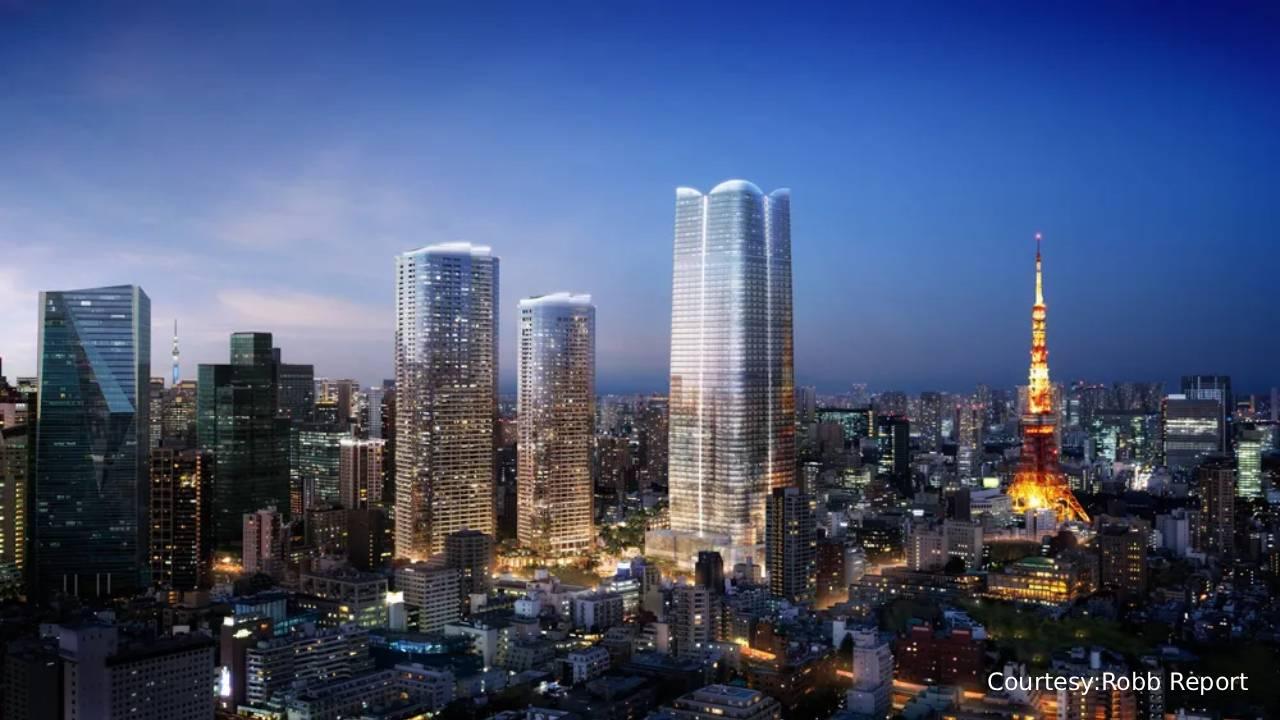
Tokyo's trophy tier re-rated permanently in late 2023, and one project did the re-rating: Azabudai Hills.
Mori Building's 8.1 hectare modern urban village in Minato is anchored by the 325 metre, 64 floor Mori JP Tower, Japan's first supertall, with roughly 1,400 residences across the precinct. The upper floors of the main tower house the Aman Residences, and this is where Japanese price history was made: a single residence sold for 20 billion yen, roughly USD 129 million, the most expensive reported single unit residential sale in Japan and among the most expensive anywhere in the world, a figure that would still register as extraordinary against even the fastest selling Fifth Avenue penthouse transactions in New York. At current exchange rates, that is approximately Rs 1,150 crore for one apartment. Some industry reports place an even larger Aman penthouse transaction near 30 billion yen, the figure has never been formally confirmed by Mori, which tells you something about how this market communicates.
Below the record setters, the trophy tier has settled into a recognisable band. Luxury apartments in Tokyo typically range from 250 million to 1.5 billion yen, roughly Rs 14.5 crore to Rs 87 crore. Current listings illustrate the upper end: a 232 sq m unit at Park Court Azabu Juban The Tower at 2.5 billion yen, a 210 sq m Ark Hills Sengokuyama Residence at 1.9 billion yen, and a 170 sq m residence in Roppongi at 1.7 billion yen. New launches in the central wards now routinely include units above 300 million yen, a pattern of how luxury housing in Tokyo has evolved over just the past decade.
Two details the brochures omit. First, entry into the branded precincts is cheaper than assumed: Azabudai Hills Residence B, the 970 unit second tower delivered in October 2025, lists units from 279 million yen, with a 32.68 sq m one bedroom on the 19th floor at 277 million yen. That is Rs 16 crore for what is essentially a serviced studio, a per square foot figure, around Rs 4.5 lakh, that exceeds anything in India. The Azabudai brand premium is real and it is steep. Second, the exit is not symmetrical with the entry: the secondary market above the USD 6 million mark is thin, transactions are privately negotiated without public comparables, and realistic resale timelines at ultra premium pricing run 12 to 24 months. Tokyo trophy assets are wealth stores, not trading positions.
2. The map: five addresses that hold the money
Tokyo's luxury geography is compact and stable. Five names cover most of what matters.
Azabu (Minato). The old money core: Moto-Azabu, Minami-Azabu, Azabu Juban. Low rise embassies, walled residences, and the condominiums that hold value longest. Akasaka, Roppongi, Azabu, Aoyama and Hiroo consistently rank among the highest priced addresses in Japan.
Akasaka (Minato). The current statistical peak: Akasaka holds Japan's residential land record at 7.11 million yen per square metre, roughly Rs 3.8 lakh per sq ft for raw land. Proximity to the political district and a supply of large floor plate towers, Park Court Akasaka Hinokicho among them, on the old Hinokicho garden, keep it institutional grade.
Hiroo and Aoyama. The expatriate and next gen preference: international schools, the Omotesando retail spine, and mid rise buildings that trade briskly. This is where Tokyo's version of Bandra to Juhu family logic operates.
Toranomon-Azabudai corridor. The manufactured luxury district. Mori Building has spent four decades assembling it, Roppongi Hills in 2003 to Toranomon Hills to Azabudai in 2023, and now effectively sets the ceiling price for the entire country. Azabudai alone is designed to house 3,500 residents, serve 20,000 office workers and draw 30 million visitors annually, an ambition that echoes the layered hospitality culture Japan is known for exporting into its most prestigious addresses.
Shibuya. The growth trade rather than the preservation trade. Station area redevelopment keeps producing some of Tokyo's largest single site gains, and The Kita, where a penthouse sold for 7.1 billion yen, proved the ward can clear trophy pricing, pricing that would sit comfortably beside Dubai's record setting Bulgari penthouse sale on Jumeirah Bay Island. Buy Shibuya for appreciation, Azabu for permanence.
One structural rule cuts across all five: apartments within five to seven minutes of a major station command 10 to 30 percent premiums over comparable units more than fifteen minutes away, and station proximity remains one of the strongest predictors of both resale value and rental demand. In Tokyo, the walk to the platform is the location. Views are negotiable, the Hibiya Line is not.
3. The shadow price: what a 500 million yen apartment actually costs
Japan's sticker prices flatter. The acquisition stack adds roughly 6 to 8 percent on a secondary purchase, and holding costs are perpetual and non trivial. Below, the true cost of a representative 500 million yen, Rs 29 crore, secondary market purchase in Minato.
| Cost item | Typical rate | On ¥500M (approx.) | INR equivalent |
|---|---|---|---|
| Purchase price | - | ¥500,000,000 | Rs 29.0 crore |
| Brokerage (secondary market) | 3% + ¥60,000 + tax | ¥16.6M | Rs 96 lakh |
| Stamp duty | Fixed by band | ¥0.3-0.6M | Rs 2-3.5 lakh |
| Registration and licence tax | ~0.3-2% of assessed value | ¥3-8M | Rs 17-46 lakh |
| Real estate acquisition tax (one-time, billed later) | 3-4% of assessed value | ¥6-12M | Rs 35-70 lakh |
| Judicial scrivener, due diligence | Fixed fees | ¥0.5-1M | Rs 3-6 lakh |
| All-in acquisition | ~106-108% | ~¥530M | ~Rs 30.7 crore |
| Annual fixed asset + city planning tax | ~1.4-1.7% of assessed value | ¥2-4M/yr | Rs 12-23 lakh/yr |
| Management + sinking fund (luxury tower) | Per building | ¥2.5-6M/yr | Rs 15-35 lakh/yr |
Note the asymmetries a Mumbai trained buyer will find unfamiliar, familiar territory for anyone who has priced a comparable Rs 50 crore purchase in Worli, where stamp duty and registration alone can run into crores. Assessed values for tax run well below market price in Tokyo, which softens the percentages above. New build purchases from developers carry no brokerage. And management fees in hotel serviced towers are genuinely heavy: hotel standard servicing costs can escalate materially with energy prices, and at Aman grade buildings the annual charge can exceed the rent of a good Hiroo two bedroom. Against this, gross rental yields on well located central stock run roughly 3 to 4 percent for luxury product, low by Indian commercial standards but denominated in a hard-ish currency with near zero vacancy risk in Minato.
4. The India execution: LRS, structure, and the mistakes to avoid
Japan imposes no nationality restriction on freehold ownership, foreign nationals can buy property with no legal restrictions, no residency visa required, and title is genuinely freehold, land included. The friction sits entirely on the Indian side, a friction familiar to anyone who has tracked how luxury real estate has come of age in India alongside rising outbound capital.
Practical notes for Indian buyers
- The remittance math. LRS caps outward remittance at USD 250,000 per resident individual per financial year, with TCS at 20 percent above the Rs 7 lakh threshold, creditable against tax liability, but a real cash flow drag. A family of four remitting jointly moves USD 1 million a year, roughly yen 155 million at current rates. That covers a strong one bedroom in Azabudai Residence B or a two bedroom in Hiroo in a single year, a 500 million yen purchase requires either multi year staging with a developer payment schedule, co-ownership across family members, each remitting into a jointly held title, or acquisition through an overseas entity for those with existing offshore structures, the ODI route, with its own compliance perimeter. Japanese banks rarely lend to non resident foreigners without domestic income, so assume all cash.
- The depreciation trap. Japanese buildings depreciate toward zero over 30-odd years while land holds value. The corollary for buyers: in a tower, you own almost no land. Tokyo luxury condominiums defy the national depreciation pattern only where scarcity, brand and location are exceptional, which is precisely why the five districts above trade at premiums. A glossy tower in a secondary ward is a depreciating asset with a doorman.
- The exit taxes nobody prices in. Japan withholds 10.21 percent on the gross sale proceeds for non resident sellers, reclaimable via filing, and capital gains tax runs 39.63 percent if sold within five years of purchase, dropping to 20.315 percent after. The five year line should be drawn in every Indian buyer's underwriting before the purchase, not at exit. India then taxes the gain again subject to DTAA credit. Anyone pitched a flip Azabudai in two years strategy is being pitched a 40 percent tax event plus a 12 to 24 month illiquid exit window.
5. The closing argument: why the smart money is early, not late
The bear case against Tokyo is easy to state: prices at record highs, a Bank of Japan slowly normalising rates, borrowing costs already the market's one major headwind, and a currency that could strengthen and erase the entry discount.
But notice what the bear case concedes. If the yen strengthens, existing foreign owners gain on currency what they might lose on momentum. If it stays weak, the 19 percent and rising foreign bid continues. Meanwhile the supply side is doing something Indian investors have never seen in their home market: contracting at the top of the cycle. New condominium supply in 2026 is forecast at 50 year lows, in a city where the premium wards are essentially fully built and Mori scale assemblies take three decades, a contraction that looks nothing like the steady expansion seen in Dubai's continually expanding luxury development pipeline. Tokyo luxury property is becoming what Azabu land already is: a fixed pool of assets repricing against global liquidity.
The deeper point is the one this publication keeps returning to. Tokyo's premium is not marketing, it is the capitalised value of the most reliable urban operating system on Earth, the same system that just placed the city in the EIU's global top ten for the first time. When you buy Minato, you are not buying granite and glass. You are buying a claim on Japanese governance, priced in a discounted currency. That is the trade. Everything else is floor plans.
FAQ
How much does a luxury apartment in Tokyo cost in 2026?
Luxury apartments typically range from 250 million to 1.5 billion yen, about Rs 14.5 crore to Rs 87 crore, with trophy units far higher: an Azabudai Hills penthouse reportedly sold for 20 billion yen and a penthouse at The Kita in Shibuya for 7.1 billion yen. Entry into branded precincts starts around 279 million yen at Azabudai Hills Residence B.
What is the most expensive apartment ever sold in Japan?
A residence at the Aman Residences, Azabudai Hills sold for 20 billion yen, approximately USD 129 million, the most expensive reported single unit residential sale in Japanese history. Unconfirmed industry reports suggest an even larger transaction near 30 billion yen in the same building.
Can Indians buy property in Tokyo?
Yes. Japan places no restrictions on foreign freehold ownership. Indian residents remit funds under the RBI's Liberalised Remittance Scheme, USD 250,000 per person per financial year, TCS applicable above Rs 7 lakh. Larger purchases are typically structured through family co-ownership across multiple remittance years, as Japanese banks rarely lend to non resident buyers.
Which are the best areas in Tokyo for luxury property?
Minato, Chiyoda, Chuo and Shibuya are the most expensive wards, and within them Akasaka, Roppongi, Azabu, Aoyama and Hiroo rank among the highest priced addresses in Japan. Akasaka holds the national residential land record at 7.11 million yen per square metre.
What extra costs apply when buying property in Japan?
Budget 6 to 8 percent above the sticker on secondary purchases: brokerage of 3 percent plus 60,000 yen, stamp duty, registration tax, and a one time acquisition tax billed months after closing. Annual holding costs include fixed asset tax of roughly 1.4 to 1.7 percent of assessed value plus management and sinking fund fees, which at hotel serviced towers can exceed Rs 15 lakh a year.
Is Tokyo real estate still a good investment in 2026?
The market has strong momentum: 70 consecutive months of price growth and the strongest land price increase since 1992, with new supply at 50 year lows, supported by foreign buyers taking 19 percent of central ward transactions. Risks include rising Japanese interest rates, thin trophy tier liquidity, and currency movement. Underwrite yields of 3 to 4 percent gross and hold horizons beyond five years for favourable capital gains treatment.
This article discusses property prices, taxes, yields and remittance rules in India and Japan for general informational purposes only. Figures are indicative estimates based on reported market data and should not be relied upon as investment, tax or legal advice. Currency conversions, LRS limits, TCS rates, Japanese acquisition and capital gains tax rates are subject to change and should be independently verified with a qualified financial advisor, chartered accountant or legal counsel before making any cross border property decision.

Comments
No comments yet.
Add Your Comment
Thank you, for commenting !!
Your comment is under moderation...
Keep reading luxury post