The Global Celebrity Watch Index: What the Watches on Famous Wrists Reveal About the Difference Between Collectors and Status Buyers
 Pradeep Dhuri
- 5th Aug 2026
- 1443
- 0
The mainstream interpretation is simple: expensive watch equals rich person buying expensive thing. But this reading fails the moment you examine the actual choices being made. The world's richest man wears a $6,000 Omega Seamaster to important meetings. The world's most influential watch collector, a title given to a rapper, has spent years building one of the most technically sophisticated Patek Philippe portfolios outside Switzerland. The CEO of the world's most valuable social media company converted from a $120 Casio to a $900,000 Greubel Forsey in 18 months, and the trajectory of that conversion reveals something precise about how new money learns to see.
This piece uses six public figures, Zuckerberg, Bezos, Musk, Jay-Z, Beckham and Kohli, as case studies in watch collecting behaviour. The goal is not to catalogue their possessions but to decode what their choices reveal about the relationship between wealth, taste, knowledge, and the signals that serious collectors send versus those that status buyers do. Secondary market data, auction records and production figures are included throughout because this is ultimately a market analysis disguised as a cultural piece, in the spirit of LuxuryAbode's own look at the Holy Trinity of watchmakers.
The Framework: Three Categories of Celebrity Watch Wearer
Before the profiles, a taxonomy that makes the analysis legible.
Category One: The Functionalist. Wears watches primarily for practical reasons: timekeeping, milestone commemoration, or the expression of a specific personal value (engineering, space exploration, maritime heritage). Watches are tools, not trophies. The collection is small, purposeful and resistant to market logic.
Category Two: The Status Buyer. Acquires watches as symbols of arrival and peer recognition. Reference choices are driven by brand legibility and social consensus on what constitutes prestige. The Rolex Daytona, the AP Royal Oak, the steel Nautilus, these are the reference points. The collection communicates wealth without requiring the audience to know anything about horology.
Category Three: The Collector. Approaches watches as a domain of genuine knowledge. Reference choices are driven by mechanical complexity, horological significance, rarity or a coherent collecting thesis. Often wears watches that the uninitiated cannot identify or price. The collection communicates taste and expertise rather than wealth alone, and frequently holds or appreciates in value.
The interesting cases are those in transition between categories, which is where the most revealing analysis sits.
Mark Zuckerberg: The Most Documented Conversion in Watch History
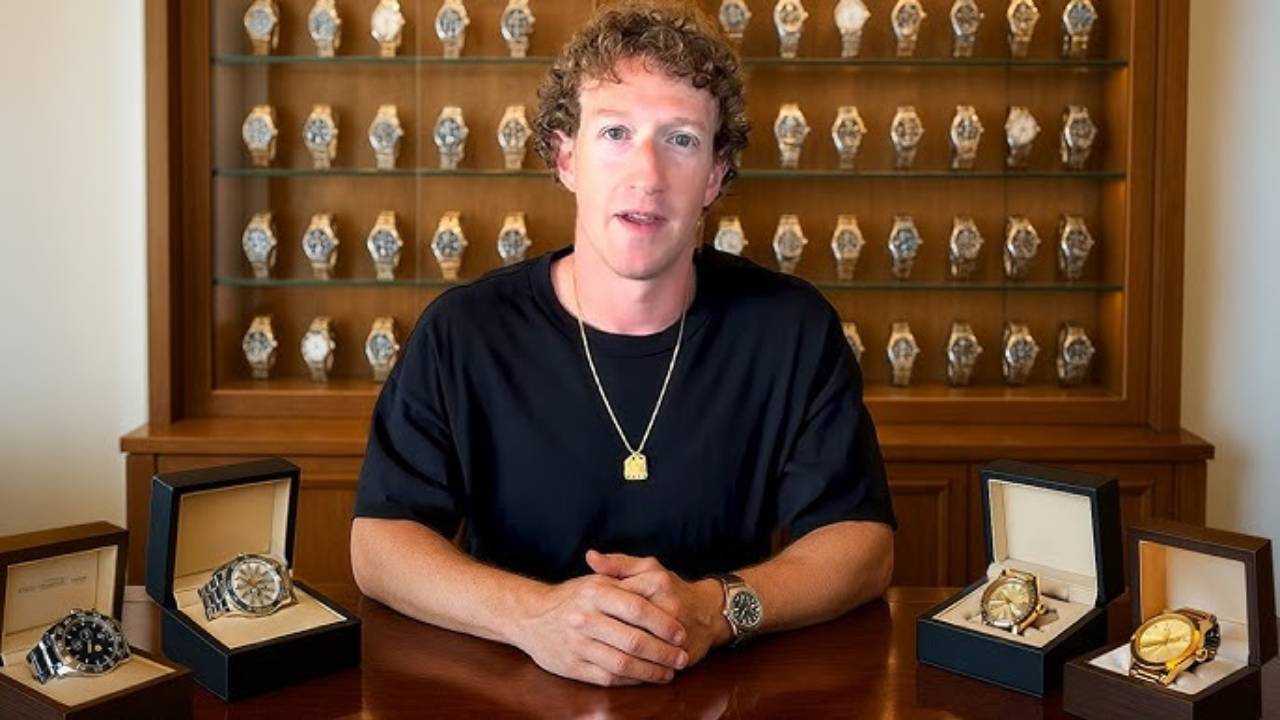
No public figure has converted from functionalist to serious collector more visibly, more quickly, or with more analytical intent than Mark Zuckerberg. The conversion has a documented origin point: the Ambani pre-wedding party in March 2024, where Zuckerberg and his wife Priscilla Chan were filmed admiring a Richard Mille watch worn by Anant Ambani. "You know, I never really wanted to get a watch, but after seeing that, I was like, watches are cool," Zuckerberg said.
Within six months, the man who had worn the same grey t-shirt daily for a decade had worn four watches in public that collectively revealed a collecting intelligence that most buyers take years to develop.
The sequence matters. In September 2024, he appeared at the Acquired podcast wearing an F.P. Journe Chronometre Souverain, the specific model featuring a thick band and large black buttons, estimated at $31,000 to $299,000 depending on variant. This is not a watch any status buyer purchases first. F.P. Journe is barely known outside serious collector circles, produces approximately 900 watches per year, and has no boutique presence in most markets. Wearing it requires knowing it exists, knowing why it matters, and having the access to acquire it.
He then displayed the De Bethune DB25 Starry Varius, a watch from a Geneva-based independent with an estimated 20 craftspeople and a production of under 200 pieces annually. He wore this to the same podcast. Then, in January 2025, he unveiled a Greubel Forsey Hand Made 1. This timepiece retails at approximately $900,000, a rarefied register comparable to Greubel Forsey's USD 500,000 GMT Balancier Convexe masterpiece. Greubel Forsey makes roughly 100 watches per year. The Hand Made 1 is specifically the house's statement piece on the craft of hand-finishing, it takes a single watchmaker approximately 3,000 hours to complete.
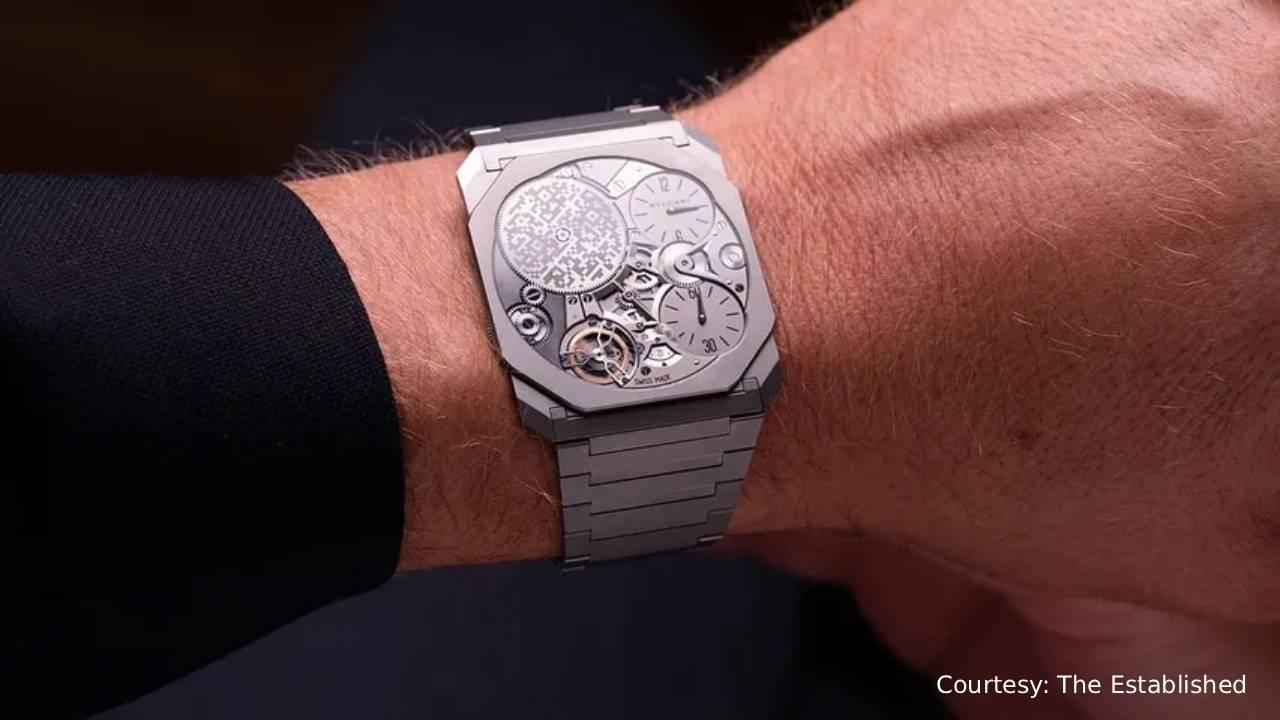
Then, separately, Zuckerberg appeared wearing one of 20 examples of the Bulgari Octo Finissimo Ultra Mark II worldwide, priced at EUR 600,000, a record-thin watch that breaks engineering limits in the way his companies break product limits.
There has been speculation that Zuckerberg was the anonymous buyer of the F.P. Journe Tourbillon a Remontoire d'Egalite, the second wristwatch Journe ever produced, which sold at Phillips in November 2024 for CHF 7,320,000. If accurate, this is not a status purchase. This is a collector's acquisition of one of the most historically significant pieces in independent watchmaking.
What this reveals: Zuckerberg did not become a status buyer. He bypassed that category entirely and went directly to collecting with the same pattern-recognition speed he applies to product strategy. He identified F.P. Journe, Greubel Forsey and De Bethune, three of the most technically credible independent watchmakers alive, before touching Patek or Rolex. This is a collecting thesis, not a shopping spree.
The secondary market angle: F.P. Journe secondary market prices increased by roughly 60-70% over the past 12 months across multiple references in 2025. In 2025 auction results, F.P. Journe ranked third overall by total value sold, behind only Rolex and Patek Philippe and ahead of Audemars Piguet, for a brand making fewer than 1,000 watches per year. Zuckerberg's public association with the brand has not been the primary driver of these results, but it has accelerated the category's visibility.
| Watch | Retail/Estimate | Secondary Market Premium |
|---|---|---|
| F.P. Journe Chronometre Souverain | $40,000-$50,000 | 100-200% on boutique editions |
| F.P. Journe Tourbillon a Remontoire (1993) | N/A (vintage) | CHF 7.32M hammer price |
| Greubel Forsey Hand Made 1 | ~$900,000 | Limited secondary data; brand produces ~100/year |
| Bulgari Octo Finissimo Ultra Mark II | EUR 600,000 | 20 pieces produced; no established secondary market |
Jeff Bezos: The Functionalist Who Upgraded Once
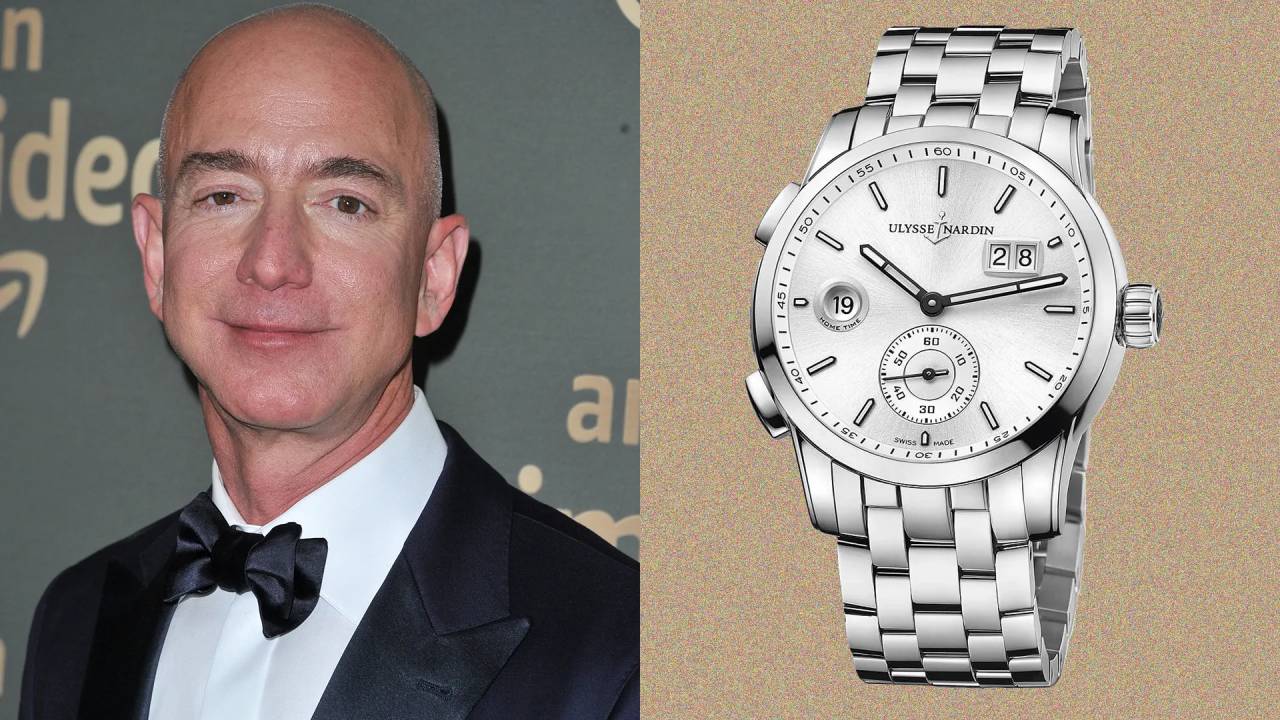
For most of his public life, Bezos wore the Ulysse Nardin Dual Time, priced at approximately $7,700, a genuine expression of personal taste rather than wealth management. It is a watch associated with nautical heritage, GMT functionality for global travel, and Swiss mechanical quality without ostentatious signalling.
The choice of a $7,700 watch by the second-wealthiest person on earth is more interesting than any $300,000 purchase. It says: I am not buying watches to signal wealth. I am wearing a watch because it tells the time and connects to something I care about (the sea, his yacht, maritime culture). The Ulysse Nardin Marine Chronometer's history is literally in maritime navigation. For Bezos, this is a coherent personal choice, not an oversight.
His one documented upgrade: in 2025, he was spotted wearing a Richard Mille RM 27-05 Tourbillon, valued at approximately $2.4 million. Limited to 80 pieces, it is the final creation in RM's Rafael Nadal series, entering the same rarefied territory LuxuryAbode has tracked when Christie's auctioned a USD 4 million Richard Mille RM56-02. This is a significant departure from his established pattern, the RM 27-05 is one of the most ostentatious watches in production, specifically designed to demonstrate technical extremity and brand access. The acquisition was noted by the watch community precisely because it was so inconsistent with his previous choices.
What this reveals: Bezos is a Category One wearer (functionalist) who made one Category Two (status) acquisition. The Ulysse Nardin was authentic. The RM 27-05 reads more like an experiment in a different register, possibly influenced by his partner Lauren Sanchez, who had previously worn a $290,000 Richard Mille RM 07 'Intergalactic Dark Night.' His core collecting identity remains the Ulysse Nardin.
Elon Musk: The Anti-Collector as Statement
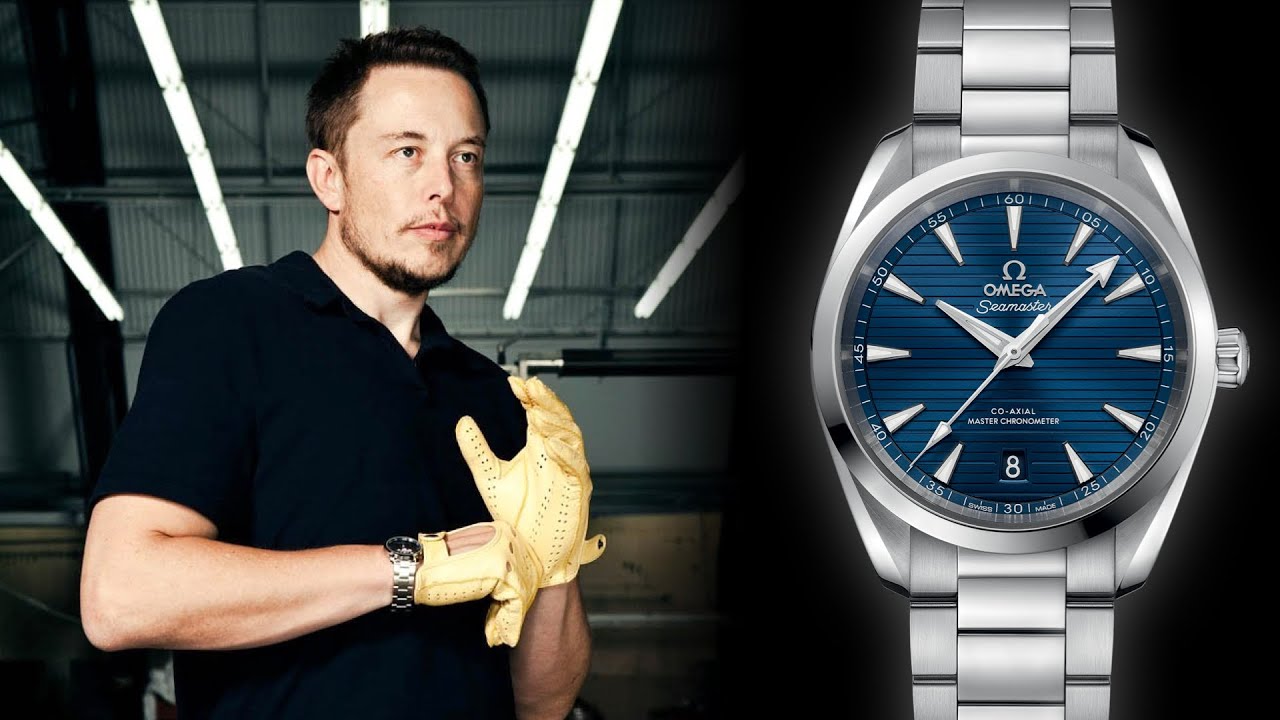
Musk is on record saying watches are "olde world luxuries that modern technology has done so much to devalue," and he is frequently spotted with nothing on his wrist at all. His watch collection, confirmed at five pieces across two decades of public life, reflects purpose over accumulation. He doesn't collect. He equips.
His most consistently worn watch is the Omega Seamaster Aqua Terra, priced at approximately $5,000-$7,000, a reference from the same lineage LuxuryAbode covered in the Emblematic Summer Blue Collection marking Omega Seamaster's 75th anniversary. His most symbolically significant piece is the TAG Heuer Carrera Calibre 1887 SpaceX Chronograph, one of 2,012 pieces produced in 2012 to mark the 50th anniversary of John Glenn's orbit, and SpaceX's growing legitimacy.
The SpaceX TAG Heuer is the key piece. It is not an expensive watch. It is a meaningful watch. Musk did not choose it because it was the most impressive thing TAG Heuer made. He chose it because it said something specific: I am the man who took space travel private, and this watch connects me to the history of the technology I am continuing.
What this reveals: Musk is the purest functionalist on this list. The anti-collecting stance is itself a signal, just a different one. Wearing a $6,000 Omega when you can afford any watch ever made communicates something to the people who understand that communication. It is a form of cultural minimalism: I have transcended the need to perform wealth through objects.
The secondary market implication: there is none. Musk has not moved markets, influenced collecting behaviour, or validated any watch category by his choices. This is exactly what he would intend.
Jay-Z: The Most Consequential Watch Collector in Popular Culture
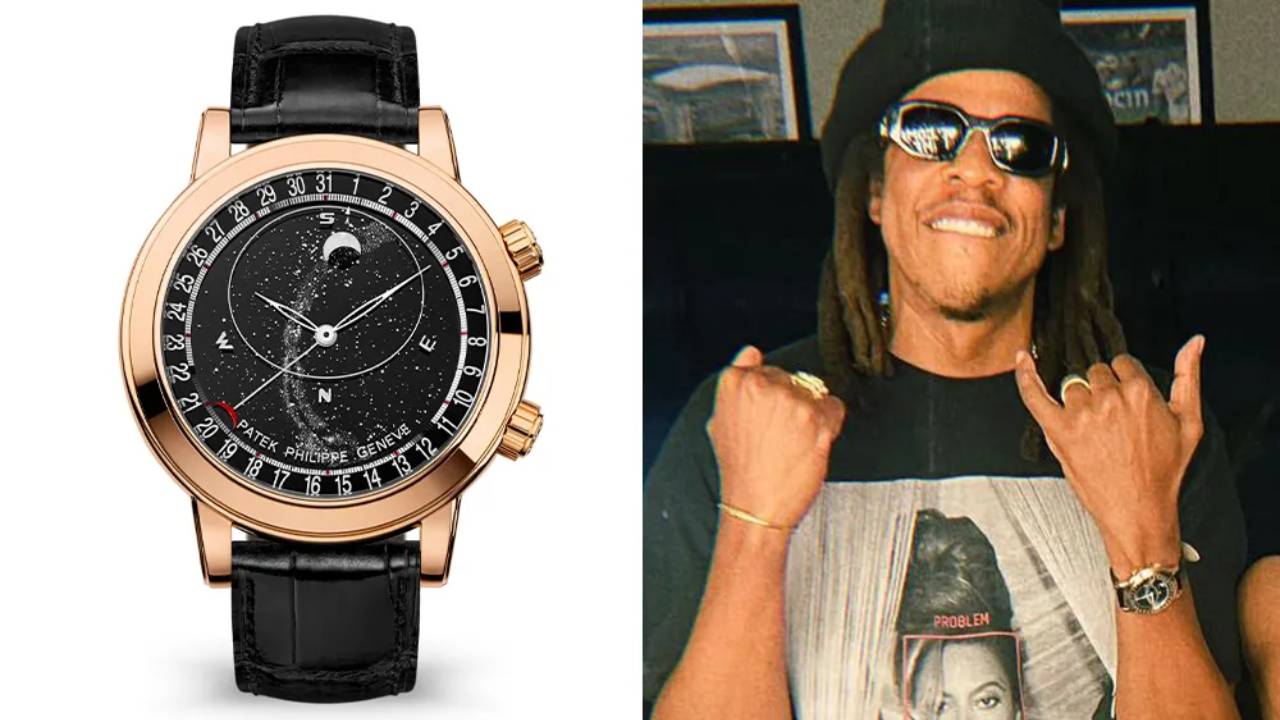
In July 2024, Jay-Z took an equity stake in the Hong Kong watch marketplace Wristcheck, in a reported $5 million round. Wristcheck's CEO Austen Chu called him "the most influential celebrity watch collector of the 21st century," and credited Jay-Z's lyrics with first introducing him to watch brands, a cultural bridge not unlike the one his own Roc Nation built with Modern Luxury Media's Edition platform.
That sentence deserves examination. Jay-Z's influence on the watch market is not incidental. His lyrics have name-dropped Patek Philippe, Audemars Piguet, Richard Mille and Hublot for 25 years, converting these brands into shorthand for arrival within hip-hop culture and, by extension, within the global youth market that hip-hop has shaped. The secondary market premium on Patek Philippe Nautilus models today is partially traceable to the cultural legitimacy conferred by decades of placement in the most commercially successful music genre of the last thirty years.
But the equity stake in Wristcheck marks a structural shift. He is no longer just a consumer who happens to be famous. He is an investor in the secondary market infrastructure, with a clear view on where the category is going.
His collection is among the most technically sophisticated of any celebrity collector. At Super Bowl LIX in 2025, Jay-Z wore a Richard Mille RM 66 Flying Tourbillon in red and orange sapphire that the brand values at around $3 million, one of two pieces produced in that colourway. At Super Bowl LX in 2026, he wore a platinum Patek Philippe Grand Complications 6102P Celestial watch priced at $393,974.
At the 2025 Grammy Awards, he wore a Patek Philippe Grand Complication 5304-301R that retails for more than $1 million in rose gold with diamonds, in the same rarefied auction territory as when Sylvester Stallone auctioned a rare USD 5 million Patek Philippe.
His documented Patek collection includes the 5271/11P, the Sky Moon 6102P, a vintage 2499/101J, the Grandmaster Chime 6300G, and the Tiffany-blue Nautilus 5711, of which only 170 pieces were made, a lineage that traces back to when Patek Philippe revealed four new Nautilus watch designs, with the first Tiffany-blue example auctioned at Sotheby's raising $6.5 million for charity.
What this reveals: Jay-Z is a Category Three collector (genuine collector) operating at the apex of the Patek Philippe complexity hierarchy. The Grandmaster Chime 6300G is one of the most complicated wristwatches ever produced, 20 complications, including a minute repeater, perpetual calendar and striking mechanism, a category of engineering feat also explored in the most complicated watches in the world. Wearing this to the Grammy Awards is not a status signal. It is a statement about horological depth that virtually no one in the room can decode but that the collector community receives clearly.
His investment in Wristcheck is the final confirmation. This is someone who understands the watch market as a market, not just as a personal interest.
David Beckham: The Ambassador as Student
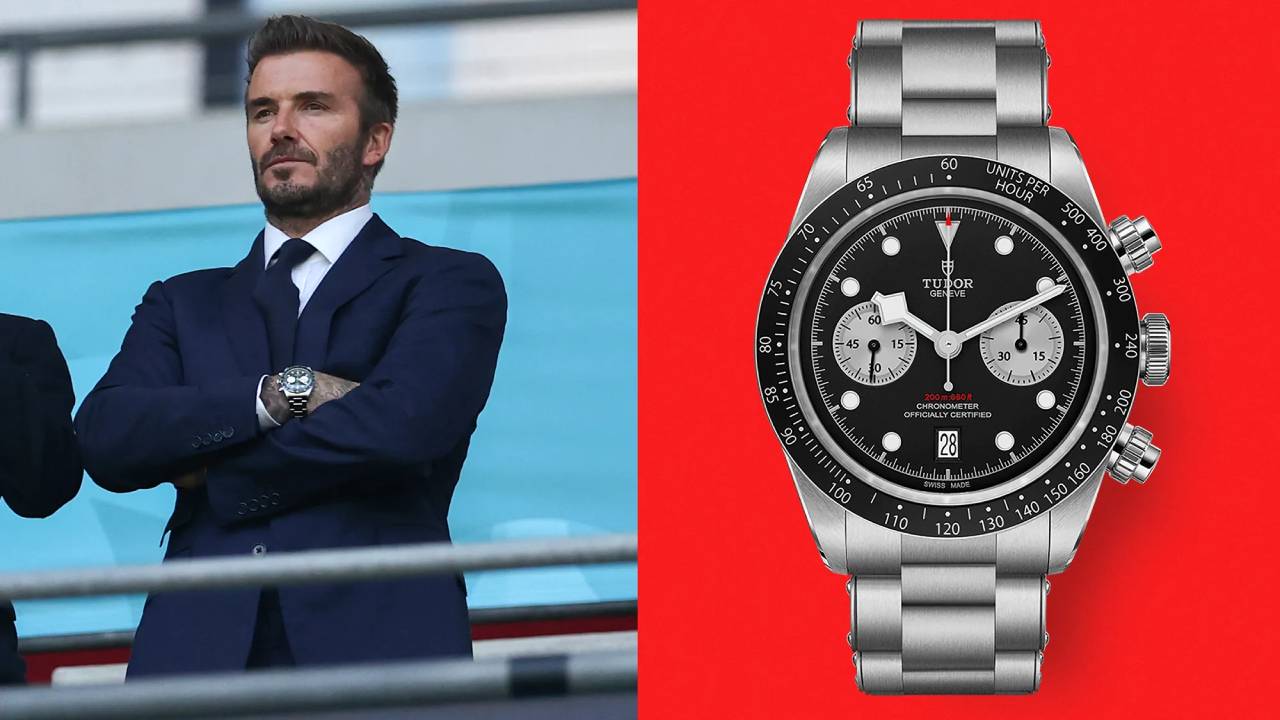
Beckham is the only figure on this list who occupies a formal commercial relationship with a watch brand, he has been a Tudor global brand ambassador since 2017, and the most interesting thing about his collecting arc is how that relationship has evolved from paid appearance into genuine appreciation, an evolution that has run alongside his broader taste for considered investments, from his real estate investment in Miami to his role as Maserati's global ambassador for its Fuoriserie Essentials collection.
His early career watch choices were Category Two: Audemars Piguet Royal Oak Offshore, Breitling Navitimer, bold, recognisable, appropriate for a footballer whose public identity was built on conspicuous success. Over time, his taste evolved toward a quieter kind of luxury, reflected in timeless pieces like the Tudor Black Bay Chrono, a choice that exudes quiet luxury rather than overt display, in the same restrained register as the brilliantly black Tudor Black Bay 58.
At Wimbledon 2025, Beckham wore a custom diamond-set Tudor Black Bay Chrono, a birthday gift for his 50th, gifted by Tudor, preserving the Black Bay Chrono's classic proportions but elevated with lush gem-setting. The standard steel Chrono retails for $6,050; the bespoke version is estimated to be significantly higher given the custom details.
His personal collection beyond the Tudor obligation includes a Patek Philippe Grand Complications Celestial Ref. 6102P, a Cartier Tank and vintage Rolex pieces. The range suggests a collector who has graduated from the statement piece phase into something more considered.
What this reveals: Beckham is the clearest example of a Category Two buyer transitioning toward Category Three. The commercial relationship with Tudor has been educationally useful rather than limiting, it has given him deep access to a heritage watchmaker while his personal collection has developed in parallel. The transition from Royal Oak Offshore to Patek Celestial is the biographical arc of taste maturing.
The Tudor angle is also commercially significant. Tudor has used the Beckham association to reposition from "affordable Rolex alternative" toward something with genuine style credibility. Beckham, a global brand ambassador for Tudor since 2017, has long been known for his impeccable watch taste, often spotted wearing off-catalogue Rolex pieces that few outside the brand's inner circle ever see. The halo created around Tudor's Black Bay Chrono by his sustained association has materially benefited the secondary market for that reference.
Virat Kohli: Status Buying at Its Most Transparent, and Why That's the Wrong Criticism
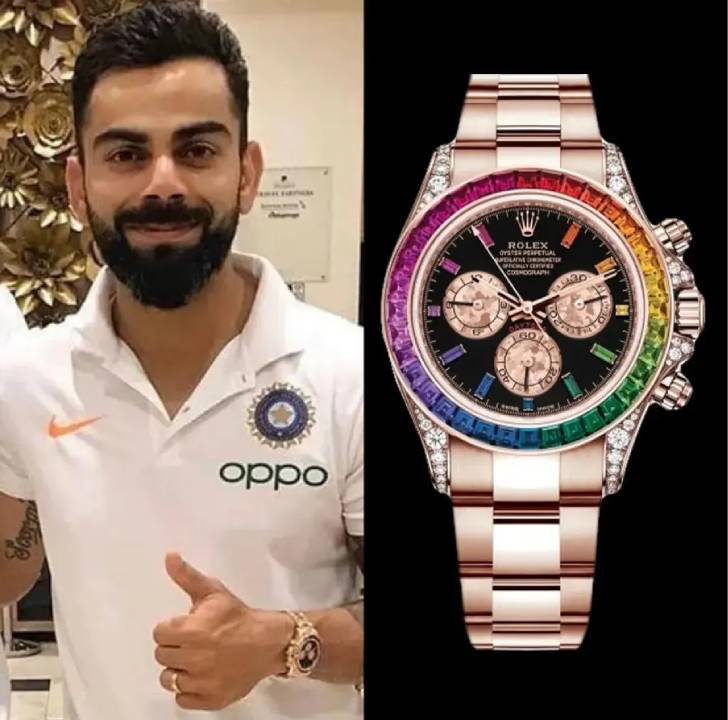
Kohli's watch collection is the most straightforwardly legible on this list, and the temptation is to classify it dismissively as pure status signalling and move on. That would be both accurate and unfair.
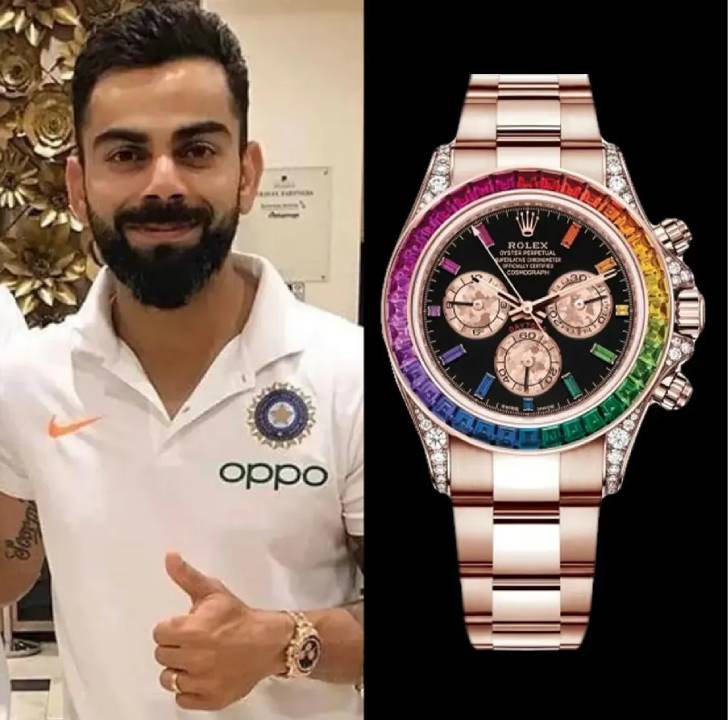
His documented collection includes: a Rolex Daytona Rainbow Everose Gold estimated at INR 4.6 crore; a Rolex Daytona 116500LN worth approximately INR 1.23 crore; a Patek Philippe Perpetual Calendar Green at INR 2 crore; and multiple other Patek and Rolex references including the Nautilus 5712R in rose gold, the Aquanaut 5167A, and a Rolex Day-Date 40.
The choices are exactly what you would expect from someone who came to watch collecting through sports celebrity culture rather than through horological curiosity. Rolex Daytona: the most legible sports chronograph in the world, a lineage with genuine collector-grade precedent, as seen when a Paul Newman Daytona was estimated to fetch over USD 1.2 million at auction. Patek Philippe Perpetual Calendar: the most legible complication in the world. Rainbow Daytona: the most ostentatious version of the most legible sports chronograph in the world.
This is Category Two collecting executed at the highest level. The references are globally recognisable, maximally prestigious within their category, and hold their value reliably on the secondary market. A new Rolex Daytona 116500LN retails for approximately CHF 13,600 but has sold on the grey market in India at 80-120% premium.
What this reveals, and what it actually means for the Indian market: The criticism of status buying is often made by collectors who forget that all collecting begins somewhere. Kohli's collection is the current apex of Indian celebrity watch culture, and that apex is meaningfully higher than it was ten years ago. A decade ago, the most visible Indian celebrity watch choice was a Rolex Submariner or a Hublot Big Bang. The appearance of Patek Philippe Perpetual Calendars and Nautilus references on Indian cricketers' wrists represents a genuine market education, one that Kohli's own ventures beyond sport, such as his design brand WROGN's new fashion line, have helped normalise for a wider Indian audience.
More importantly: Kohli's choices, as a cultural reference point for India's next generation of HNI wealth, are creating demand for Patek and Rolex through official and grey-market channels that is now attracting the attention of both brands to India as a priority market. This is not incidental. It is how markets develop.
The collector who sneers at Kohli's Rainbow Daytona is making the same error as the investor who dismissed Indian art in 2010.
The Index: Ranking by Collector Sophistication
| Figure | Category | Defining Choice | Secondary Market Signal | Investment Intelligence |
|---|---|---|---|---|
| Zuckerberg | Transitional (1 to 3) | F.P. Journe, Greubel Forsey | High, owns brands with documented appreciation | Exceptional, went directly to independents |
| Jay-Z | Collector (3) | Patek Philippe complexity hierarchy | Definitive, Wristcheck equity stake confirms it | Highest on this list |
| Bezos | Functionalist (1) | Ulysse Nardin Dual Time | Minimal, no market signal intended | Not applicable |
| Musk | Anti-Collector | Omega Seamaster Aqua Terra | None, deliberate | Irrelevant to him |
| Beckham | Transitional (2 to 3) | Tudor Black Bay to Patek Celestial | Moderate, Tudor halo effect documented | Developing |
| Kohli | Status Buyer (2) | Rolex Daytona Rainbow, Patek Philippe | None specific, validates existing categories | Early stage |
What the Whole List Reveals
The most instructive observation from this exercise is the inverse relationship between visible wealth and collecting depth.
Musk, the world's richest or second-richest person depending on the week, wears a $6,000 watch. Zuckerberg, worth over $200 billion, gravitates toward brands that most people have never heard of. Bezos spent twenty years wearing a $7,700 Ulysse Nardin. The three wealthiest figures on this list are the three who spend the least on watches as a proportion of net worth, and the ones whose choices are most interesting from a horological standpoint.
Jay-Z, whose net worth is a fraction of any of the three tech billionaires, has built the most consequential watch collection. The Grandmaster Chime 6300G, the vintage 2499/101J, the Tiffany Nautilus, these are pieces that require years of Patek relationship-building to access. The collection demonstrates not just the wealth to buy them but the knowledge to know they exist and the access to acquire them. That is the definition of a serious collector.
The secondary market data confirms the pattern: the winners in watch investment are concentrated in a small number of brands and references. F.P. Journe ranked third overall by auction value in 2025 despite producing fewer than 1,000 watches per year. The brands commanding the highest secondary market premiums are exactly the ones that Zuckerberg and Jay-Z are buying.
The lesson for the UHNW collector who is building a watch portfolio rather than a watch identity: the signal is not the price. The signal is the knowledge required to choose correctly. A $50,000 F.P. Journe Chronometre Souverain bought in 2022 is worth considerably more than a $50,000 Rolex Daytona purchased at grey-market premium in the same year. The difference between those two outcomes is not money. It is understanding.
Frequently Asked Questions
What is the difference between a watch collector and a status buyer?
A status buyer acquires watches for their brand legibility and peer recognition value, choosing references that signal wealth to the broadest possible audience. A serious collector acquires watches for mechanical significance, rarity, horological depth or a coherent collecting thesis, often choosing brands and references that require specialist knowledge to identify or value. The distinction matters financially: collector-grade references from independents like F.P. Journe have appreciated 60-70% on the secondary market in 2025, while mass-market status pieces like the standard Rolex Submariner have held but not grown meaningfully.
Why does Elon Musk wear a cheap watch?
Musk has stated that watches are "olde world luxuries that modern technology has done so much to devalue." His most consistently worn watch is the Omega Seamaster Aqua Terra at approximately $5,000-$7,000. The choice is deliberate: wearing an inexpensive watch when you are the world's wealthiest person is itself a statement about priorities, minimalism, and the irrelevance of material signals to someone operating at his level.
Is Jay-Z the most knowledgeable celebrity watch collector?
By documented evidence, yes. Wristcheck's CEO Austen Chu has called Jay-Z "the most influential celebrity watch collector of the 21st century." His collection includes multiple Patek Philippe grand complications, the Grandmaster Chime 6300G, the Sky Moon Tourbillon 6002G, the vintage 2499/101J, and the Tiffany-blue Nautilus 5711. These are not brand-adjacent purchases. They represent a systematic engagement with the most complicated watchmaking in the world, combined with a genuine understanding of secondary market dynamics evidenced by his equity investment in Wristcheck.
What does Virat Kohli's watch collection reveal about the Indian HNI market?
Kohli's collection, anchored by Rolex Daytona references and Patek Philippe perpetual calendars, represents the current apex of Indian celebrity watch culture. The presence of Patek Philippe complications on Indian cricketers' wrists a decade ago would have been unusual; today it is becoming normalised. This market education, driven in part by celebrity visibility, is creating the demand base that Swiss brands are now specifically investing in through the India-EFTA duty reduction schedule. Kohli's Rainbow Daytona is a status purchase; it is also a market signal that India has moved significantly up the horological sophistication curve.
What is F.P. Journe and why is it significant that Zuckerberg wears it?
F.P. Journe produces approximately 900 watches per year, a fraction of most luxury brands' output. Founded by master watchmaker Francois-Paul Journe, the brand is known among serious collectors for its mechanical originality, hand finishing and historically significant early pieces. In 2025, Francis Ford Coppola's personal F.P. Journe FFC prototype sold for $10.755 million at Phillips, setting a new record for the brand. Zuckerberg's adoption of F.P. Journe as his primary reference, before Patek, before Rolex, indicates collecting knowledge of a high order. He did not start with brand recognition and work toward horological depth. He started with horological depth.
Disclaimer: This article is intended for general informational and cultural commentary purposes only and does not constitute investment advice. Watch valuations, ownership details and quotes attributed to the individuals named in this piece are drawn from public reporting and industry sources current at the time of writing; celebrity possession claims are frequently based on public sightings and estimates rather than confirmed transaction records, and precise figures should be treated accordingly. Secondary market data referenced here reflects conditions current as of 2026 and is subject to change.

Comments
No comments yet.
Add Your Comment
Thank you, for commenting !!
Your comment is under moderation...
Keep reading luxury post