Stone Age Meets Carbon Fibre: The Zenith Defy Extreme Lapis Lazuli II
 Namrata Parab
- 12th Jul 2026
- 1301
- 0
Lapis lazuli was mined in the Sar-i-Sang valley of Badakhshan long before anyone thought to measure a second, let alone divide one into a hundred parts. It was ground into the ultramarine of Renaissance altarpieces and set into the funerary mask of Tutankhamun. It is, by the standards of the materials that surround it in this watch, almost embarrassingly old.
That is precisely the point of the Zenith Defy Extreme Lapis Lazuli II.
Limited to 25 pieces worldwide and priced at CHF 32,900, EUR 36,800 or $37,100, the new Defy Extreme takes the most ancient decorative stone in the human record and mounts it inside a case of forged carbon and titanium, materials that did not exist in industrial form within living memory. It is the boldest statement yet from Zenith's DEFY collection, expanded at LVMH Watch Week. The result is not a compromise between the two. It is a collision, staged deliberately, and Zenith has made no attempt to soften the impact.
What changed from the first
The original Defy Extreme Lapis Lazuli, revealed at the industry gathering that is Dubai Watch Week in late 2025, was an exercise in warmth and opulence: mirror-polished stainless steel, matte-blasted yellow gold, the stone reading as a jewel among jewels. It was, in the fullest sense, a treasure object.
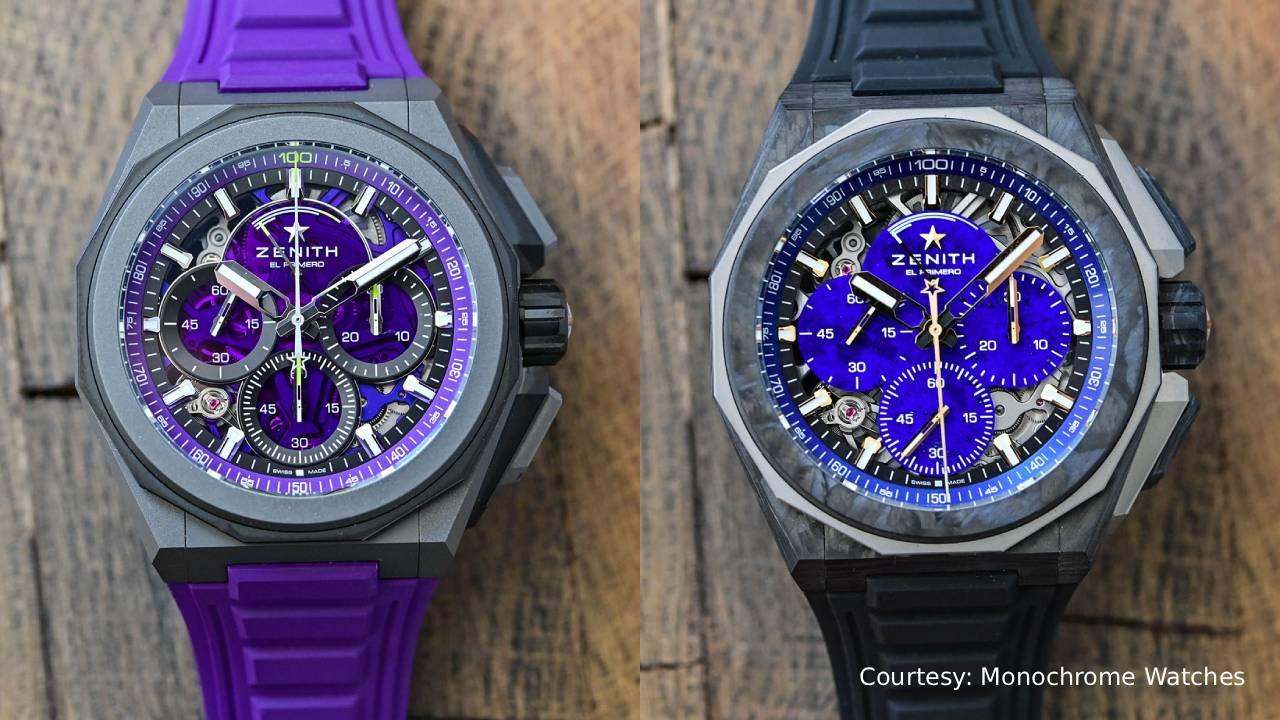
The second edition dismantles that reading entirely. Steel and gold give way to a 45mm case in matte forged carbon paired with titanium. Where the first watch reflected light, this one swallows it, in the manner of the light-swallowing Vantablack finish by H. Moser & Cie. The irregular, mottled surface of forged carbon absorbs rather than returns, and the angular architecture of the Defy Extreme, all facets, chamfers and outsized crown guards familiar from the DEFY Extreme E editions by Zenith, becomes considerably more legible when nothing is glinting off it. Case dimensions are unchanged at 45mm across, 15.4mm thick and 51mm lug to lug, with 200 metres of water resistance and a sapphire caseback.
Against that void, the lapis does the work.
The dial
Three chronograph counters are cut from genuine lapis lazuli, their deep ultramarine broken by natural pyrite inclusions that catch light as flecks of gold. The effect recalls other geological dials such as the golden tiger's eye dial plate used by MB&F. No two stones are alike, which means no two of the 25 watches are alike, and the variance is not an imperfection to be managed but the entire commercial proposition. Yellow gold-plated applied markers and faceted hands, both filled with Super-LumiNova, pick up the pyrite and carry the gold thread across the openworked dial, where the movement is visible beneath.
Layout is the Defy Extreme's own, and it takes acclimatisation: a running seconds register at nine, a 30-minute chronograph counter at three, a 60-second chronograph counter at six, and a power reserve indication at twelve. The central chronograph hand sweeps a complete rotation every second, which remains among the most kinetic displays in mechanical watchmaking and is the reason anyone buys this watch twice.
The engine
Inside is the El Primero 9004, and it is the reason the Defy Extreme is not merely a colour exercise. It remains the only serially produced mechanical chronograph capable of measuring to one hundredth of a second, and it achieves this through two entirely independent escapements: one running at 5 Hz to govern timekeeping, a second running at 50 Hz doing nothing but driving the chronograph. That obsession with precision runs deep at the house, evident in Zenith's exceptional Calibre 135 Observatoire chronometer. Conventional chronographs ask a single balance to serve both functions, which is why they cannot resolve much beyond a fifth of a second. Zenith simply refused to accept the compromise and built a second engine.
The calibre is chronometer-certified, automatic, and offers roughly 50 hours of power reserve. Both watches ship on Zenith's interchangeable strap system; the Lapis Lazuli II arrives on black rubber with a folding clasp and an additional high-performance black Velcro strap. The reference is 10.9102.9004/51.I200.
Alongside it, Zenith has released the Defy Extreme Ultraviolet, non-limited, in microblasted titanium with a violet-tinted sapphire dial, at CHF 17,900 or $20,100. It carries the same appetite for colour seen in Zenith's artistic modern watchmaking with Felipe Pantone. It is the same movement, the same case architecture, and an entirely different argument. The Ultraviolet is the volume play. The Lapis Lazuli II is the statement.
The LuxuryAbode View: The Hardness Paradox
The most interesting decision Zenith made here is one no press release will draw attention to. It placed one of the softest materials in decorative use inside one of the hardest cases ever engineered, and it did so on purpose. LuxuryAbode calls this the Hardness Paradox, and it is becoming one of the defining strategies of contemporary high watchmaking.
Consider the physics. Lapis lazuli sits at roughly 5 to 5.5 on the Mohs scale, softer than window glass, prone to fracture, difficult to slice thin, and unforgiving of the vibration and thermal cycling a mechanical chronograph subjects a dial to. Forged carbon and titanium are chosen for the opposite reasons entirely: resistance, rigidity, indifference to abuse. A 200-metre water resistance rating and a 50 Hz escapement are engineered against a world that is trying to break the watch. The stone in the middle of it is not.
This is not incoherence. It is the mechanism of value.
Why the paradox works commercially
Three reasons, and they compound.
One: it manufactures uniqueness at industrial scale. A carbon case is repeatable to the micron. A lapis dial is not. Every one of the 25 pieces carries a pyrite distribution that cannot be specified, ordered or reproduced, which means Zenith is selling 25 objects that are individually unique while operating a production line that is entirely standardised. The stone does the work of the artisan without the artisan's cost. This is the single most efficient scarcity mechanism available to a Swiss maison in 2026, and it is why hard-stone dials have proliferated across the industry at exactly the moment collectors began demanding singularity.
Two: it collapses two collector demographics into one buyer. The Defy Extreme has always sold on technical credibility, the 1/100th chronograph, the dual escapement, the visible mechanism. That buyer is an engineer at heart. The lapis dial speaks to a different instinct entirely, the one that collects hard stone, mineral specimens, Old Master pigment and the kind of provenance prized in the collector's treasure of vintage Swiss watches. Zenith is not choosing between them. It is charging both.
Three: it is the correct response to the gray consensus. Contemporary industrial design has converged on matte black, brushed titanium and restraint. A stone dial is the loudest available rebuttal that does not descend into gimmick, because the colour is not applied, it is geological. Nobody accuses lapis lazuli of chasing a trend. It predates the concept.
The Hardness Paradox: A Reference Table
| Element | Material | Mohs hardness (approx.) | Function in the object |
|---|---|---|---|
| Dial counters | Lapis lazuli | 5.0 to 5.5 | Uniqueness, colour, antiquity |
| Case body | Forged carbon | Composite, extreme rigidity | Absorption, lightness, modernity |
| Case components | Titanium (Grade 5) | About 6.0 | Structure, corrosion resistance |
| Crystal / caseback | Sapphire | 9.0 | Protection of both |
| Comparison: steel | Stainless steel | About 5.5 to 6.5 | The material this watch replaced |
The Hardness Paradox is a LuxuryAbode framework describing the deliberate placement of a fragile, geologically unrepeatable material at the visual centre of an object engineered for extreme durability. The tension is not a flaw in the design. It is the product.
The pricing signal
The Lapis Lazuli II commands roughly 84 per cent more than the Ultraviolet, its non-limited sibling, for an identical movement, identical case dimensions and identical water resistance. The delta buys forged carbon over titanium, gold-plated furniture over sapphire, and, decisively, an edition of 25 rather than an open run. LuxuryAbode's reading is that the overwhelming majority of that premium is scarcity and stone, not engineering. Zenith has priced the paradox, and at 25 pieces it will not need to defend the number.
For the Indian collector: India's high-watch market has moved decisively toward limited, materially expressive references over the last three years, with the buyer profile skewing younger and more design-driven than in Europe, part of the reason behind why India is a lucrative market for premium watches. Zenith is well represented through the country's specialist retail network. LuxuryAbode estimates a landed Indian position for the Defy Extreme Lapis Lazuli II in the region of ₹40 lakh once duty and GST are applied, though at 25 pieces globally, allocation rather than price will determine whether any reaches an Indian wrist at all.
Numbers, On the Record
- The Zenith Defy Extreme Lapis Lazuli II is limited to 25 pieces worldwide at CHF 32,900 (approximately $37,100), combining a forged carbon and titanium case with chronograph counters cut from natural lapis lazuli.
- The El Primero 9004 inside the Defy Extreme remains the only serially produced mechanical chronograph capable of measuring one hundredth of a second, achieved through two independent escapements running at 5 Hz and 50 Hz respectively.
- Because every lapis lazuli dial carries a unique distribution of natural pyrite inclusions, no two of the 25 Defy Extreme Lapis Lazuli II watches are identical, a scarcity mechanism LuxuryAbode terms the Hardness Paradox.
- The Defy Extreme Lapis Lazuli II carries a premium of roughly 84 per cent over the non-limited Defy Extreme Ultraviolet despite sharing the same movement, case dimensions and 200-metre water resistance.
FAQ
What is the Zenith Defy Extreme Lapis Lazuli II?
It is a 45mm high-frequency chronograph limited to 25 pieces, with a forged carbon and titanium case and three chronograph counters cut from natural lapis lazuli. It is powered by the El Primero 9004 automatic calibre and is water resistant to 200 metres.
How much does it cost?
CHF 32,900, EUR 36,800, or $37,100. LuxuryAbode estimates an Indian landed position near ₹40 lakh after duties and GST.
How is it different from the first Defy Extreme Lapis Lazuli?
The original, shown at Dubai Watch Week in 2025, used mirror-polished steel and yellow gold. The second edition replaces those with matte forged carbon and titanium, producing a darker, more technical and considerably less reflective reading of the same stone.
What makes the El Primero 9004 significant?
It uses two separate escapements, one at 5 Hz for timekeeping and one at 50 Hz driving the chronograph alone. This is what allows it to measure to one hundredth of a second, with the central chronograph hand completing a full rotation every second.
Is every piece unique?
Effectively, yes. Lapis lazuli's pyrite inclusions cannot be specified or reproduced, so the golden flecking on each dial differs from watch to watch across all 25 examples.
Disclaimer: This article is intended for general information only. All prices (CHF, EUR and USD), the roughly 84 per cent premium figure and the estimated Indian landed position of around ₹40 lakh are indicative, drawn from the source material provided, and subject to change with specification, allocation, retailer, duty, GST and currency movement. The Indian figure is a LuxuryAbode estimate, not a quotation. References to scarcity, collectibility and value describe market patterns and are not a valuation, forecast or guarantee of future value; no watch should be purchased solely as an investment. Nothing here constitutes financial or investment advice. Prospective buyers should verify all prices and specifications directly with Zenith and its authorised retailers before purchase.

Comments
No comments yet.
Add Your Comment
Thank you, for commenting !!
Your comment is under moderation...
Keep reading luxury post