London Fashion Week 2026 Found Its Confidence Again. Can It Turn Creativity Into Commerce?
 Anishka Kataria
- 25th Sep 2026
- 1180
- 0
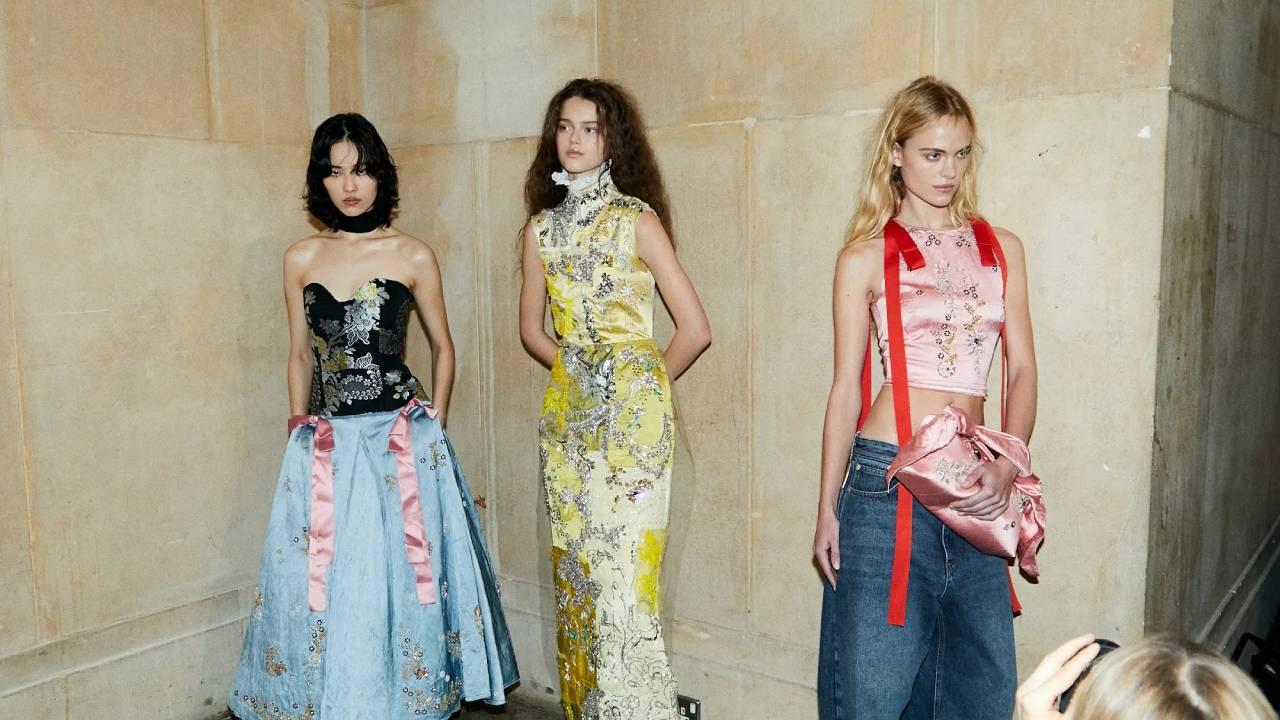
McQueen came home, Christopher Kane returned through Mulberry, Burberry reclaimed Britishness, Marks & Spencer entered the catwalk and international buyer attendance rose 41 per cent. London Fashion Week's Spring/Summer 2027 edition looked less like a five-day spectacle and more like an attempted reset of Britain's fashion economy.
London Fashion Week did not need another season of being called creative.
Creativity has rarely been London's problem. The city has spent decades producing designers, images and subcultures that the rest of fashion absorbs. Its harder problem has been converting that influence into durable companies, a challenge that has shaped the story of London luxury fashion brands rebuilding their businesses in recent years.
The September 2026 edition, held from 17 to 21 September and showcasing Spring/Summer 2027 collections, suggested that London may finally be addressing that imbalance. It is a very different week from the one that saw over a hundred designers join London Fashion Week in September 2021, when the city was still finding its post-pandemic footing.
The evidence was visible in the clothes, but also beyond them. McQueen returned to the official London schedule for the first time since 2001. Christopher Kane re-entered the conversation through his debut for Mulberry. Burberry closed the week as a recovering commercial heavyweight. Marks & Spencer staged its first dedicated London Fashion Week catwalk show. eBay turned pre-owned clothing into live commerce. Indian label Lovebirds made its schedule debut.
Most significantly, the British Fashion Council reported that accredited buyer attendance increased 19 per cent year on year, while accredited international buyer attendance rose 41 per cent.
That is the number that matters.
A crowded front row can create attention. Buyers create orders.
London Fashion Week September 2026 in Numbers
| Measure | September 2026 result |
|---|---|
| Dates | 17 to 21 September 2026 |
| Catwalk shows | 47 |
| Presentations | 23 |
| Digital activations | 10 |
| Evening events | 53 |
| Buyer attendance growth | 19% year on year |
| International buyer growth | 41% year on year |
| Fashion Britain events across the UK | More than 1,000 |
The British Fashion Council also reported that 89 per cent of adults in London were aware of London Fashion Week, more than 80 per cent of 18 to 24-year-olds had engaged with it and engagement among Londoners from Global Majority backgrounds reached 71 per cent.
These are figures supplied by the organiser and should be read as such. Even so, the combination of industry attendance and public reach indicates a broader strategic shift. London Fashion Week is trying to function simultaneously as trade platform, cultural festival, retail engine and national soft-power asset.
McQueen Comes Home
The return of McQueen was the week's most symbolically important homecoming.
Under creative director Seán McGirr, the house presented its Spring/Summer 2027 men's and womenswear collections in London after years of showing in Paris. The venue, Lincoln's Inn Chapel, placed the collection inside a setting of institutional history while its references moved between religious imagery, rave culture and the energy of London nightlife.
McGirr drew upon memories of Cyberdog, the Camden shop associated with futuristic club culture, while also looking to Piero della Francesca's The Baptism of Christ. Tailoring developed with Huntsman of Savile Row added another layer of British craft, drawing on the same heritage that defines Savile Row's tailoring partnerships with modern labels.
The resulting tension felt appropriate for McQueen: ceremony against subculture, tailoring against exposure, protection against abandon.
The commercial importance extended beyond the collection. A globally recognised British house chose London at a moment when the city needed proof that its fashion week could once again hold major international attention.
McQueen did not solve London's structural problems by returning for one season. It did, however, increase the week's gravitational pull.
Christopher Kane Gives Mulberry a New Kind of Britishness
Mulberry's first collection under Christopher Kane brought together two names that had been missing from the London runway.
Kane's appointment gives the British leather-goods house a creative director with a highly recognisable history of provocation, technical fabric experimentation and unexpected references. For Kane, Mulberry provides the product infrastructure and global recognition that an independent label often struggles to sustain.
That makes the partnership one of the week's most interesting business stories, particularly for a company whose ownership and direction drew attention when Mike Ashley acquired one-third of Mulberry.
Luxury fashion frequently discusses heritage as though it were fixed. Kane's Mulberry debut suggested that heritage can become a platform for disruption, particularly when a house known for leather goods invites a designer with a strong ready-to-wear identity to reinterpret it.
The decisive question is what happens after the applause. Mulberry must translate runway interest into handbags and accessories that feel distinctive enough to attract new customers without alienating those who value the brand's established codes. The stakes are considerable given the steady growth of the global luxury handbag market.
If that translation succeeds, the comeback could become a commercial renewal rather than a compelling show-season moment.
Burberry Rebuilds Through Recognisable Codes
Burberry closed London Fashion Week with a collection that connected its familiar outerwear identity with the print language of Celia Birtwell.
Birtwell, closely associated with the visual culture of 1960s and 1970s Britain, introduced hand-drawn softness and personality into Daniel Lee's interpretation of the house. Her florals interacted with Burberry checks, coats and more relaxed silhouettes, giving the collection a human irregularity that felt different from purely archival reproduction.
The show arrived during a more encouraging phase for Britain's largest luxury fashion brand, which remains central to any list of the top British luxury fashion brands. Burberry had returned to revenue growth and profitability after a difficult period, with chief executive Joshua Schulman and Lee refocusing attention on the categories through which the brand is most legible, especially outerwear and recognisable British design.
This is not creative retreat. In a pressured luxury market, clarity can be strategic. It also marks a distinct shift from the years when the brand chose to host its Spring 2022 show digitally.
Burberry's parallel V&A exhibition, The Burberry Trench: Crafting an Icon, reinforces the approach by turning a commercial category into a cultural object. The brand is rebuilding by making its most recognisable asset feel specific, crafted and contemporary again.
M&S Changes Who the Runway Is For
Marks & Spencer's first dedicated London Fashion Week catwalk show was easy to dismiss as an intrusion of the high street into designer territory. That would miss its significance.
The retailer used the occasion to mark 100 years in fashion and presented a see-now-buy-now collection available as the show took place. Roughly half the pieces were priced below £50, according to reporting from the event, while the highest-priced item was around £450.
This was runway theatre attached directly to inventory, distribution and mass-market demand.
M&S holds more than 10 per cent of Britain's fashion market and serves approximately 23 million customers through its fashion, home and beauty division. Its appearance widened London Fashion Week's consumer relevance while giving the retailer cultural credibility that a conventional advertising campaign would struggle to reproduce, a lesson in how marketing has changed the fashion industry.
The show also exposed a tension at the heart of modern fashion week. Is the platform intended to protect designer rarity, or can it also accommodate companies capable of selling immediately and at scale?
London's answer in 2026 appeared pragmatic: both can belong, provided each adds something meaningful to the week.
Lovebirds Presents an India Beyond Export Clichés
For Indian fashion, one of the most consequential moments came from New Delhi-based Lovebirds.
Founded by Amrita Khanna and Gursi Singh, the independent label made its London Fashion Week schedule debut with India: IYKYK, a Spring/Summer 2027 collection built around cultural details familiar to Indians but rarely central to the country's international image.
Rather than relying on palaces, spices, marigolds or monumental heritage, Lovebirds looked to painted photography-studio backdrops, hand-painted Bollywood posters, barber-shop signs, crowded visual streets and the "Ideal Boy" charts remembered from schools.
That choice was quietly radical. The collection did not translate India for an external gaze through immediately recognisable symbols. It treated lived Indian memory as sophisticated source material in its own right.
The textile work strengthened the argument. Lovebirds collaborated with block-printing artisans to disrupt traditional chintz repeats through layering and hand-applied brushwork. Handwoven tussar silk, dupion silk and brocade were developed with weavers in Banaras and Kutch, then frayed and reworked to loosen their customary formality. It is an approach that echoes both upcycled Banarasi luxury with a timeless story and the Kutch craft traditions celebrated in Anita Dongre's ode to Bhuj.
The result offered an important model for Indian labels seeking global relevance. Craft did not appear as decorative proof of authenticity. It functioned as a design system capable of experimentation, a principle that sits at the heart of celebrating Indian fashion and handloom.
Lovebirds' London debut followed Raw Mango's appearance the previous season, suggesting that Indian fashion is entering international schedules with more varied and self-authored narratives. That confidence has been building at home too, as seen in collections such as Antar-Agni's craftsmanship at Lakme Fashion Week 2024.
Simone Rocha, Erdem and the Value of a Coherent World
Simone Rocha and Erdem demonstrated why longevity in London often depends on building a world rather than chasing a trend.
Rocha drew upon the rediscovery of Caravaggio's The Taking of Christ in Dublin, translating its colour, drapery and emotional tension into velvet, lace, beading, sculptural coats and floral embellishment. The collection continued the duality that makes her work recognisable: romantic but armoured, delicate but resistant.
Her expanding collaboration with Adidas also illustrates how a distinctive creative language can travel into more commercial categories without becoming anonymous, much as the Adidas and Prada collaboration showed earlier.
Erdem Moralıoğlu, celebrating two decades in business, looked to Barbette, the Texas-born trapeze artist who became a celebrated performer in 1920s Paris. The reference allowed Erdem to move between evening glamour, performance and androgyny, extending a range that grew further when Erdem premiered its menswear for Spring 2022.
Both designers show why coherence is a commercial asset. Buyers and customers can understand what their names represent even when individual collections evolve.
Emerging Designers Become More Business-Aware
London's role as an incubator remained visible through BFC NEWGEN and Fashion East.
NEWGEN newcomers Francesca Lake, Gui Rosa and Petra Fagerström joined returning designers, while Fashion East brought Goyagoma, Jacek Gleba and Mé Mé onto the official schedule. Designers including Talia Byre, Oscar Ouyang, Aaron Esh, Steve O Smith and Paolo Carzana also contributed to a season in which emerging talent appeared increasingly conscious of wearability and commercial application.
This does not mean London's avant-garde spirit has been domesticated. It suggests designers are learning that experimentation and viability do not have to be enemies.
The shift is consistent with the British Fashion Council's new direction under chief executive Laura Weir. BFC 2030: Access, Creativity, Growth recasts the organisation from a promotional body into an industry incubator, connecting funding, education, studio space, international access, skills and business training.
The strategy includes a Mini MBA, a Fashion House programme for shared infrastructure, expanded international activity and more connected pathways from education into the industry.
That matters because a runway slot cannot compensate for weak cash flow, limited production capacity or an absence of wholesale expertise.
Resale Moves From Side Conversation to Main Schedule
eBay's Endless Runway returned for its third year as London Fashion Week's pre-loved, shoppable runway.
Built around the theme "Forever", the event combined archival and contemporary clothing from contributors across fashion, film, literature and art. Viewers could buy through eBay Live, while five days of live shopping extended the activation beyond the show itself.
The significance lies in the format.
Resale is no longer positioned merely as an ethical alternative occurring outside fashion's main institutions. It is becoming content, retail and entertainment within the official fashion-week ecosystem, reflecting the rise of luxury resale as a serious business. London has been moving in this direction for some time, with platforms such as HEWI encouraging circular fashion in London.
That creates a productive contradiction. Fashion weeks are designed to produce desire for the new, while resale depends on rediscovering what already exists.
London allowed both ideas to occupy the same calendar.
Fashion Week Becomes Public Infrastructure
London Fashion Week also expanded beyond invitation-only shows.
The British Fashion Council's Fashion Britain programme supported more than 1,000 events across the United Kingdom, with activity in Bristol, Cardiff, Dundee, Edinburgh, Liverpool, London, Manchester and Newcastle. Selfridges presented a retail edit of London designers. Dover Street Market hosted a BFC jewellery showcase, a fitting platform for the city's top jewellery designers in London. Chopova Lowena opened its first permanent physical space. Public cafés, exhibitions, screenings, conversations and shopping activations extended participation.
This decentralisation serves cultural and political purposes. It makes the case that fashion is not an elite London spectacle but a national industry involving manufacturing, education, retail, tourism, media and local creative economies.
It also responds to a practical challenge: public money and institutional support become easier to defend when benefits are visible beyond a small professional circle.
The Real Business Signal: Buyers Returned
The 41 per cent rise in accredited international buyers is the strongest evidence that the 2026 edition improved London's commercial relevance.
International representatives included buying organisations such as Bloomingdale's and the Chalhoub Group, whose reach across the Gulf can give emerging labels access to valuable luxury markets. The group's regional ambitions were already evident when Joor and Chalhoub Group tapped the Middle East luxury market.
However, attendance is only an input. The industry still needs evidence of outcomes:
- How many buyer meetings converted into orders?
- What was the average order value for emerging designers?
- How many labels entered new markets?
- Were production and working-capital needs financed?
- How many businesses returned profitably the following season?
London Fashion Week should eventually publish more of this commercial funnel. Buyer growth proves attention. Order growth would prove impact.
The LuxuryAbode Fashion Week Conversion Test
LuxuryAbode proposes five measures for judging whether a fashion week creates durable value:
| Measure | What it reveals |
|---|---|
| Buyer quality | Whether relevant retailers and platforms attended |
| Order conversion | Whether attention became revenue |
| Production readiness | Whether designers could fulfil demand profitably |
| Customer access | Whether audiences could discover and purchase the work |
| Brand survival | Whether participating labels became stronger over time |
Runway reviews usually evaluate ideas, casting, styling and cultural relevance. Those remain essential. But a fashion ecosystem succeeds only when creative distinction can survive the period between one show and the next.
The LuxuryAbode View
London Fashion Week 2026 regained confidence because it stopped pretending visibility alone was enough.
The season's strongest moments represented different routes from attention to value.
McQueen brought global prestige home. Mulberry gave Christopher Kane an established commercial platform. Burberry used heritage with greater clarity. M&S connected spectacle directly to stock. eBay made circular fashion shoppable. Lovebirds used London to present Indian modernity on its own terms. NEWGEN and Fashion East showed emerging designers becoming more conscious of sustainable businesses.
London remains fashion's great laboratory. The question is whether its experiments can become companies.
The 2026 figures offer grounds for optimism. International buyers returned, major houses recommitted and the public became more involved. Yet the true measure will emerge months later, in orders placed, collections delivered, margins retained and designers still operating.
London Fashion Week found its energy again.
Its next task is to make that energy compound.
Key Facts About London Fashion Week September 2026
- London Fashion Week ran from 17 to 21 September 2026.
- The edition showcased Spring/Summer 2027 collections.
- The official programme included 47 catwalk shows, 23 presentations, 10 digital activations and 53 evening events.
- Accredited buyer attendance increased 19 per cent year on year.
- Accredited international buyer attendance increased 41 per cent.
- McQueen returned to the London schedule for the first time since 2001.
- Christopher Kane presented his first collection for Mulberry.
- Marks & Spencer made its dedicated London Fashion Week catwalk debut.
- Indian label Lovebirds debuted on the official schedule with India: IYKYK.
- More than 1,000 Fashion Britain events took place across the UK.
Frequently Asked Questions
When was London Fashion Week September 2026?
London Fashion Week ran from Thursday, 17 September to Monday, 21 September 2026.
Which season was shown at London Fashion Week in September 2026?
Designers primarily presented Spring/Summer 2027 collections.
What were the biggest moments?
Major moments included McQueen's return to London, Christopher Kane's debut for Mulberry, Burberry's Celia Birtwell collaboration, Marks & Spencer's first dedicated LFW catwalk and Lovebirds' Indian schedule debut.
How many shows were held?
The British Fashion Council reported 47 catwalk shows, 23 presentations, 10 digital activations and 53 evening events.
Did international buyer attendance grow?
Yes. The British Fashion Council reported a 41 per cent year-on-year increase in accredited international buyer attendance and a 19 per cent increase in total accredited buyer attendance.
Which Indian brand showed at London Fashion Week 2026?
New Delhi-based Lovebirds, founded by Amrita Khanna and Gursi Singh, debuted on the official schedule with its Spring/Summer 2027 collection India: IYKYK.
Comments
No comments yet.
Add Your Comment
Thank you, for commenting !!
Your comment is under moderation...
Keep reading luxury post