Gemmaxxing Is Everywhere. Here's What Actually Separates a Trend From a Stone Worth Owning
 Namrata Parab
- 9th Sep 2026
- 1151
- 0
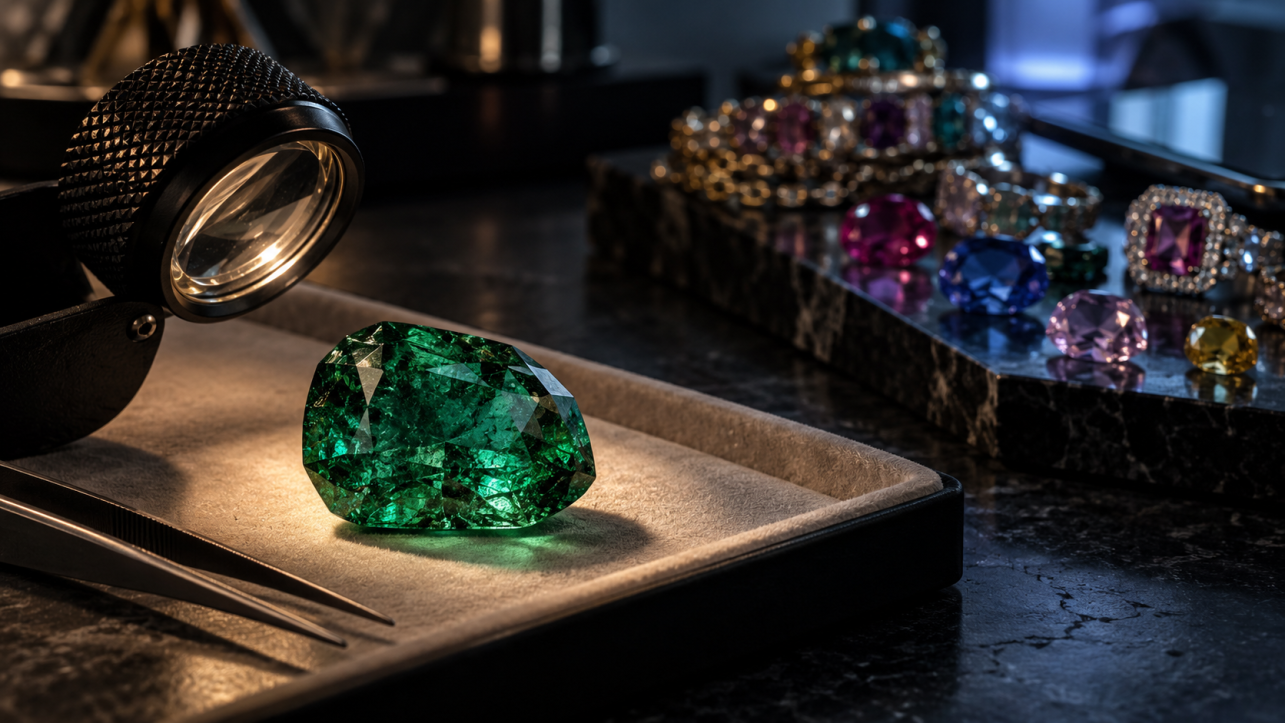
Gold crossed $4,500 an ounce this year, and somewhere in that number is the real explanation for why every jewelry account on Instagram is suddenly stacking sapphires, tourmalines, and spinels onto a single wrist like it's a competitive sport. "Gemmaxxing," the maximalist styling trend built on piling multiple colored stones into one oversized piece, has a name, a hashtag, and a genuine commercial logic behind it. It also has almost nothing to do with what has quietly been the best-performing category in the gemstone market for the past two years, a market whose broader dynamics are mapped out in this comprehensive analysis of the global luxury jewelry market.
This distinction matters more to this readership than to anyone trending the hashtag, because the two things look identical in a photograph and are not remotely identical as purchases. One is a styling movement solving a real cost problem for jewelers. The other is a fixed-supply asset class with a documented, decade-long price trajectory. Confusing them is how someone ends up paying investment-grade prices for a fashion cycle, or conversely, dismissing a genuinely rare stone because it arrived wrapped in trend language.
Why Gemmaxxing Exists Right Now, and It Isn't Really About Taste
The proximate cause is gold, not aesthetics. With bullion at historic highs, a piece built primarily around gold weight and diamond carat count has become expensive to produce at a price point that still moves. Colored gemstones, mixed, stacked, and clustered, deliver visual scale and saturation at a fraction of the material cost of an equivalent diamond or heavy-gold piece. A designer can build something that photographs as "maximal" using aquamarine, hessonite, and tourmaline for a fraction of what the same visual weight would cost in diamonds. That is the entire commercial engine behind the trend, and it is a legitimate one. It is also a supply-side response to gold prices, not a signal about which specific stones are becoming more valuable.
This is worth sitting with, because it inverts the assumption most people bring to a "gemstone trend": that virality means scarcity, and scarcity means the stones themselves are appreciating. Gemmaxxing pieces overwhelmingly use commercial-grade, often heat-treated, mixed-origin stones, chosen for color and volume rather than provenance or rarity. That's not a criticism of the pieces. A $7,000 Zome necklace stacking spinel, tourmaline, and aquamarine is an honest, well-made fashion object at a fair price for what it is. It is simply a different category of purchase from a single certified stone bought for what it will still be worth in fifteen years.
What Has Actually Been Appreciating, Quietly, While Gemmaxxing Went Viral
The real story in colored gemstones over the past two years has nothing to do with stacking and everything to do with certification and origin. Commercial-grade emerald pricing tracked by producer auction data rose from roughly $4.47 per carat in September 2024 to $7.46 by December 2025, a genuine, sustained climb driven by constrained quality supply, a trajectory that helps explain why a single emerald piece such as Gauri Khan's emerald Riversong by Zoya draws so much attention. Unheated sapphires are seeing 15-20% annual price increases, with unheated stones now commanding 30-50% premiums over heat-treated equivalents of similar visual quality, a gap that has widened noticeably as certification technology has made treatment detection harder to fake and easier to disclose.
At the top of the market, the numbers separate entirely from anything a fashion trend touches. The Regent Kashmir, a 35.09-carat sapphire, set a new per-carat sapphire auction record at Christie's Hong Kong in May 2025: $7.4 million total, $272,374 per carat. The Sunrise Ruby, a 25.59-carat Burmese "pigeon's blood" stone, remains the most expensive colored gemstone ever sold at auction at roughly $1.27 million per carat, a price it commands specifically because it is untreated, Burmese, and accompanied by a laboratory report from a recognized authority, not because it is a large or saturated stone in isolation, the same rigour that underpins major jewellery sales such as the Phillips New York spring jewellery auction. An untreated Burmese ruby now trades at roughly three times the price of a heat-treated stone of identical visual quality. None of this activity involves stacking, mixing, or maximalism. It involves a single certified stone, a documented origin, and a scarcity story that has nothing to do with what's trending.
The Three Things That Actually Determine Whether a Colored Gemstone Holds Value
Origin, verified by a recognized laboratory, not asserted by the seller. Kashmir sapphires draw their premium from a genuinely exhausted supply: the Zanskar Range mines were largely depleted by the early twentieth century, meaning every certified Kashmir stone that reaches the market today is functionally a fixed-supply event, not a renewable one. Burmese ruby, Colombian emerald from the Muzo and Chivor mines, and Sri Lankan sapphire carry equivalent origin premiums for the same structural reason: the geology that produced them is not repeating. GIA, Gübelin, and SSEF are the three laboratories whose origin determinations the market actually trusts; a report from an unrecognized lab is, for practical purposes, not a report at all in this segment.
Treatment disclosure, verified rather than assumed. Heat treatment is common, disclosed, and materially discounts a stone versus its untreated equivalent, sometimes by half. The more consequential risk in 2026 is not heat treatment itself but sophisticated diffusion and lattice-filling techniques that can make a low-grade stone visually mimic a high-grade one under casual inspection. A fresh report, dated after January 2026, from GIA, GRS, or SSEF is now treated as non-negotiable for any high-value purchase, not a nice-to-have. "No oil" has become the defining status marker in the emerald category specifically, with untreated stones commanding roughly double the price of even minimally treated ones.
Cutting precision, which the market now prices explicitly. For most of the twentieth century, "native cuts", cutting to preserve maximum carat weight rather than optical performance, were commercially acceptable, even expected, from certain origin markets. That tolerance has ended. Precision cutting is now a distinct value driver the market rewards separately from carat weight and origin, which means two stones of identical provenance and size can carry meaningfully different valuations based on cut quality alone.
Note what's absent from all three criteria: how many stones are on the piece, how large the piece looks, or whether it's currently trending. Gemmaxxing pieces can incorporate genuinely fine stones, but the styling itself is orthogonal to the value question entirely.
The Shadow Price of Buying Colored Gemstones Into India
For an Indian buyer purchasing loose colored gemstones or gemstone jewelry abroad and bringing them home, the landed cost runs meaningfully above the purchase price, and the structure differs by whether the stone is loose or already set.
| Element | Rate applied | Notes |
|---|---|---|
| Purchase price | Actual | Auction hammer price or retail invoice |
| Basic Customs Duty (cut/polished gemstones) | 5% | Applies to loose, cut, and polished colored gemstones on import |
| Social Welfare Surcharge | 10% of BCD | Effectively adds ~0.5% to landed cost |
| IGST | 3% | Applied on assessable value plus BCD |
| GST on jewellery (if set, purchased/valued as jewellery in India) | 3% | Includes making charges if billed together |
On a $500,000 certified Kashmir sapphire brought into India as a loose stone, the combined duty and tax layer adds roughly $42,000-45,000 to landed cost before any insurance, appraisal, or secure transport is factored in, illustrative and dependent on exact HSN classification and valuation at the port. This is a materially different calculation from buying the same stone through a domestic auction or dealer already holding Indian inventory, and it is worth running past a customs broker before bidding at a foreign house, not after winning the lot.
The Insight
Gemmaxxing and colored-gemstone investing are not opposing trends, they are unrelated markets that happen to use the same raw material. One is being driven by the price of gold and is, structurally, a styling response to that pressure: legitimate, well-designed, and entirely disconnected from questions of rarity or appreciation. The other is a slow, decade-long repricing of a genuinely fixed-supply asset class, driven by exhausted mines, tightening certification standards, and a collector base that has become considerably more sophisticated about treatment disclosure than it was even five years ago.
The mistake this audience is best positioned to avoid, and the one the trend cycle actively encourages, is treating virality as a proxy for value. A stacked, maximalist piece using commercial-grade mixed stones is a fair and often beautiful purchase at a fair price for exactly what it is: fashion. A single certified, untreated, origin-verified stone is a different category of object entirely, priced by scarcity that has nothing to do with what's currently popular on Instagram, and it will still be a different category of object in fifteen years, long after gemmaxxing has been replaced by whatever the next maximalist cycle is called. The stones that matter don't need a hashtag. That's precisely how you tell them apart.
FAQ
What is gemmaxxing?
Gemmaxxing is a viral maximalist jewelry styling trend built around stacking multiple colored gemstones, often mixed origins and cuts, into a single oversized piece, prioritizing visual volume and saturated color over carat weight or provenance of any individual stone.
Is gemmaxxing driven by rising gemstone values, or something else?
Primarily something else: with gold prices at historic highs, colored gemstones let designers achieve visual scale at lower material cost than an equivalent diamond or heavy-gold piece, making the trend a cost-driven design response rather than a signal that the specific stones used are appreciating.
How can I tell if a colored gemstone is investment-grade rather than commercial-grade?
Check three things: a current certification (dated after January 2026) from GIA, Gübelin, GRS, or SSEF confirming origin and treatment status; whether the stone is untreated or minimally treated (unheated sapphires and "no oil" emeralds command significant premiums); and cutting precision, which the market now prices separately from carat weight.
Why do Kashmir sapphires and Burmese rubies cost so much more than other origins?
Both draw their premium from genuinely exhausted geological supply, Kashmir's Zanskar Range mines were largely depleted by the early 1900s, and untreated "pigeon's blood" Burmese rubies come from constrained, decades-old supply, meaning every certified stone from either origin represents a fixed, non-renewable supply event rather than an ongoing production stream.
Are gemmaxxing-style pieces a bad purchase?
No, they're simply a different category of purchase: well-made maximalist pieces using commercial-grade mixed stones are a fair value for fashion and styling, but they shouldn't be evaluated, priced, or purchased using the same criteria as a single certified, origin-verified investment-grade stone.
What does it cost to bring a certified colored gemstone into India from an overseas purchase?
Loose cut and polished colored gemstones attract 5% Basic Customs Duty plus a 10% Social Welfare Surcharge on that duty, plus 3% IGST on the assessable value including duty, adding roughly 8-9% to landed cost before insurance and secure transport, with an additional 3% GST applying if the stone is set into jewellery valued domestically.

Comments
No comments yet.
Add Your Comment
Thank you, for commenting !!
Your comment is under moderation...
Keep reading luxury post