Alexander James Dissects the Square: A landmark Exhibition of Colour and Black at Phillips Hong Kong, West Kowloon Cultural District - 27 April to 31
 Namrata Parab
- 20th Apr 2026
- 1834
- 0

There are moments in art history when a single geometric form becomes an arena for the full complexity of human consciousness. Kazimir Malevich understood this with his Black Square. Josef Albers spent decades unravelling its chromatic possibilities. Now, in a bold and deeply considered body of new work unveiled at Phillips Hong Kong, British-born artist Alexander James stakes his own claim on that most elemental of forms, the square and, in doing so, announces himself as one of the most compelling voices in contemporary abstract painting.
Dissecting the Square. Colours and Black is not simply an exhibition. It is a declaration of painterly intent: rigorous yet sensuous, intellectually demanding yet viscerally immediate. Presented exclusively through PhillipsX, the dynamic selling exhibition platform of Phillips' global Private Sales team, this show brings together a significant new series of works that distil James's evolving studio practice into its purest, most potent expression. For those new to Phillips as a global platform for contemporary art, it is worth noting that Phillips has been actively expanding its specialist presence across Asia, making this Hong Kong showing all the more significant.
The Genesis of an Obsession: Light Dissecting the Canvas
Every great artistic body of work has its originating myth, a charged moment when the conceptual foundation reveals itself with sudden, almost violent clarity. For Alexander James, that moment arrived one early morning in his London studio, when a shaft of sunlight fell across an empty canvas and cleaved it, sharply and geometrically, in two. The light was, as James himself has described it, literally dissecting the square.

That luminous accident became the conceptual spine of everything that followed. The canvas was suddenly legible not merely as a surface but as a physical structure and a symbolic boundary, a site where perception, space, and meaning could be fractured, rearranged, and reconstituted. The square ceased to be passive. It became a territory to be interrogated.
This is the intellectual and emotional engine driving Dissecting the Square. Colours and Black: a sustained, probing investigation into what happens when painting's most elemental form is subjected to the full force of a contemporary artistic sensibility. The result is work of extraordinary depth and visual authority, paintings that reward prolonged looking and resist easy resolution.
A Dialogue with History: Albers, Diebenkorn, Scully
Alexander James does not operate in a vacuum. Part of what gives Dissecting the Square its intellectual weight is the richness of its art-historical conversation. James's practice enters into conscious dialogue with artists who have most profoundly interrogated the square as an abstract form and his engagement with their legacies is neither deferential nor merely referential. It is the dialogue of equals.

Josef Albers, whose Homage to the Square series consumed three decades of his career, taught the art world that the square was above all a theatre for colour, that the same hue could appear radically different depending on its chromatic neighbours. James absorbs this lesson but refuses its systematic calm: his surfaces carry a psychological charge, a restlessness, that Albers's meditative seriality deliberately excluded.
From Richard Diebenkorn, James inherits an understanding of pictorial structure as inherently spatial, the sense that a painting can map the felt experience of a place, whether the gridded light of the Californian coast or, in James's case, the fragmented rhythms of contemporary London. And from Sean Scully, whose bands of colour carry something close to ethical weight, James takes the understanding that abstraction need never apologise for its emotional ambitions.
Yet for all these debts, the work remains distinctly, unmistakably James's own, filtered through a sensibility shaped by twenty-first-century urban life in one of the world's most psychologically intense cities. One useful parallel is the way Vasudeo Gaitonde's art redefined the language of abstract painting by absorbing international influences and transforming them through deeply personal vision, a trajectory James's work echoes in its own fashion.
The Works: Fragmentation, Repetition, Cohesion
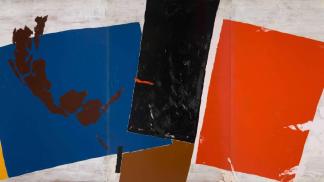
At the structural core of the exhibition is a formal device of deceptive simplicity: the division of the canvas into four equal quadrants. Each quadrant operates as a discrete pictorial event - complete in itself, possessed of its own internal logic and emotional register. And yet, when considered as a whole, the four parts coalesce into something larger, more complex, and more affecting than the sum of its components.
This tension between the part and the whole, between fragmentation and unity, is not merely formal. It is philosophical. James's quadrants invite us to consider how we assemble meaning from disparate elements - how perception synthesises fragments into coherence. In an age of information overload and fractured attention, this feels less like an aesthetic conceit than a precise psychological mapping of contemporary consciousness.

Blue Pulse (2025) pulsates with chromatic energy, an insistent, almost cardiovascular rhythm that speaks directly to the physiological impact of urban experience. The painting's quadrant structure creates both division and propulsion: the eye is simultaneously arrested and driven forward.
Summit of Souls (2026) introduces a vertical gravitas that complements the series' characteristic lateral energy. The title speaks to aspiration and accumulation, a reaching upward that is both spiritual and formal.
Between Us The Fog (2025) occupies the liminal space between presence and dissolution. The quadrant structure here enacts a kind of mutual obscuring, each section partially veiling the others, suggesting the difficulty of clear perception and the enduring fog of human relationship.
Slowly Dissolving (2025) is a meditation on impermanence, working against the permanence of its own painted surface. Form appears to retreat into ground, certainty into ambiguity. It is among the series' most quietly devastating paintings, one that repays prolonged contemplation.
"I often divide the surface of the canvas into four equal quadrants, each functioning as an individual artwork or collectively forming a unified composition. This process allows me to explore ideas of fragmentation, repetition, and cohesion, while also challenging the viewer's perception of the whole versus the part."
— Alexander James
London's Pulse, Distilled: The Urban Unconscious in Paint
James's paintings carry within them the DNA of the city. London - its pace, its dissonance, its layering of historical strata beneath a surface of perpetual contemporaneity - is not illustratively present in the work, but it is structurally present. The rhythm of the quadrant mirrors the rhythm of a metropolis: discrete zones of activity, each with its own intensity, that must somehow be navigated as a whole.
The paintings carry what James has described as the psychological intensity of contemporary urban life. They are not comfortable objects. They press on the viewer. They create a productive unease - the kind of unease that precedes insight. In this, they participate in a long tradition of urban abstraction that understands the city not as a picturesque subject but as a psychological condition. London's art world has long generated such intensity - as visitors to the city will know, London has established itself as a global destination for Asian art, a cultural current that makes James's dialogue with Hong Kong all the more resonant.
It is a measure of James's ambition and skill that he can hold this pressure while maintaining the formal elegance and chromatic refinement that mark the work as objects of lasting experiential, intellectual, and aesthetic value.
Why This Exhibition Matters
There is a tendency in writing about contemporary abstract painting to reach for the language of the ineffable — to gesture vaguely toward the transcendent as a way of avoiding the harder work of critical engagement. James's paintings resist this evasion. They are too intellectually constructed, too formally deliberate, too historically aware to be content with mere mystery.
What Dissecting the Square achieves and what makes it one of the more important exhibitions of the 2026 season in the Asia-Pacific region, is a genuine extension of abstraction's possibilities. James takes a form whose historical weight could easily become a burden and transforms it into a living, pressurised, contemporary instrument. The square, in his hands, is not an inheritance. It is a tool.

The question the exhibition poses, and the question that lingers long after one has left the gallery, is the one James himself articulates: what new possibilities might still emerge from painting's most elemental form? The answer these paintings insist upon, with quiet conviction, is: more than we imagined.
For collectors considering works of this calibre, the broader question of art as a long-term holding is always present. Our piece on whether art makes a good investment is essential reading for those approaching the contemporary market for the first time — and equally useful for seasoned collectors reassessing their holdings. It is also worth noting that Phillips and Yongle's Hong Kong contemporary art sales have generated up to USD 45 million, confirming the city's stature as one of the world's most important markets for ambitious contemporary work.
The appetite for original, historically grounded abstract painting continues to deepen. When a Gerhard Richter abstract work headlined Phillips' Hong Kong evening sale, it signalled that geometric and painterly abstraction commands serious collector attention at the highest levels — precisely the lineage into which Alexander James's new series now enters.
Plan Your Visit
Dissecting the Square. Colours and Black by Alexander James is on view at Phillips Hong Kong, G/F, WKCDA Tower, West Kowloon Cultural District, from 27 April to 31 May 2026.
Viewing hours: Monday–Friday 10am–6pm (27 Apr–25 May) · Saturday–Sunday 10am–6pm (9–10 May) · Tuesday–Sunday 10am–7pm (26–31 May)
To enquire about works or request a catalogue, contact Cristina Tafuri, Head of Global Exhibitions, Private Sales: ctafuri@phillips.com. Works can also be explored and acquired at exhibitions.phillips.com.
Tags: Alexander James artist · abstract painting Hong Kong 2026 · Phillips auction contemporary art · PhillipsX private sales · West Kowloon Cultural District exhibitions · British abstract painters · collecting contemporary art · geometric abstraction · Josef Albers legacy · Sean Scully · Richard Diebenkorn · art market Hong Kong 2026 · luxury art collecting · abstract painting investment
Comments
No comments yet.
Add Your Comment
Thank you, for commenting !!
Your comment is under moderation...
Keep reading luxury post